- | 8:40 am
Nana Patekar, the restless actor who made rage, restraint and dark comedy his own
The actor who brought an abrasive, unmistakable style to Hindi and Marathi cinema won three National Film Awards, moved between gangsters, soldiers and comedy, and later turned his attention to drought-hit farmers in Maharashtra
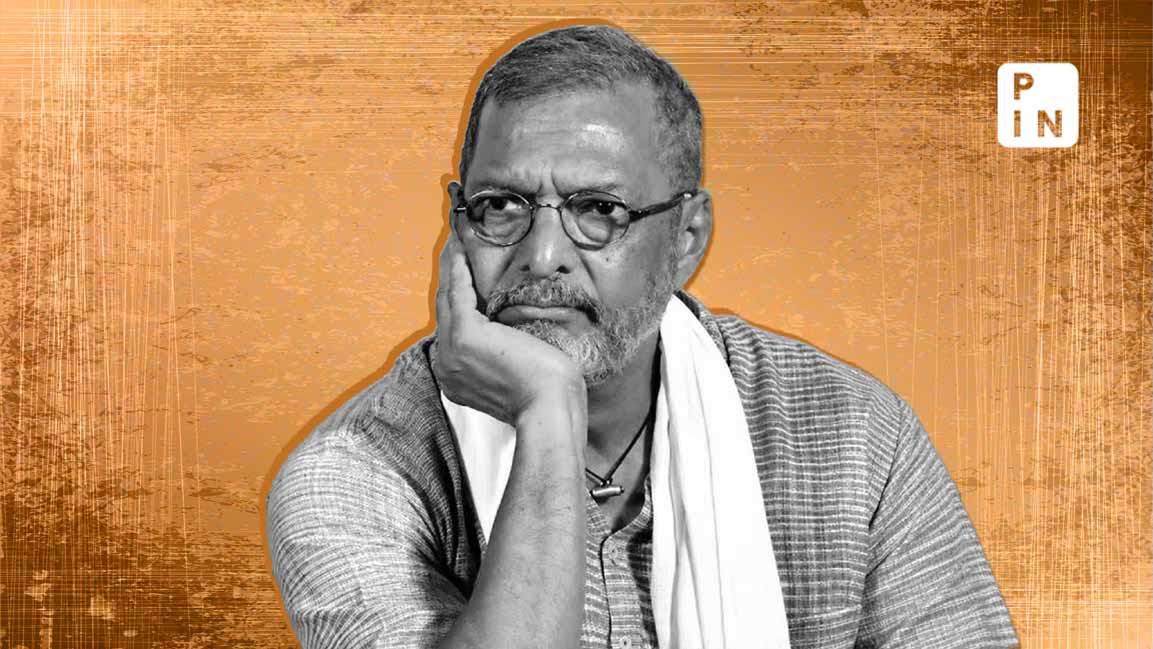


Veteran actor Nana Patekar, whose clipped delivery, simmering anger and refusal to fit Bollywood’s conventional leading-man mold made him one of Indian cinema’s most distinctive performers, died in Goa on Thursday, 8 October. He was 75.
Patekar was found unconscious at his residence in Dona Paula early on Thursday and was taken to Manipal Hospital, where doctors were unable to revive him despite about 45 minutes of cardiopulmonary resuscitation.
He was declared dead at 5:20 am, according to Dr. Shekhar Salkar of Manipal Hospital. A medico-legal case has been registered and a post-mortem examination is expected to establish the precise cause of death. Initial reports said he had suffered a severe cardiac arrest. His son Malhar Patekar confirmed the death.
Born Vishwanath Patekar on 1 January 1951 in Murud-Janjira, in what was then Bombay State, Patekar built a career that ran for nearly five decades across Hindi and Marathi cinema. He won three National Film Awards, for Parinda, Krantiveer and Agni Sakshi, and received the Padma Shri in 2013 for his contribution to the arts. The government announcement of that year’s Padma awards listed him under his full name, Vishwanath Dinkar Patekar.
Those honors, however, tell only part of the story. Patekar occupied an unusual place in popular Indian cinema.
He was neither a classic romantic star nor simply a character actor. He could dominate a film while technically playing the supporting role. His narrow-eyed stare, sudden changes of tempo and rapid, staccato delivery made confrontation his natural dramatic terrain.
Anger in a Patekar performance rarely arrived as a conventional movie-star roar. It accumulated, often through sarcasm, pauses and increasingly quick speech, until a scene appeared to buckle around him.
That style became sufficiently recognizable that generations of mimics and comedians could summon Patekar with a few clipped sentences and a fixed stare. Yet the mannerisms could obscure how wide his range actually was. Across his career he played gangsters and policemen, soldiers and politicians, fathers, eccentrics and comic criminals, moving between social realism, crime drama, commercial action and broad comedy.
Poverty shaped his early years
Patekar’s path into acting was far removed from the film industry’s dynastic routes.
He spoke frequently in later life about a childhood marked by financial hardship. In a 2024 interview, he said he began working at 13, while still in the ninth grade, after his family’s circumstances deteriorated. He recalled earning ₹35 a month and surviving on one meal a day while working and continuing his studies.
“I started working at the age of 13. So I turned 30 very early in life,” he said.
He studied commercial art at Mumbai’s Sir J.J. Institute of Applied Art before gravitating toward theater and film. The training in visual art was an unusual foundation for an actor who would later become known almost entirely for the force of his voice and physical presence.
His film career began with Muzaffar Ali’s Gaman in 1978, but recognition came slowly. Through the 1980s he took roles in Hindi and Marathi films including Aaj Ki Awaz, Ankush, Pratighaat and Andha Yudh.
Ankush, N. Chandra’s 1986 drama about four unemployed young men in Mumbai, helped establish Patekar’s ability to channel frustration and social anger into performances that felt less polished than those of many mainstream actors.
Patekar later recalled that he earned only ₹10,000 for the entire film and even mortgaged his house to help director N. Chandra when the production ran short of money.
His reputation widened with Mira Nair’s Salaam Bombay! in 1988, in which he played Baba, a pimp in the brutal world surrounding children living on Mumbai’s streets. The film was nominated for the Academy Award for best foreign-language film and helped introduce Patekar to an international audience.
But it was Vidhu Vinod Chopra’s Parinda the following year that decisively changed his career.
Anna in ‘Parinda’
As Anna, the volatile underworld boss in Parinda, Patekar created one of Hindi cinema’s memorable gangsters.
The performance was unpredictable and unsettling. Anna could move from conversational to murderous without the ornamental menace that defined many screen villains of the period. Patekar won both the National Film Award and Filmfare Award for best supporting actor for the role.
The part crystallized a screen persona that filmmakers would repeatedly draw on. Patekar could suggest violence without looking physically imposing in the conventional action-star sense. His weapon was often language.
The early 1990s expanded that persona rather than confining it.
He directed and starred in Prahaar The Final Attack in 1991, playing Major Pratap Chauhan, an Army officer unable to reconcile military discipline with the corruption and indifference he encounters in civilian life.
Patekar treated the preparation with characteristic extremity. He trained with the Maratha Light Infantry for years while developing the film. In a 1992 profile, India Today reported that he had undergone rigorous physical training at the regiment’s center in Belgaum. Patekar later said he trained with the Army for almost three years while writing the script.
His association with the military continued beyond the production. Patekar later recounted that during the 1999 Kargil War he received permission from then defense minister George Fernandes to spend time with soldiers near the Line of Control, drawing on the training he had received for Prahaar.
Meanwhile, mainstream Hindi cinema was discovering just how adaptable his intensity could be.
In Angaar in 1992, he played a crime boss and won Filmfare’s award for best villain. The same period brought films including Raju Ban Gaya Gentleman and Tirangaa, proof that Patekar could move between urban drama and unabashedly commercial cinema without sanding down the characteristics that made him unusual.
‘Krantiveer’ turned him into a leading man
His biggest breakthrough as a leading actor came with Mehul Kumar’s Krantiveer in 1994.
Playing Pratap Narayan Tilak, an aimless man gradually transformed into a crusader against corruption, communal violence and criminal power, Patekar was given exactly the kind of role that could turn his rhetorical force into the film’s main event.
Krantiveer was a commercial success, and Patekar won the National Film Award and Filmfare Award for best actor.
The film also helped fix a particular version of Patekar in popular memory. His long confrontational speeches, frequently delivered in an accelerating rhythm, became inseparable from the actor himself.
That association could be limiting, but Patekar repeatedly showed that he was more than the sum of the fury.
In 1996, Agni Sakshi cast him as an abusive and obsessively possessive husband opposite Manisha Koirala and Jackie Shroff. The performance brought him another National Film Award for best supporting actor.
In the same year, Sanjay Leela Bhansali’s Khamoshi The Musical offered a strikingly different role, with Patekar playing a deaf father whose emotional life had to be conveyed without the torrents of dialogue for which he had become famous.
His work through the following decade included Ghulam-E-Mustafa, Shakti The Power, Ab Tak Chhappan and Prakash Jha’s Apaharan.
Ab Tak Chhappan, released in 2004, gave him another role closely tailored to his strengths. As encounter specialist Sadhu Agashe, Patekar delivered a performance built less around explosive speeches than weary understatement. The film became one of the defining entries in the wave of Mumbai crime films inspired by the city’s police encounters and underworld wars.
In Apaharan the following year, he played a ruthless politician operating through Bihar’s kidnapping economy and won another Filmfare award for a negative role.
Comedy opened another career
Then came one of the less predictable reinventions.
Patekar’s casting as Uday Shetty in Anees Bazmee’s Welcome in 2007 turned an actor associated with menace into a comic figure without really changing his screen personality.
That was the joke.
Uday was still a gangster, still irritable and still capable of intimidation. But Patekar played the character’s vanity, frustration and wounded dignity completely straight. His scenes with Anil Kapoor’s Majnu became central to the movie’s enduring popularity.
Patekar once explained his approach simply.
“One should do comedy with a straight face,” he said.
The film exposed him to a younger audience and led to Welcome Back in 2015. Along the way came Prakash Jha’s political drama Raajneeti in 2010 and Ram Gopal Varma’s The Attacks of 26/11 in 2013, in which he played a senior Mumbai police officer recounting the 2008 terrorist attacks.
Yet some of Patekar’s finest late-career work came not in Hindi cinema but in Marathi.
‘Natsamrat’ brought him home
Mahesh Manjrekar’s Natsamrat in 2016 cast Patekar as Ganpat Ramchandra Belwalkar, an aging Shakespearean stage actor whose retirement and family troubles destroy the world he thought he had built.
Based on V.V. Shirwadkar’s celebrated Marathi play, the film demanded both the theatricality for which Patekar was famous and something quieter beneath it. The actor had to play a man accustomed to performing even when life no longer provided him an audience.
Natsamrat became a major Marathi success and gave Patekar one of the signature performances of his later years. He won the Filmfare Marathi award for best actor.
He continued acting well into his seventies.
His later appearances included Kaala, alongside Rajinikanth, Vivek Agnihotri’s The Vaccine War, Anil Sharma’s Vanvaas, Housefull 5 and Vishal Bhardwaj’s 2026 crime drama O’Romeo. In O’Romeo, released in February, he played intelligence officer Ismail, working with Shahid Kapoor’s underworld hitman.
His temperament remained as visible off screen as on it. At the January launch of the O’Romeo trailer, Patekar walked out after reportedly being kept waiting for about 90 minutes. It was an almost implausibly on-brand episode for an actor whose impatience with ceremony had followed him throughout his career.
A difficult reputation
Patekar never cultivated the smooth public persona expected of major film stars.
He acknowledged being argumentative, interfering in scripts and direction and quarreling on film sets. In one interview, he joked that fighting during a production might as well have been written into his contracts.
“Yes, I do,” he said when asked whether he interfered in directors’ work. “Not just the director, even the writer’s work and my co-artist too. It is an old habit.”
That reputation for volatility was sometimes treated as eccentricity and sometimes as evidence of a more difficult personality.
The most serious controversy of his career came in 2018, when actor Tanushree Dutta accused him of sexually harassing her during the filming of a song for Horn Ok Pleassss in 2008. Dutta alleged that Patekar touched her inappropriately after entering a dance sequence in which she was appearing.
Patekar denied the accusation, calling it false. An FIR was registered against him and three others in October 2018. He subsequently withdrew from Housefull 4 amid the controversy. Dutta’s allegations became one of the catalysts for India’s film industry’s #MeToo reckoning.
Mumbai Police filed a closure report in 2019, saying investigators had found insufficient evidence to prosecute and that witnesses had not corroborated the allegation. Dutta challenged the police conclusion. In March 2025, a Mumbai magistrate disposed of the complaint because of the delay in filing the case, while making clear that the court was not examining its merits or the police’s closure report.
It remained the most consequential dispute attached to Patekar’s public life and complicated a reputation that had often been built around authenticity, plain speaking and contempt for Bollywood polish.
Farmers became his second public life
Away from cinema, Patekar increasingly devoted himself to Maharashtra’s agrarian crisis.
In 2015, after drought and farmer suicides devastated parts of Marathwada and Vidarbha, he and fellow actor Makarand Anaspure established the Naam Foundation.
Its origins were unusually direct. Patekar said he had watched the family of a farmer who had died by suicide being interviewed on television and decided he could no longer remain a spectator. He and Anaspure initially distributed financial assistance to affected families before creating a permanent organization.
Naam says it was formally established in September 2015 in response to drought, farmer suicides and chronic water shortages. Its work expanded from immediate assistance to widows and families into water conservation, river and canal restoration, village development, education and disaster relief.
By September 2026, the organization had completed 11 years, saying it had supported thousands of distressed farmers and families, revived water sources and undertaken education and relief projects.
The work fitted an image Patekar had long cultivated, and to a large degree lived, of material austerity despite a successful film career.
He was known for speaking dismissively about celebrity consumption and repeatedly directed money toward charitable work. The line between the austere public persona and the actual man could sometimes be difficult to determine, as it is with most stars who become their own mythology. But Naam became an institutional rather than merely symbolic expression of his concern for rural Maharashtra.
An actor who never sounded like anyone else
Patekar’s place in Indian cinema rests partly on the fact that he was difficult to classify.
His rise came during a period when Hindi cinema still relied heavily on clearly defined types. Heroes looked and behaved like heroes. Villains announced themselves accordingly. Character actors generally remained character actors.
Patekar kept slipping between those categories.
The gangster in Parinda could become the righteous protagonist of Krantiveer. The furious Army officer of Prahaar could become the silent father in Khamoshi. The encounter cop of Ab Tak Chhappan could, improbably, become Uday Shetty in Welcome.
His performances were not always restrained. Neither were the films around him. At his worst, the familiar cadences could verge on self-parody.
At his best, however, Patekar possessed something less teachable than technique. He could make a scene feel unstable.
You watched because you did not quite know where the next sentence would go, how loudly it would arrive or what the face delivering it might do before it was finished.
That quality survived fashion, changing generations of stars and the decline of the kind of dialogue-heavy commercial cinema in which he first became famous.
It also explains why Patekar could remain unmistakably Nana Patekar whether he was playing a gangster, policeman, grieving father or buffoon.
Few actors had a voice as instantly recognizable. Fewer still built an entire body of work around refusing to smooth its edges.
More Top Stories: