


- | 7:40 pm
Delhi lockdown blocks Jantar Mantar protest but confrontation spreads
Thousands were detained as police sealed central Delhi, opposition leaders joined the protest and a parallel crackdown unfolded in Mumbai
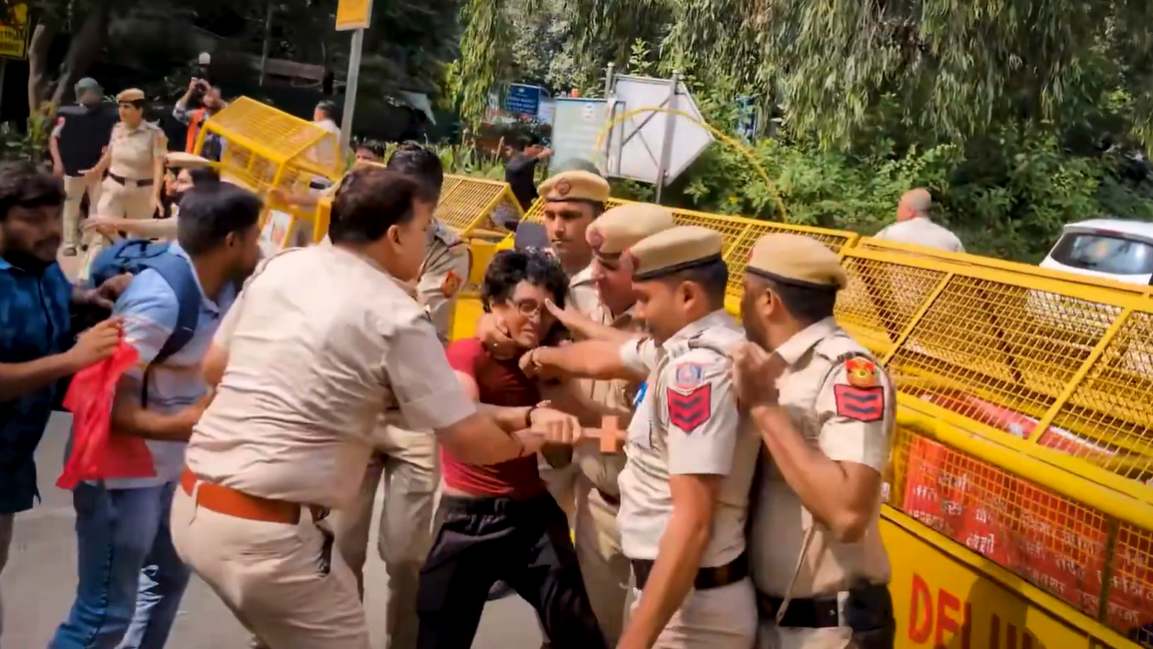


Indian authorities prevented a mass protest against chief election commissioner Gyanesh Kumar from taking place in New Delhi on Saturday, 10 October, detaining thousands of demonstrators and opposition politicians as a dispute over the country’s voter rolls developed into a wider confrontation over elections and the right to protest.
Police sealed Jantar Mantar, a designated protest site in central Delhi near Parliament, restricted Metro services and mobile internet and stopped the leaders of the youth movement behind the demonstration before they could reach the venue.
The rally had been called by the Cockroach Janta Party, or CJP, a youth movement founded earlier this year by 31-year-old political strategist Abhijeet Dipke, which is demanding Kumar’s resignation over a contentious revision of India’s electoral rolls that has removed about 130 million names nationwide.
The Election Commission says the exercise is intended to remove dead, duplicate and otherwise ineligible voters. Opposition parties and activists say legitimate voters have also been excluded and accuse the commission of favouring Prime Minister Narendra Modi’s Bharatiya Janata Party. The commission and BJP deny that accusation.
By late afternoon, Delhi Police had reportedly detained more than 3,000 people across the capital.
Those detained included Dipke and senior CJP figures Saurav Das and Ashutosh Ranka, YouTuber Dhruv Rathee and some opposition politicians, including former West Bengal chief minister and Trinamool Congress leader Mamata Banerjee, former Delhi chief minister Arvind Kejriwal and former Kerala chief minister Pinarayi Vijayan.
Two police officers were injured in stone-pelting near Akashwani Bhawan in central Delhi, according to police. Around 30 people were detained after the incident.
The security operation stretched far beyond Jantar Mantar. Thousands of police and paramilitary personnel were deployed across a metropolitan area of about 20 million people. Roads were barricaded, vehicles searched and officers boarded buses looking for protesters. Mobile internet was suspended in parts of central Delhi, Metro stations were closed or access restricted, and rail services were disrupted.
The measures stopped the CJP from holding the mass gathering it had planned at Jantar Mantar, but they did not contain the protest there.
Groups surfaced at other points across the capital, including Raj Ghat, Connaught Place and the Dilli Haat-INA area in south Delhi. Activists Neha Bora and Yogendra Yadav were detained near INA Metro station as they marched toward Jantar Mantar, while students later surrounded and briefly stopped the police bus carrying detainees near the Safdarjung flyover.
Others tried to approach central Delhi on foot after Metro closures and roadblocks prevented them from getting closer. Police dispersed or detained groups as they appeared.
“We are the youth of this country. If we don’t come, who will?” one protester who reached the Jantar Mantar area told The Times of India.
CJP leaders detained aboard aircraft
One of the most visible police actions came shortly after 10.30 am, when officers entered an aircraft arriving from Mumbai at Delhi’s Indira Gandhi International Airport before passengers had disembarked.
Dipke, Das and Ranka were on board.
Video showed officers approaching them in the cabin as Dipke challenged police to take him into custody.
“I have come to be arrested, arrest me … I am not afraid of you guys,” he said.
🚨 ABHIJEET DIPKE, SAURAV DAS AND ASHUTOSH RANKA DETAINED FROM INSIDE THEIR FLIGHT 🚨
Shame on you @narendramodi @AmitShah https://t.co/hXl6bzh53i
— Cockroach Janta Party – CJP (@Cockroachisback) October 10, 2026
An officer replied: “No, this is not an arrest. Please cooperate.”
The three were taken to separate locations. The CJP condemned what it called the “authoritarian detention” of its leaders and said the protest would continue.
Dipke has become the face of a movement that barely existed several months ago. The name originated in a social-media exchange about unemployed young Indians and developed into an online campaign that later organized protests over jobs, education and exam-paper leaks.
Rathee, a prominent political YouTuber, was detained separately at his home in Gurugram, a satellite city adjoining Delhi, after saying he intended to attend the rally. Gurgaon Police said officers had asked him not to join because the Delhi demonstration had not received permission.
The CJP had told supporters before Saturday to remain peaceful and not breach barricades.
Opposition joins the confrontation
Police action against the youth movement quickly became a wider political issue.
Banerjee was detained with lawmakers from her Trinamool Congress after attempting to join the protest. She later staged a sit-in inside Dwarka North police station in southwest Delhi.
“We were kidnapped and driven around in a prison van for two hours,” Banerjee wrote on X during the afternoon.
4pm. Along with our 4 MPs, we have started our dharna at Dwarka North PS where we have been brought. We were kidnapped and driven around in a prison van for two hours. I am not returning to Kolkata tonight and in protest against all that is happening today against the youth and all, I will join the I.N.D.I.A march on Monday.
— Mamata Banerjee (@MamataOfficial) October 10, 2026
Kejriwal, who led Delhi for more than a decade and heads the Aam Aadmi Party, was detained while walking from his residence toward Jantar Mantar with party supporters.
He later urged people unable to reach central Delhi to demonstrate where police stopped them.
“Turn the entire country into Jantar Mantar,” he said.
देश का युवा जाग चुका है। https://t.co/exbaigpUwW
— Arvind Kejriwal (@ArvindKejriwal) October 10, 2026
Vijayan, a senior figure in the Communist Party of India (Marxist) who previously served as Kerala chief minister, was detained with other Left politicians as they tried to join the demonstration.
Imagine being so scared of the opposition that you make the Delhi Police detain elected reps and drive them around in circles for an hour just to keep them quiet.
Modi’s panic is really showing here, and honestly, it’s just embarrassing at this point. Such high-handed tactics are a blatant attack on our democratic rights, but we will not be intimidated.
#jantarmantar
— Pinarayi Vijayan (@pinarayivijayan) October 10, 2026
Rahul Gandhi, the most prominent national leader of the opposition Congress party, did not join Saturday’s CJP march but backed the protesters after police began detaining them.
“Arrest all the leaders. Arrest all the young people. Arrest us all,” Gandhi wrote, adding: “We are not going to back down.”
I’ve been fighting Narendra Modi and the RSS for over a decade now. I understand them like you would understand your opponent – inside out, like the back of my hand.
The core characteristic of these people is cowardice.
Narendra Modi, Amit Shah, Mohan Bhagwat, Gyanesh Kumar and Ajit Doval, the villains of this story, are slowly finding the space closing around them. We are closing that space.
Mr. Modi, do whatever you want. Call out all the police: 10,000, 20,000, 50,000, whatever you want.
Arrest all the leaders. Arrest all the young people. Arrest us all.
We are surrounding you, and we are not going to back down. Mark my words: we already have the information we need.
We are going to defend our Constitution. We are going to protect the voice of the Indian people. And we are going to ensure that what was done to India over the last 10-15 years will never, ever be done again.
Youth of India, I am proud of you. Keep protesting. We are standing with you.
We are going to ensure that this regime and the people who have attacked our Constitution are defeated.
मैं नरेंद्र मोदी, RSS और इनसे जुड़े लोगों के ख़िलाफ़ एक दशक से भी ज़्यादा समय से लड़ रहा हूँ। मैं अपने विरोधियों को उतनी अच्छी तरह समझता हूँ, जितना कोई भी अपने प्रतिद्वंद्वी को समझता है। मैं इन्हें अंदर तक जानता हूँ, इनकी हर चाल से वाक़िफ़ हूँ।
इन लोगों की सबसे बड़ी पहचान है – कायरता।
नरेंद्र मोदी, अमित शाह, मोहन भागवत, ज्ञानेश कुमार, अजीत डोभाल – इस कहानी के खलनायक – अब धीरे-धीरे घिरते जा रहे हैं। इनके चारों तरफ़ से दायरा सिमट रहा है।
जो करना है, कर लीजिए। जितनी पुलिस बुलानी है, बुला लीजिए – 10 हज़ार, 20 हज़ार, 50 हज़ार, जितनी चाहें बुला लीजिए।
सारे नेताओं को गिरफ़्तार कर लीजिए। सारे युवाओं को गिरफ़्तार कर लीजिए। हम सबको गिरफ़्तार कर लीजिए।
घबराइये मत – हम आपको चारों तरफ़ से घेर रहे हैं, और हम पीछे हटने वाले नहीं हैं।
मेरी बात याद रखिए – हमें जो जानकारी चाहिए, वह हमारे पास पहले से है।हम अपने संविधान की रक्षा करेंगे। हम हिंदुस्तान की जनता की आवाज़ की हिफ़ाज़त करेंगे। और हम यह सुनिश्चित करेंगे कि पिछले 10-15 सालों में हिंदुस्तान के साथ जो हुआ है, वह दोबारा कभी, किसी भी सूरत में न हो।
हिंदुस्तान के युवाओं, मुझे आप पर गर्व है। अपना विरोध जारी रखिए। हम आपके साथ खड़े हैं।
हम यह सुनिश्चित करेंगे कि इस सरकार और हमारे संविधान पर हमला करने वालों को शिकस्त मिले।
— Rahul Gandhi (@RahulGandhi) October 10, 2026
Congress itself had chosen not to formally join the CJP demonstration, while the Aam Aadmi Party and Left parties had said they would participate.
Gandhi and other opposition lawmakers have themselves been detained repeatedly this week during demonstrations demanding Kumar’s resignation. Police broke up a Congress-led sit-in near the Election Commission headquarters on Tuesday, and Gandhi was detained again during another protest on Wednesday.
BJP leaders defended Saturday’s restrictions and rejected accusations that the government was suppressing dissent.
Delhi Chief Minister Rekha Gupta said the capital could not be “held hostage”.
BJP spokesperson Ravi Shankar Prasad defended the voter-roll revision, arguing that people who had died or permanently moved, as well as those registered in more than one constituency, could not remain on electoral rolls.
आज जो दिनभर चला है और इससे पहले 3 दिन जो चला है, उससे दो बातें साफ हैं –
1- अराजकता को प्रोत्साहित करने की कोशिश को भारत के लोकतंत्र ने ध्वस्त किया है।
2- देश संसद से चलेगा, सड़क से नहीं। https://t.co/9IWBw7b0oH
— Ravi Shankar Prasad (@rsprasad) October 10, 2026
Thousands taken into custody
The detention count rose throughout the day.
Delhi Police officials cited by The Times of India said more than 3,000 people had been detained by around 5 pm while trying to reach Jantar Mantar or join demonstrations elsewhere in the city. Police separately said more than 600 people with previous criminal records had been taken into preventive custody before the protest.
Those caught up in the operation extended beyond CJP members and politicians.
The Indian Express reported that development economist Jean Drèze, known internationally for his work on poverty and India’s welfare system, filmmaker Aban Raza and several academics were detained near Jantar Mantar.
Some people told the newspaper they were caught in the police sweep despite not participating in the protest.
Journalists were also briefly detained. Representatives of two digital news organisations told Reuters that four of their reporters had been held, while a Reuters journalist was detained and later released. Lawyers protesting outside the Supreme Court were also taken into custody and subsequently freed, according to the head of the Supreme Court Bar Association.
Mumbai protest also blocked
The police response extended beyond Delhi.
Hundreds were detained in Mumbai after trying to gather at August Kranti Maidan, a ground with considerable symbolic importance in India because it was the site where the Congress leadership launched the Quit India movement against British colonial rule in 1942.
Tushar Gandhi, a great-grandson of Mahatma Gandhi, had called a 3.30 pm solidarity demonstration there.
Police detained Gandhi in the Bandra area before he reached the venue. Protesters arriving near August Kranti Maidan were stopped behind several layers of barricades and taken away in police vehicles.
The protest restrictions had already attracted scrutiny from India’s Supreme Court.
On Friday, the court told the national government and Delhi authorities that security measures should not effectively shut down the city’s transport system. It objected in particular to sweeping restrictions on Metro and rail services, telling authorities not to “use a hammer to kill a fly”.
The court also made clear that organizers could not ignore the police decision refusing permission for the demonstration.
Delhi Police said the CJP had applied only three days before the rally, although applications for protests at Jantar Mantar are required at least 10 days in advance. Police also cited traffic, security concerns and alleged violations during an earlier CJP demonstration.
The protests now pose one of the most sustained domestic political challenges to Modi midway through his third term. Several important state elections are due from early 2027.
Activist Sonam Wangchuk, known for environmental campaigns in the Himalayan region of Ladakh, warned that he could begin a fast or march if detainees were not freed by Sunday.
“INDIA IN A STATE OF UNDECLARED EMERGENCY,” Wangchuk wrote on X.
INDIA IN A STATE OF UNDECLARED EMERGENCY…
Yesterday when I posted a message appealing for unity & peace in today’s protest I had never imagined that the biggest democracy in the world would be under an undeclared EMERGENCY.
I was happy there were so many leaders to lead the movement, but I now learn that they have all been arrested. I hope those arrested will be released soon. I will be compelled to consider an Anshan Fast or Padyatra March if they are not released by tomorrow.
#JantarMantar #protest #CJP #CEC #sonamwangchuk— Sonam Wangchuk (@Wangchuk66) October 10, 2026
More Top Stories:


