- | 7:05 pm
Mass detentions continue in Delhi despite top court’s order
Student leaders, politicians, journalists and protesters were dragged into police buses across central Delhi on Sunday as the Supreme Court ordered authorities not to detain peaceful demonstrators unlawfully
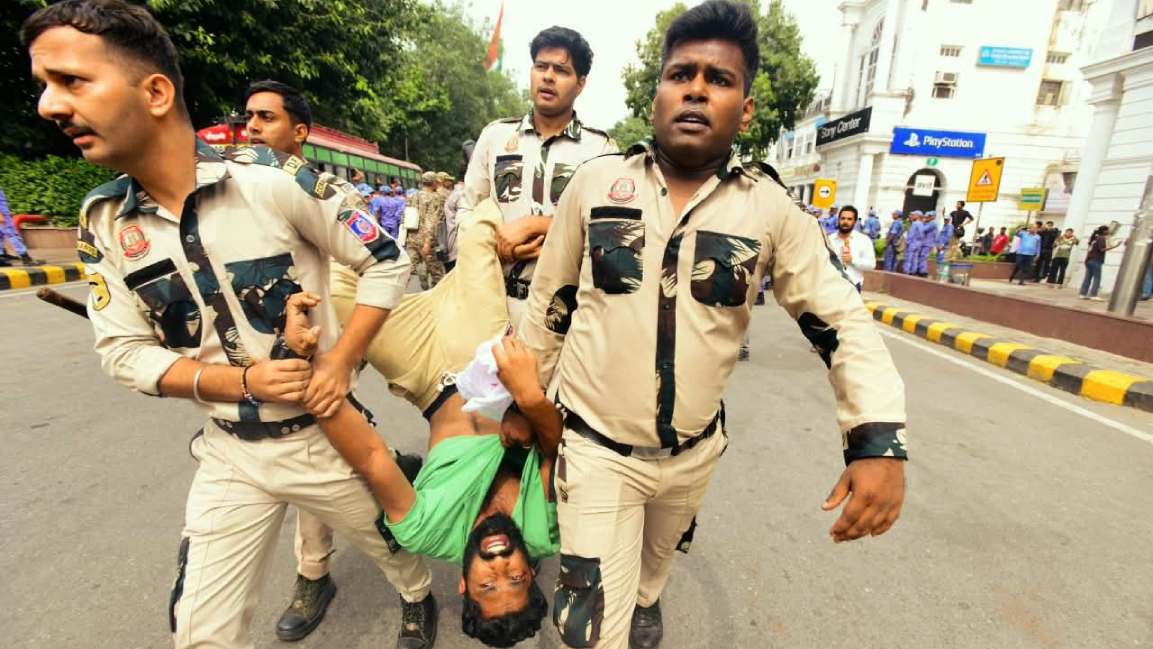


Hundreds of protesters were detained across central Delhi for a second straight day on Sunday, 11 October, as police broke up marches demanding the resignation of chief election commissioner Gyanesh Kumar even while the Supreme Court was hearing challenges to the sweeping restrictions and detentions imposed during the agitation.
Students attempting to march from Rajiv Chowk and Connaught Place toward Jantar Mantar were among those taken away. Videos and photographs from the scene showed police pulling and dragging protesters towards buses as demonstrators resisted being removed.
Among those detained was CPM Rajya Sabha member John Brittas, who had also been taken into custody on Saturday.
A video released by the CPM after Sunday’s detention showed Brittas partly lying on the steps of a police vehicle with what appeared to be a blood-stained cloth across his face. He was later seen being helped towards an autorickshaw.
“Rajya Sabha MP John Brittas was brutally attacked by the Delhi Police,” the CPM said in a post accompanying the video.
Delhi Police had not publicly responded to the party’s allegation that officers assaulted him. The video showed the member of Parliament in visible distress.
The confrontation was particularly intense around Rajiv Chowk, where members of the Students’ Federation of India (SFI) and other Left student groups tried to march toward Jantar Mantar.
The SFI said its all-India president Adarsh M Saji, Delhi secretary Sooraj Elamon, central executive committee member Abhijith Manilal and hundreds of other activists were detained.
The organization alleged that police beat protesters while taking them into custody and again inside police vehicles. Video released by the group appeared to show blood on Saji’s forehead.
“In the video, you can see blood coming out of Adarsh’s forehead,” the SFI said.
The scenes came only hours after the Supreme Court, sitting specially on a Sunday, told authorities that peaceful, unarmed people could not be detained except according to law and directed the government to ensure normal Metro, rail and internet services.
The court also ordered that journalists, lawyers and other professionals should not be obstructed while carrying out their work.
The juxtaposition was immediate. As lawyers inside the Supreme Court argued over preventive detention and the shutdown of transport services, police outside were moving fresh groups of protesters into buses.
Students regroup across central Delhi
The Cockroach Janta Party (CJP) had called supporters back to Jantar Mantar at 10 am after police prevented Saturday’s planned mass gathering from reaching the protest site.
The CJP’s Ajinkya Shinde had urged supporters who were stopped before reaching Jantar Mantar to protest wherever police intercepted them.
With the immediate area around Jantar Mantar heavily guarded, student organizations and smaller groups gathered at Rajiv Chowk, Connaught Place and elsewhere in central Delhi. PTI visuals showed activists marching and shouting “Gyanesh Kumar isteefa do” before police moved in. Protesters who resisted were pulled towards buses.
All India Students’ Association (AISA) president Neha Bora, one of the most visible faces of the youth protests, was detained again on Sunday after being released from custody the previous night.
Bora and other activists began assembling around RK Ashram before moving towards Connaught Place, where she was picked up by police. AISA workers were also detained near the Election Commission office later in the day.
Bora had written earlier on Sunday that the treatment of protesters could not be allowed to become routine.
“When those sworn to protect the Constitution look away, the people must remind them what it demands,” she said in a post on X. “We cannot let this become normal.”
Top court steps into policing dispute
Sunday’s Supreme Court hearing had been called after petitions challenged the scale of Saturday’s measures. At least four petitions questioned preventive detentions, restrictions on Metro and railway services and alleged violence against lawyers and journalists.
One contempt petition accused the central government, Delhi Police and Delhi Metro Rail Corporation of violating an earlier court direction against a complete shutdown of public transport.
The bench directed authorities to allow Metro and railway services to function normally unless specific law-and-order circumstances required otherwise and said internet access should not be disrupted except in accordance with law.
Barricades were to be reviewed and free movement restored where restrictions were no longer required.
The court was particularly clear on detention.
Peaceful and unarmed people outside areas covered by valid prohibitory orders should not be detained except through procedures established by law, it said.
Justice Joymalya Bagchi said the court’s concern for life and liberty did not depend on who was before it.
“Be it a police officer, be it a lawyer, or be it an ordinary citizen,” the court’s concern was equally engaged, he said.
Delhi Police removed some barricades near the Supreme Court after the directions were issued.
Police nevertheless retained restrictions around Jantar Mantar and parts of New Delhi. Officers had said earlier that groups of five or more assembling in restricted areas could be detained and that the protest would not be allowed to proceed without permission.
CJP leaders allege illegal detention
Sunday also brought the first detailed account from CJP leaders Saurav Das and Ashutosh Ranka after their release from preventive custody.
Das, Ranka and CJP founder Abhijeet Dipke had been detained after their flight from Mumbai landed at Delhi airport on Saturday. They were released after an executive magistrate required them to furnish ₹50,000 bonds and undertake not to breach the peace for a year.
Dipke returned to Maharashtra following the death of his grandmother. Das and Ranka appeared at a press conference in Delhi on Sunday afternoon.
They alleged that police took their phones without preparing seizure documents, denied them access to lawyers and did not give them formal detention notices.
“Delhi Police did not give us formal detention notice; our phones were seized, weren’t allowed to contact lawyer,” Das said.
Ranka and Das also raised concerns that police could have copied data from their devices while the phones were out of their possession.
Both said their phones had been held for about 24 hours without a seizure memo and that they feared the devices could have been cloned or tampered with. No evidence has emerged that police altered the devices, and the allegation remained unproven.
Das also alleged at the press conference that independent journalists had been assaulted and accused police of using excessive force against demonstrators.
He urged supporters to continue peaceful protests.
“I appeal to youth to stage peaceful protests on roads,” Das said.
The CJP separately alleged custodial violence against its Mumbai organizer Pranay Ahire, prompting Das to demand intervention by the National Human Rights Commission and courts. The allegation had not been independently verified by the 5.10 pm cutoff.
Journalists demand inquiry after detentions
The treatment of journalists has become a separate flashpoint. The Press Club of India, Indian Women’s Press Corps, Delhi Union of Journalists and Kerala Union of Working Journalists’ Delhi unit issued a joint statement condemning the detention and alleged harassment of reporters covering Saturday’s events.
Journalists from The Quint, The Wire, Scroll, Reporter TV, Navbharat Times and Newslaundry, along with senior journalist Paranjoy Guha Thakurta, were among those reported detained.
The organizations said reporters had been taken away despite displaying press cards and that phones and other equipment belonging to some journalists were confiscated.
They called the detentions a “blatant attack on the freedom of press” and demanded an inquiry, the return of seized equipment and an apology from Delhi Police.
Newslaundry said its reporters Ashwine, Astha and Anmol and intern Anshu were detained while reporting on the protest.
It said police seized Anmol’s and Anshu’s phones, while Ashwine was pushed and had his phone taken away.
When the reporters identified themselves as journalists, Newslaundry said they were told: “Koi media nahin hai.”
Navbharat Times journalists Ritik Joshi and Rahul Charas said they were detained near Minto Bridge despite wearing press cards around their necks and repeatedly identifying themselves as reporters.
They were placed in a bus and taken to Maurice Nagar police station.
Scroll investigative journalist Ayush Tiwari was also detained near ITO, according to the publication and its executive editor.
Several journalists said they were transported alongside protesters rather than being allowed to continue reporting.
The Supreme Court’s direction on Sunday that journalists and lawyers be allowed to carry out their professional duties appeared aimed partly at preventing a repeat.
Brittas detained for second straight day
Sunday’s treatment of John Brittas drew particular attention because he had already been detained on Saturday alongside former Kerala chief minister Pinarayi Vijayan and former Kerala minister K.N. Balagopal.
Brittas said on Saturday that police drove the group around Delhi for about three and a half hours after taking them from Kerala House.
“All of Delhi is Jantar Mantar for us now. The entire country is Jantar Mantar,” he told The Indian Express after that detention.
He returned to the protests on Sunday and was detained again during the march from Connaught Place.
Sunday’s clashes followed an extraordinary security operation on Saturday.
Hindustan Times, citing police figures, reported that close to 7,000 people were detained across Delhi.
Those detained included former chief ministers Mamata Banerjee, Arvind Kejriwal, Pinarayi Vijayan and Manik Sarkar; CPM leaders M.A. Baby and Brinda Karat; CPI(ML) Liberation general secretary Dipankar Bhattacharya; activist Yogendra Yadav; lawyer Prashant Bhushan; Bora; journalists; content creators; students and CJP organizers.
Police collected information on organizers before the protest, including addresses, telephone numbers and social-media accounts, and checked hotels and guest houses, Hindustan Times reported, citing officers. People were picked up at railway stations, the airport, hotels, homes and on the streets.
Stadiums, police stations and community halls were turned into temporary detention centers.
Police also positioned buses across central Delhi to transport detainees. Accounts and photographs from several locations showed protesters being lifted, pulled or dragged into them.
The government succeeded in preventing a large crowd from occupying Jantar Mantar, but protests broke out elsewhere, including Dilli Haat, Safdarjung, Connaught Place, Raj Ghat and around Bangla Sahib.
Police cite violence and lack of permission
Delhi Police has defended the restrictions on public-order grounds.
Officials have said the CJP did not apply for permission within the required period and cited violence during previous demonstrations. Police also reported stone-pelting near Akashvani Bhawan on Saturday in which officers were injured.
More than 20 FIRs have been registered over incidents connected with Saturday’s protests, including alleged assaults on police and obstruction of officials.
Authorities have also released footage they say shows stone-pelting by protesters.
Delhi chief minister Rekha Gupta defended the security operation on Saturday, saying residents could not be subjected to disruption and that Delhi would not be “held hostage” by demonstrators.
BJP president J.P. Nadda went further, accusing the CJP and opposition politicians of seeking to create “anarchy” and alleging foreign support for attempts to destabilize the country.
The CJP and student groups deny that violence represents their movement and say the protests are intended to be peaceful.
Police also arrested four men after a separate video circulated showing people being attacked during Saturday’s demonstrations. The four were reported to have claimed links to the Hindu Raksha Dal. Their arrests followed criticism from protesters who accused police of failing to stop assaults taking place near officers.
Politics moves towards Supreme Court
Congress president Mallikarjun Kharge said he and party leader Rahul Gandhi would meet Chief Justice of India Surya Kant on Monday to raise concerns over the crackdown and what Kharge called an “undeclared Emergency.”
“We can’t demand anything from him. Only with folded hand we’ll request them,” Kharge said in Bengaluru.
Congress and other INDIA bloc parties have also signaled further demonstrations.
Rahul Gandhi, speaking in Chennai on Saturday, urged young people to continue protesting and accused the government of using police and BJP supporters to suppress students.
AAP leader Arvind Kejriwal said on Sunday that Saturday’s crackdown could expand the political target of the protests.
“After yesterday’s mayhem, it should not happen that along with Gyanesh Kumar, Modi ji also has to resign,” he wrote on X.
Samajwadi Party leader Akhilesh Yadav also attacked the government over footage he said showed the mistreatment of women protesters, writing: “India’s capital is drenched in shame!”
Delhi Police subsequently disputed one widely circulated interpretation of a video Yadav had shared, saying the person shown being beaten in that particular clip was a male protester rather than a woman.
Protest is spreading beyond Delhi
The mobilization is no longer confined to Jantar Mantar.
CJP organizers announced another protest near Shivaji Park in Mumbai on Sunday afternoon, while student organizations called demonstrations elsewhere, including Lucknow.
Mumbai police had detained more than 600 people during Saturday’s solidarity demonstration at August Kranti Maidan, among them Tushar Gandhi, actor Imran Khan and Shiv Sena UBT MLA Varun Sardesai.
The protests began around accusations that the Election Commission’s Special Intensive Revision (SIR) of electoral rolls resulted in large-scale deletion of legitimate voters.
About 130 million names were removed during the revision. Opposition parties and protest groups say eligible voters, including minorities and people thought more likely to oppose the BJP, were disproportionately affected.
The Election Commission rejects allegations that the exercise was manipulated for political purposes and says electoral-roll revision is intended to remove duplicate, dead, shifted or otherwise ineligible entries. The BJP has also denied benefiting from improper deletions.
Protests draw UN scrutiny
The crackdown has drawn growing international scrutiny, with the UN Human Rights Office and Amnesty International questioning the scale of the restrictions and detentions imposed around the protests.
The UN Human Rights Office expressed concern over reports of mass detentions of protesters, civil society members, lawyers and journalists before and during Saturday’s demonstrations. It called on India to respect the right to peaceful assembly and said anyone arbitrarily detained should be released.
India rejected the criticism as “misplaced” and “unwarranted interference” in its internal affairs.
“India is the world’s largest democracy, where the right to peaceful assembly is guaranteed by our Constitution and safeguarded by robust institutions, an independent judiciary and a free media,” India’s mission in Geneva said.
It said demonstrations remained subject to reasonable restrictions in the interests of public order and accused the UN office of failing to apply comparable scrutiny to large protests elsewhere.
Amnesty International has also criticized the response. Ahead of Saturday’s protest, it described restrictions including preventive detentions, transport curbs, border closures and the suspension of mobile internet as “sweeping and disproportionate”.
“Peaceful protesters must be able to demand accountability from those in power without facing intimidation, arbitrary detention, or sweeping restrictions on their freedoms,” Amnesty International India board chair Aakar Patel said.
Amnesty said the authorities should protect and facilitate peaceful assembly rather than prevent demonstrations from taking place, and argued that the restrictions risked breaching India’s obligations under international law.
The criticism builds on concerns raised earlier in the protest movement. Human Rights Watch said in July that Indian security forces had used excessive force against largely peaceful protesters in Delhi and called for investigations into police conduct, as well as an end to internet shutdowns during demonstrations.
The government maintains that restrictions are imposed to preserve public order and prevent violence.
More Top Stories: