


- | 2:00 pm
Police detain over 1,500 as they block Delhi protest against election chief
Abhijeet Dipke and other CJP leaders were detained after landing in Delhi as police stopped protesters from reaching Jantar Mantar. Lawyers, journalists and opposition leaders were also picked up during the operation
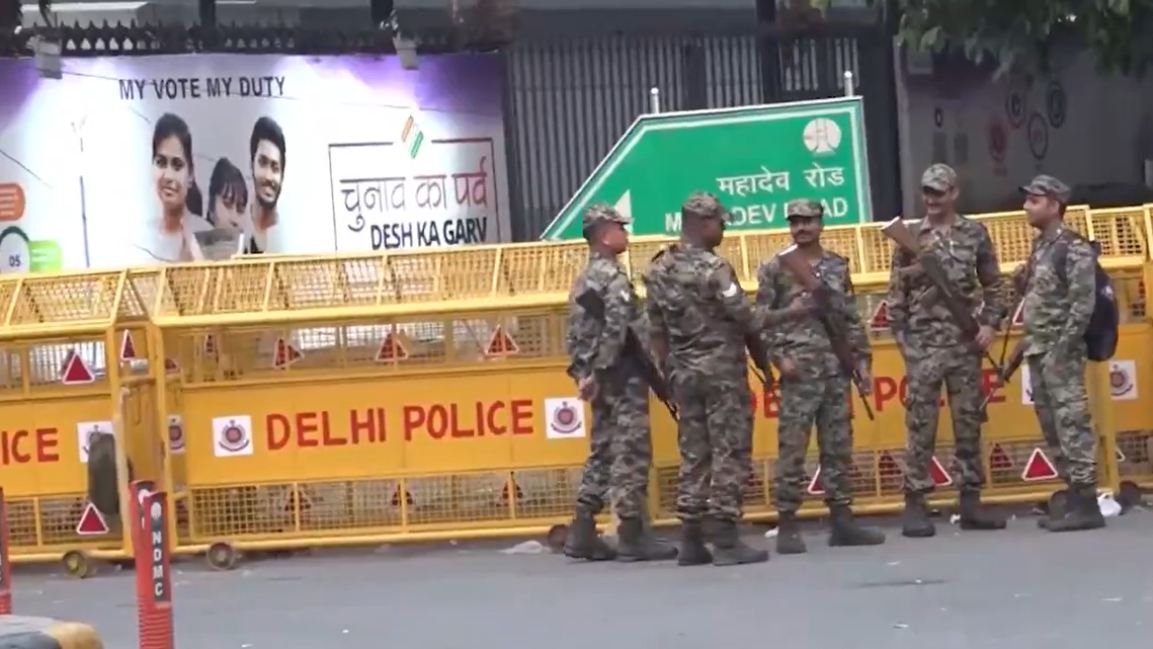


More than 1,500 people were detained across Delhi on Saturday, 10 October, as police prevented a protest demanding the resignation of Chief Election Commissioner Gyanesh Kumar from assembling at Jantar Mantar.
Two police personnel were later injured during stone-pelting near Akashwani Bhawan in central Delhi, one of the first reported outbreaks of violence during a morning dominated by preventive detentions and attempts to stop protesters from reaching the demonstration site.
Sub-Inspector Bajrang Jadhav was among those injured. He told reporters he was hurt while police were apprehending protesters. Security was tightened around the area after the incident.
Cockroach Janta Party (CJP) founder Abhijeet Dipke and senior leaders Saurav Das and Ashutosh Ranka were detained after their flight from Mumbai landed at Indira Gandhi International Airport at about 10.45 am.
Police personnel entered the aircraft before the three could leave the airport.
“I have come to be arrested, arrest me … I am not afraid of you guys,” Dipke told officers aboard the plane.
“No, this is not an arrest. Please cooperate,” an officer replied.
Dipke was subsequently taken toward Gurugram, Ranka to Dwarka and Das to another location in Delhi.
The CJP had asked supporters to gather at Jantar Mantar at 10 am for what it called a “Save Democracy” protest against Kumar and the Election Commission’s Special Intensive Revision, or SIR, of electoral rolls.
The gathering never took shape on the scale planned by the organizers.
Police stopped groups approaching central Delhi, detained protesters at railway stations and other locations and moved them to temporary holding centers. At Connaught Place and roads around Jantar Mantar, people trying to proceed towards the site were put into police buses.
Reporters saw young protesters being chased by police and dragged into buses as others continued to arrive.
“Long live the revolution,” some protesters shouted.
By shortly before 1 pm, more than 1,500 people had been detained in different parts of Delhi, according to police figures reported by the Times of India.
Among them were former Kerala chief minister Pinarayi Vijayan, CPM general secretary M.A. Baby, Brinda Karat, K.K. Shailaja, Rajya Sabha member of Parliament John Brittas, K.N. Balagopal and other Left leaders.
Vijayan, Brittas and Balagopal were detained near Kerala House and driven around Delhi before being taken to Chhatrasal Stadium, according to the CPM.
The party said M.V. Govindan, E.P. Jayarajan and P.K. Sreemathi were also detained.
DMK leader M.K. Stalin condemned the detentions, saying events in Delhi brought back “painful memories of the Emergency that I lived through”.
“All political leaders, students and young protesters detained in Delhi and across the country must be released immediately,” he said.
YouTuber Dhruv Rathee was detained at his Gurugram residence before he could travel to Delhi. CJP legal team head Ratna Singh and content creator Kavya Karnatac were also reported to have been detained.
Police action also extended to journalists covering the protest.
The Indian Express reported from Chhatrasal Stadium that 15 journalists had been detained and brought to the complex. Newslaundry journalist Anmol Pritam said four journalists working together at New Delhi Railway Station were among those picked up.
“While we were reporting, all journalists were detained. Four of us were reporting at the New Delhi railway station together. They picked us up from there and brought us here in this bus,” Pritam said.
Actor Raj Zutshi and several social-media content creators were among other detainees seen at the holding centers.
One man taken to Rajiv Gandhi Stadium in Bawana told The Indian Express he was not involved in the protest and had been travelling with a relative to a hospital when police stopped him on Mahadev Road.
“I have nothing to do with the protest,” he said. “They picked me up from Mahadev Road, asking me why I was there, when I was taking a relative to the hospital.”
The police had established detention facilities across Delhi before Saturday’s mobilization. Chhatrasal Stadium in north Delhi and Rajiv Gandhi Stadium in Bawana were among the sites being used.
Police buses continued arriving at Chhatrasal Stadium around noon. Some detainees were later moved again, including to a government school in Shalimar Bagh.
Lawyers attempting to march from the Supreme Court toward Jantar Mantar were also detained.
The Supreme Court Bar Association asked Chief Justice of India Surya Kant to intervene, saying senior and junior lawyers, including women, had been detained and alleging excessive force.
The association asked that the whereabouts and safety of the lawyers be established, that they be given access to legal assistance and that those without lawful grounds for detention be released.
The Chief Justice was subsequently understood to have communicated to authorities that the detained lawyers should be released.
The detentions came a day after the Supreme Court questioned restrictions imposed on public transport ahead of the protest.
The court had said authorities could regulate movement but could not impose an outright prohibition on Metro services. It asked the government to reconsider restrictions affecting Metro and railway operations and ensure that security measures were proportionate.
A contempt petition was filed on Saturday against the Union government, Delhi Police and Delhi Metro Rail Corporation alleging that restrictions continued despite those directions.
Delhi Police had denied permission for the Jantar Mantar protest on Friday.
Police said organizers applied on 7 October, less than the 10 days they said was required for such a demonstration. They also cited public safety, traffic and law-and-order concerns and alleged violations during an earlier CJP protest.
The CJP rejected the decision and said it would proceed peacefully.
Before leaving Mumbai on Saturday morning, Dipke questioned the scale of the restrictions.
“Why did you need to close all the railways, the metro, the internet has been closed, roads have been closed?” he said. “This is nothing but fear.”
Around 35,000 police and paramilitary personnel were expected to be deployed for Saturday’s operation. Barricades and checkpoints were placed across central Delhi and at entry points into the capital, while police stopped buses and private vehicles to check for protesters.
Entry and exit were restricted at 45 Delhi Metro stations, although interchange remained available at most stations. Mobile internet was suspended in parts of central Delhi.
More than 250 rail services were cancelled or affected, including 179 local trains and more than 75 long-distance Mail and Express services.
Markets in parts of central Delhi were also shut. Barricades and concrete blocks restricted traffic on several approaches to the protest zone, while anti-riot vehicles equipped with tear-gas launchers were stationed on key roads.
The security operation had been planned several days earlier.
The Indian Express reported that Union home secretary Govind Mohan met state police chiefs and selected commissioners on 4 October and asked them to stop people who had participated in earlier protests from travelling to Delhi. Officials were told to issue notices, make preventive detentions where necessary and examine sources of funding.
A second preparedness meeting was held on 8 October.
Police in other states also intercepted people traveling toward Delhi. The Madhya Pradesh High Court on Friday sought the production of two protesters reportedly detained while travelling to the capital. At least 30 Delhi-bound protesters were reported to have been stopped at Bhopal, Itarsi and Gwalior railway stations.
In Mumbai on Saturday, police detained Tushar Gandhi, Mahatma Gandhi’s great-grandson, and several associates as they travelled to a solidarity protest at August Kranti Maidan. Mumbai Police said Gandhi had been detained rather than arrested.
Saturday’s mobilization followed days of protests over the Election Commission’s revision of electoral rolls.
Election Commission data show that about 130 million entries were deleted or flagged during the verification exercise, including about 63 million people recorded as having moved, 30 million who could not be traced and 28 million recorded as dead.
The commission says these figures relate to entries identified during the draft revision process and that eligible voters wrongly removed can apply to be enrolled again.
The opposition and the CJP allege that legitimate voters have been removed and that the changes benefited the Bharatiya Janata Party in recent elections. They have demanded Kumar’s resignation and an end to the SIR exercise.
The Election Commission and BJP deny wrongdoing.
The BJP says opposition parties are attacking the electoral system because they have been unable to defeat Prime Minister Narendra Modi at the polls.
The protest is the CJP’s second major mobilization in Delhi this year. Its earlier agitation over examination paper leaks drew tens of thousands of people and was followed by the resignation of then education minister Dharmendra Pradhan.
Saturday’s police operation was designed to prevent a similar concentration of protesters at Jantar Mantar.
By 1.45 pm, police remained in control of the protest site, but smaller confrontations had broken out elsewhere in central Delhi and detainees were continuing to be moved to holding centers across the capital.
More Top Stories:





