
- | 5:30 pm
BRICS unity masks deeper tensions over Trump, Israel and China
The New Delhi Declaration showed how far BRICS could stretch consensus across sanctions, Gaza and de-dollarization, while exposing the limits of India’s balancing act with China and the wider bloc
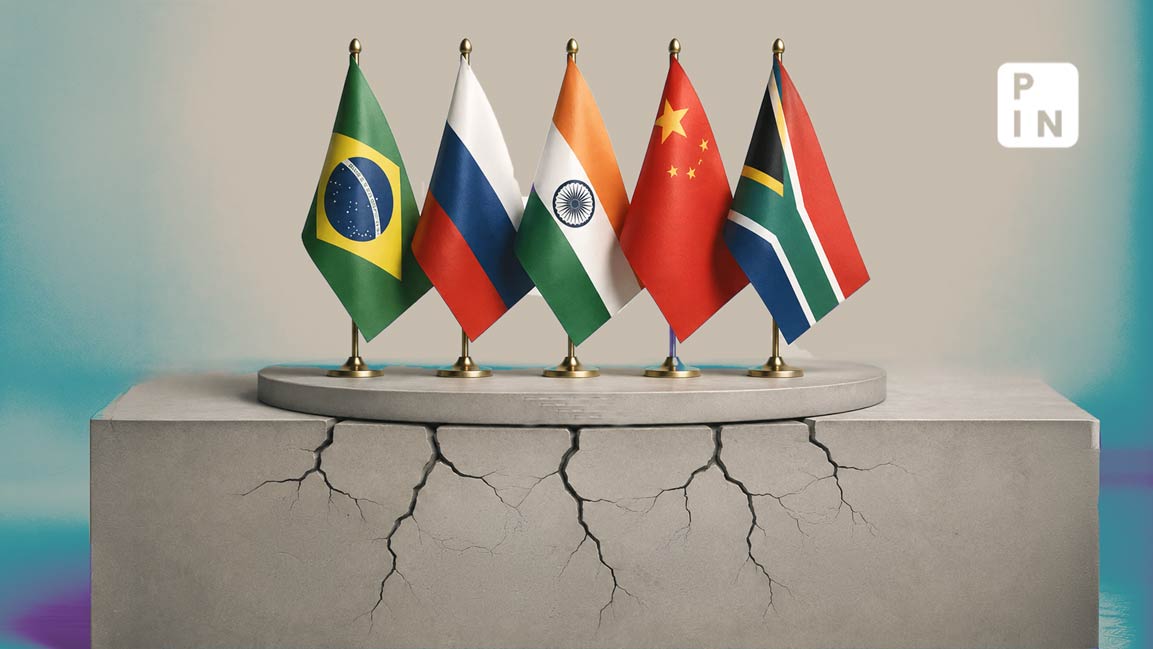


The 18th BRICS Summit, chaired by India in New Delhi on 12 and 13 September, marked two decades of cooperation among a grouping that began with Brazil, Russia, India and China and has since expanded to 11 members. Held at Bharat Mandapam, a convention center capable of accommodating up to 7,000 delegates and equipped with 20 technology-enabled meeting rooms on its first level as well as premium meeting spaces and five-star hospitality, the summit ended with a lengthy, over 17,800 words, New Delhi Declaration agreed despite wars, sanctions, trade tensions and deep differences among its members.
There were two elephants in the room: a large one, US President Donald Trump, and a smaller one, Israeli Prime Minister Benjamin Netanyahu. It is worth examining how the declaration dealt with both.
Before the summit, there had been doubts over whether BRICS would be able to produce a declaration at all. The foreign ministers, meeting in New Delhi in May, had failed to agree on a joint statement because of differences over the war in the Middle East, particularly between Iran and the United Arab Emirates. India, as chair, had to issue its own statement instead.
That the leaders nevertheless agreed on a declaration in September was therefore a diplomatic achievement for India and its BRICS team led by Sherpa Sudhakar Dalela and sous-sherpa Shambu L. Hakki.
There is, however, a larger context. Neither the UAE nor Iran nor Saudi Arabia had much to gain from being seen as the country that prevented a consensus declaration at the leaders’ summit. Iranian President Masoud Pezeshkian and Abu Dhabi Crown Prince Khaled bin Mohamed bin Zayed also met during the summit, providing another indication that both sides were prepared to keep channels of communication open.
A ministerial meeting of the Gulf Cooperation Council (GCC) states, Iran, and Iraq, was being planned in Oman on 14 September.
The larger elephant
The New Delhi Declaration carefully avoided naming either Trump or the US. But some of its language was unmistakably relevant to Washington’s use of sanctions.
Paragraph 22 condemns unilateral coercive measures contrary to international law, including unilateral economic and secondary sanctions, and calls for the elimination of measures not authorized by the UN Security Council.
It reads: “We condemn the imposition of unilateral coercive measures that are contrary to international law, and reiterate that such measures, inter alia in the form of unilateral economic sanctions and secondary sanctions, have far-reaching negative implications for the human rights, including the rights to development, health and food security, of the general population of targeted states, disproportionally affecting the poor and people in vulnerable situations, deepening the digital divide and exacerbating environmental challenges. We call for the elimination of such unlawful measures, which undermine international law and the principles and purposes of the UN Charter. We reaffirm our opposition to unilateral coercive measures that are contrary to international law and the Charter of the United Nations, including non-UN Security Council authorized sanctions.”
That is strong language, even without mentioning the US.
On one issue that has repeatedly exercised Trump, however, the summit produced no proposal for a common BRICS currency. The declaration instead continued the grouping’s more limited work on using national currencies and improving cross-border payment arrangements.
Trump had warned BRICS countries even before returning to the White House that they could face 100% tariffs if they created a new BRICS currency or backed another currency intended to replace the US dollar.
In December 2024, he posted on X: “The idea that the BRICS Countries are trying to move away from the dollar while we stand by and watch is OVER. We require a commitment from these Countries that they will neither create a new BRICS Currency, nor back any other Currency to replace the mighty U.S. Dollar or, they will face 100% Tariffs, and should expect to say goodbye to selling into the wonderful U.S. Economy.”
He repeated that warning after taking office in January 2025.
Does the absence of a BRICS currency mean his threat worked?
Not necessarily.
Much of the discussion of BRICS and “de-dollarization” confuses several quite different things.
A common currency would require a degree of monetary and political coordination for which there is little evidence of appetite within BRICS. China is by far the largest economy in the grouping, and any common monetary arrangement would inevitably raise questions about Chinese dominance. India and several other members would have strong reasons to guard their monetary autonomy.
Indeed, when Brazilian President Luiz Inácio Lula da Silva raised the idea of greater monetary cooperation and eventually a common trading currency in 2023, it did not result in a BRICS plan to establish one. The Kremlin itself said in January 2025 that BRICS was not planning a common currency.
Reducing dependence on the dollar is a different matter.
BRICS countries can increase the use of their own currencies in bilateral trade without creating a common currency. Russia and China have already shifted the overwhelming majority of their bilateral trade settlement away from Western currencies.
Nor is the principle new. India and the Soviet Union began using rupee-rouble trading arrangements in 1953.
The more relevant question today is whether BRICS can make cross-border payments in national currencies easier, cheaper and more widely available.
Work on that continues. The declaration calls for greater interoperability between payment systems and further use of national currencies in trade and investment, while recognizing differences in the approaches taken by individual members. It does not establish either a common currency or a unified BRICS payment system.
Recent estimates suggest that, under a wider BRICS+ network, about 39.5% of India’s trade could potentially fall within local-currency arrangements. The comparable estimate for Iran is about 64%. These are measures of potential trade exposure, however, not evidence that those proportions are already being settled in national currencies.
De-dollarization, in other words, is better understood as a gradual increase in alternatives to dollar settlement rather than the imminent appearance of a BRICS currency.
The smaller elephant
The declaration was considerably more explicit on Israel.
Paragraphs 30 to 36 deal extensively with Gaza, Palestine and Lebanon. They oppose the forced displacement of Palestinians, reaffirm support for a sovereign and viable Palestinian state within the internationally recognized 1967 borders, with East Jerusalem as its capital, and reiterate support for a two-state solution.
On Lebanon, the declaration goes further. It calls on Israel to respect the terms agreed with the Lebanese government and “withdraw its occupying forces from all of the Lebanese territories” where they remain.
On Syria, the declaration reaffirms the country’s sovereignty, independence, unity and territorial integrity, language that also has implications for Israeli military activity there.
For India, which has developed a close strategic relationship with Israel while continuing formally to support Palestinian statehood, accepting such language required balancing competing relationships.
It would be going too far, however, to describe this declaration alone as a fundamental change in Indian policy. India has long officially supported a negotiated two-state solution and a sovereign Palestinian state. What is notable is its willingness, as BRICS chair, to join consensus behind unusually direct language on Israeli actions at a time of severe conflict in the Middle East.
There is another diplomatic consideration. India is seeking election as a non-permanent member of the UN Security Council for 2028-29. Tajikistan is also a candidate for that term and has secured backing from the Organisation of Islamic Cooperation for its candidature.
The Central Asians and China are likely to support Tajikistan, which also has the backing of the African Union, with 54 votes in the General Assembly.
That makes India’s relationships across the Islamic world an important part of the diplomatic arithmetic, although it would be speculative to attribute New Delhi’s position on the BRICS declaration primarily to its Security Council campaign.
China and the unfinished reset
The summit also gave Prime Minister Narendra Modi an opportunity for bilateral diplomacy, most importantly with Chinese President Xi Jinping.
Xi’s visit was his first to India since 2019 and came after relations had been badly damaged by the 2020 Galwan clashes.
According to India’s ministry of external affairs, Modi told Xi that peace and tranquility in the border areas remained “an essential basis for the continued development of bilateral relations.” The two leaders also committed themselves to seeking a “fair, reasonable, and mutually acceptable” resolution of the boundary question.
The economic relationship nevertheless remains profoundly unbalanced.
Official Indian trade data for 2025-26 show exports to China of about $19.5 billion against imports of about $131.6 billion, implying a merchandise trade deficit of roughly $112 billion.
India depends on Chinese supplies in several important manufacturing sectors, while New Delhi has repeatedly raised concerns about market access for Indian products.
The question is whether improved political engagement will produce meaningful changes in that economic relationship. For now, there is little basis for assuming that it will.
What can be said is that India and China are again attempting to expand engagement without waiting for a final settlement of the boundary dispute. That represents a significant change from the deep freeze that followed the clashes of 2020, although India’s insistence on peace along the border has not disappeared.
The limits of the rapprochement were demonstrated almost immediately. On 16 September, three days after the BRICS summit concluded, China and Pakistan held the inaugural meeting of their Boundary Joint Commission in Islamabad, operationalizing a mechanism for border management, joint surveys, trade and cross-border connectivity.
India rejected the commission the same day, saying it had “no legal basis” because New Delhi does not recognize a China-Pakistan boundary or the 1963 China-Pakistan boundary agreement concerning territory India claims as its own.
At the same time, Chinese foreign minister Wang Yi has emphasized Beijing’s preference for maintaining the improvement in relations and avoiding another deterioration in ties.
As the French saying goes, plus ça change, plus c’est la même chose: the more things change, the more they stay the same.
More Top Stories: