- | 11:35 am
Tesla straps rocket tech onto Roadster to make it fly
Tesla’s long-delayed electric supercar used compressed-air thrusters to lift off, rotate in midair and land at a Texas demonstration, turning Elon Musk’s years-old flying-car promise into a working prototype
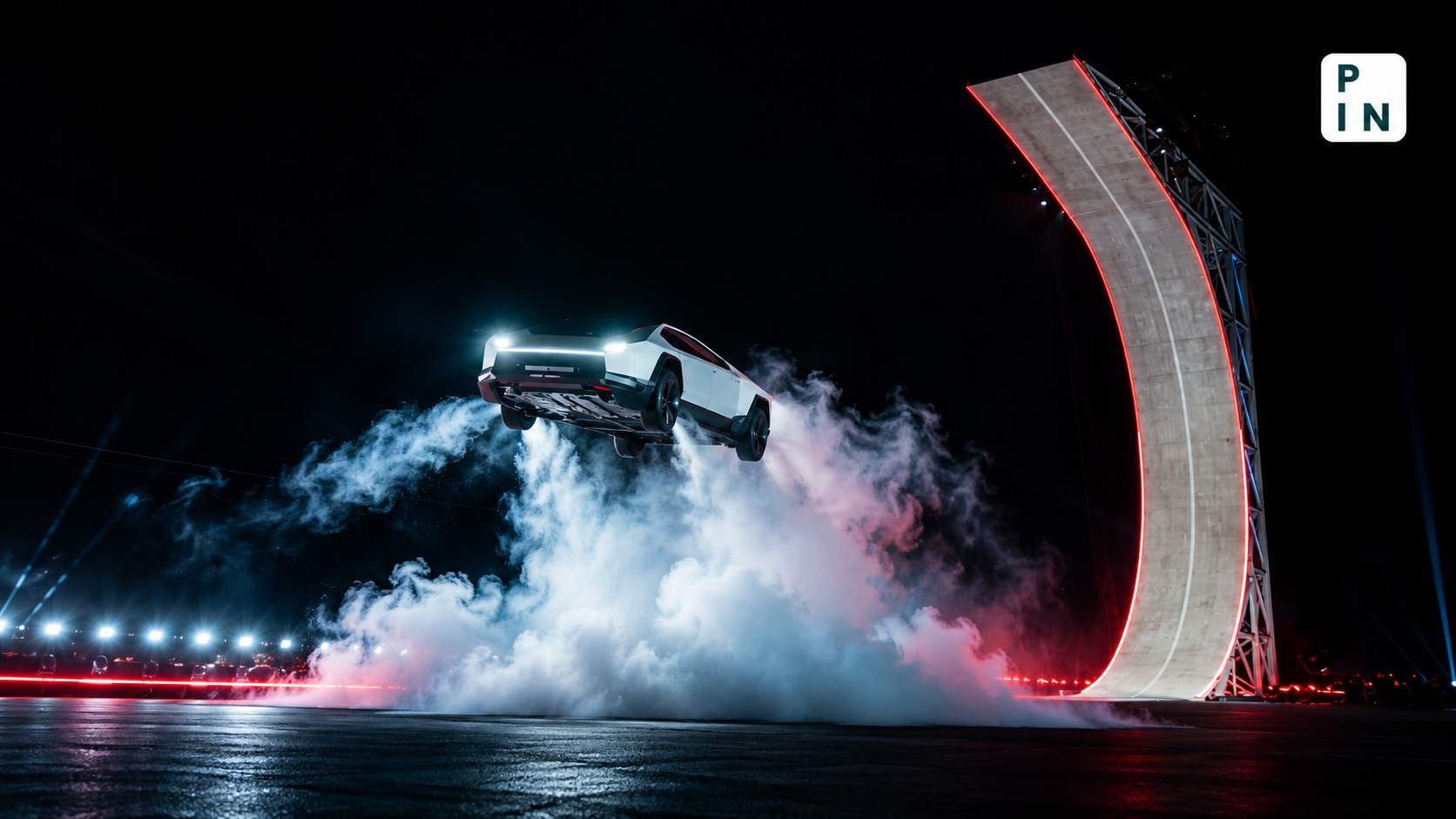


Tesla has unveiled a redesigned Roadster capable of briefly flying using rocket-style thrusters developed with SpaceX, nearly nine years after the electric-car maker first showed the second generation of the sports car.
The white two-seat Roadster drove upside down along a curved ramp, left the structure while inverted, rotated in the air and landed using built-in compressed-air thrusters during a demonstration at SpaceX’s rocket-testing facility in McGregor, Texas, on Thursday, 15 October.
Real life, baby https://t.co/3QEqn18wig
— Tesla (@Tesla) October 16, 2026
Tesla later demonstrated the car lifting off and jumping over a line of vehicles that included a Cybercab, Cybertruck, Semi, Model Y and Model 3.
“Well, it worked,” Chief Executive Elon Musk said after the first demonstration.
Turns out the future does have flying cars https://t.co/6fexPp6SXI
— Elon Musk (@elonmusk) October 16, 2026
Tesla plans to begin production in 2028, putting the first customer vehicles more than a decade after the company initially unveiled the second-generation Roadster in November 2017.
The demonstration gives substance to one of Musk’s more unusual promises. In 2018, he said an optional SpaceX package for the Roadster would use about 10 small rocket thrusters to improve acceleration, braking, cornering and top speed, adding at the time that they might even allow the car to fly.
Tesla has now gone considerably further than merely suggesting the possibility.
The most extreme Roadster uses cold-gas thrusters around the vehicle to provide upward and rotational movement. Rather than burning rocket fuel, the system releases highly compressed air stored in carbon-fiber overwrapped pressure vessels.
Musk said the vehicle has both attitude-control thrusters and larger rear thrusters, allowing it to maneuver in the air.
The result is closer to a car capable of short, powered aerial maneuvers than an aircraft designed to transport passengers through the sky.
Tesla has not described the Roadster as an eVTOL aircraft and has not demonstrated the sort of sustained, controlled flight envisioned by companies developing electric air taxis.
The distinction could become important as Tesla seeks regulatory approval for the technology.
Three versions of Roadster
Tesla outlined three configurations of the redesigned Roadster, ranging from a road-focused electric supercar to an invite-only version built around its thruster technology.
The Performance model is designed for road use and seats two people. It includes active aerodynamics and a suction system designed to generate unusually high levels of downforce. Tesla says it can accelerate from zero to 60 mph in less than 1.6 seconds.
The Thrust version adds rear-mounted cold-gas thrusters and is aimed more directly at track performance. Tesla says it can reach 60 mph in less than 0.9 seconds.
At the top sits the single-seat Rocket version, which adds thrusters around the perimeter of the vehicle to control vertical and rotational movement. Tesla claims acceleration from zero to 60 mph in less than 0.59 seconds and a top speed above 230 mph.
The Rocket model is invite-only and is not approved for public-road use. Availability may also vary by market.
Tesla demonstrated a Roadster accelerating from zero to 60 mph in 0.81 seconds during the event. Musk said the production vehicle should ultimately be faster.
That would put the Roadster far beyond the performance Tesla promised when it originally unveiled the second-generation model in 2017. At the time, the company advertised a 1.9-second zero-to-60 mph time, a top speed above 250 mph and a range of 620 miles.
The redesigned model has changed substantially since then. Tesla now cites a range of more than 300 miles for the latest vehicle, depending on configuration, while its emphasis has shifted toward extreme acceleration, aerodynamics and the SpaceX-derived thruster system.
How the Roadster drives upside down
The thrusters are only part of Tesla’s engineering demonstration. For the sequence in which the Roadster traveled upside down, Tesla used a high-powered suction system beneath the vehicle to create downforce independently of its speed.
Musk said the system could pull as much as two times the force of gravity, allowing the vehicle to remain attached to the inverted section of the ramp. The concept resembles so-called fan cars, which use powered fans to extract air from beneath the chassis and create an area of low pressure that pushes the vehicle toward the road.
That means the Roadster can theoretically produce substantial grip even at relatively low speeds, unlike conventional aerodynamic wings and diffusers whose effectiveness typically rises as airflow increases. The suction system is also intended to improve the Roadster’s cornering ability on a racetrack.
SpaceX technology moves into a car
The flying demonstration highlights increasingly visible engineering links between Tesla and SpaceX, the two companies controlled by Musk.
Tesla said the Roadster’s compressed-air system uses two carbon overwrapped pressure vessels with a combined capacity of about 600 liters and carrying roughly 250 kilograms of compressed air. The system feeds around 10 nozzles positioned around the vehicle.
Those pressure-vessel technologies have roots in aerospace engineering, though Tesla has had to adapt the system for use in a passenger vehicle operating in the atmosphere. The redesigned Roadster also uses a new battery and electric drive system. Tesla says the powertrain can deliver about one megawatt of power while being substantially lighter than the system used in its Model S Plaid.
Musk described the Roadster as a collaboration between Tesla and SpaceX and has repeatedly presented the project as an engineering exercise rather than a vehicle expected to transform Tesla’s earnings.
“This will be the actual car that’s on the roads,” Musk said during the presentation, referring to the thruster-equipped technology demonstrated at the event.
He acknowledged separately that some versions may face legal restrictions depending on the jurisdiction.
A halo car rather than a volume business
The Roadster occupies an unusual place in Tesla’s strategy. Musk has previously described the program as a relatively small financial opportunity, and the sports car is unlikely to approach the volumes of the Model 3 or Model Y.
Its importance instead lies in what the auto industry calls a halo vehicle, a low-volume model intended to demonstrate technology, performance and engineering capability across the wider brand. Tesla currently lacks such a model after spending recent years directing much of its attention toward autonomous driving, the Cybercab robotaxi and its Optimus humanoid robot.
The Roadster also returns Tesla to its origins. The company’s first production vehicle was the original Roadster, launched in 2008 using a Lotus-based chassis. That car helped demonstrate that battery-powered vehicles could offer serious performance at a time when electric cars were still widely associated with limited range and modest speed.
The second-generation Roadster was unveiled in 2017 with an expected starting price of about $200,000 and planned deliveries from 2020. Those deliveries never happened.
Tesla repeatedly pushed back the program as it concentrated resources on mass-market vehicles, manufacturing expansion, autonomous driving and other projects. Customers were allowed to reserve the Roadster with deposits of $50,000, while Tesla initially sought $250,000 for limited Founder’s Series reservations.
Roadster is still two years away
The latest unveiling resolves only part of the uncertainty surrounding the Roadster. Tesla has now demonstrated a working redesigned vehicle and disclosed considerably more about how its extreme versions will operate, but production is still scheduled to start only in 2028.
Final pricing has not been disclosed. There are also unanswered questions over where the thruster-equipped versions can legally operate, how regulators will classify the technology, what restrictions could apply to compressed-air systems on public roads and whether the performance demonstrated under controlled conditions can be offered to customers.
Musk himself acknowledged that the project prioritizes spectacle and extreme performance.
The company is unlikely to sell Roadsters in anything approaching mass-market numbers, analysts said, adding that after years in which established manufacturers and electric-car startups have narrowed Tesla’s performance advantage, the Roadster gives the company something it has largely lacked: a vehicle built primarily to show what its engineers can do.
More Top Stories: