- | 3:00 pm
India, China edge closer as Trump tariffs upend world order
Modi accepts Xi’s SCO invite, Delhi and Beijing move to restart direct flights, revive boundary talks, and ease supply bottlenecks to steady ties
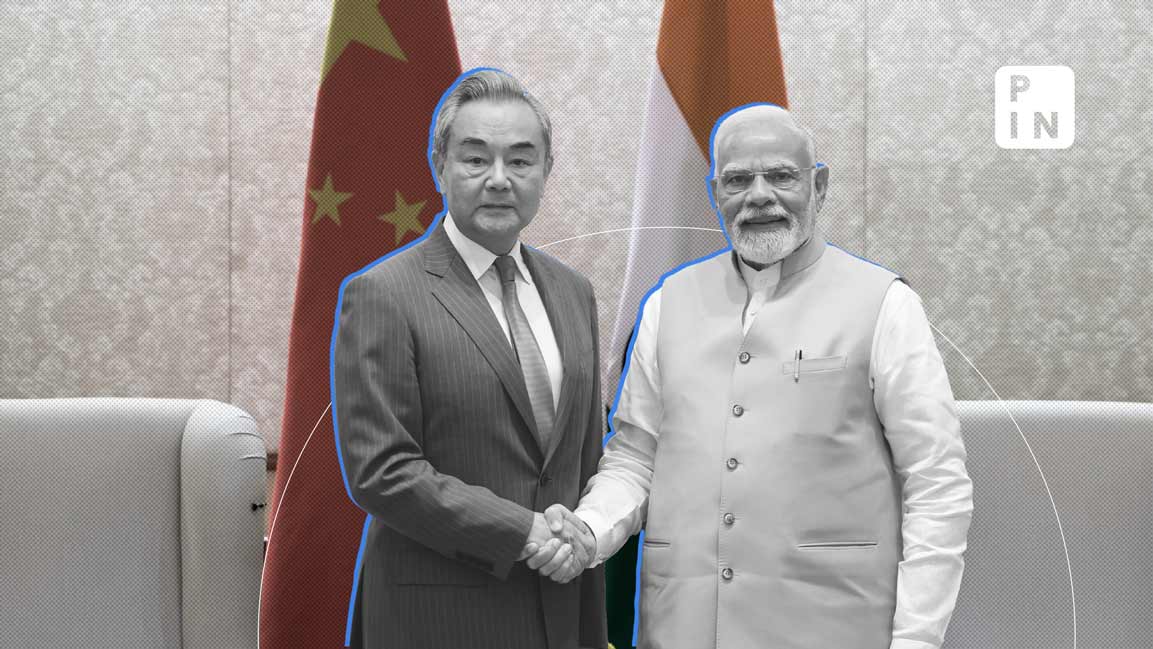


India and China moved to amend bilateral ties this week as Prime Minister Narendra Modi accepted Chinese President Xi Jinping’s invitation to the Shanghai Cooperation Organisation (SCO) summit in Tianjin, Beijing signaled relief on key raw materials for India, and both sides agreed to resume direct flights and widen economic links.
Chinese foreign minister Wang Yi met Modi in New Delhi on Tuesday, 19 August, handing over Xi’s message and formal invite, scheduled for later this month.
Modi “emphasized the importance of maintaining peace and tranquillity on the border,” and said “stable, predictable, and constructive” ties would serve regional and global prosperity.
He noted “steady and positive progress” since his meeting with Xi in Kazan, Russia, last year, including the resumption of the Kailash Manasarovar Yatra.
Earlier, on Monday, Wang met external affairs minister Subrahmanyam Jaishankar, co-chaired the 24th round of the Special Representatives’ (SR) dialogue on the boundary question with National Security Adviser Ajit Doval on Tuesday, and then called on Modi.
The ministry of external affairs said the SR dialogue is back at the center of the boundary process after a multi-year freeze. Practical steps accompanied the symbolism. India and China agreed in principle to resume direct flights “at the earliest” and to “step up trade and investment flows,” as part of a broader restart of people-to-people and commercial engagement disrupted after the 2020 clash.
Beijing also moved on long-running Indian supply-chain concerns. China eased curbs on rare-earth magnets used across electronics and autos, with fertilizers and tunnel-boring machines discussed as priority bottlenecks, The Economic Times reported, citing people aware of the matter.
“China’s decision to ease export restrictions on fertilizers, rare earths and tunnel-boring machines is a useful signal, but it is only a tactical gesture,” Delhi-based think-tank Global Trade Research Initiative (GTRI) said in a report dated 20 August. “India’s real safeguard lies in reducing dependence, strengthening domestic manufacturing, and building resilient supply chains.”
GTRI quantified the exposure: “The trade deficit with China has hit a record $100 billion in FY25, and the problem is structural… China now supplies over 70% of India’s needs in several critical areas, including 97.7% of erythromycin, 96.8% of silicon wafers, 98.9% of viscose yarn, and 82.7% of solar cells. Everyday products like laptops (80.5%) and flat-panel displays (86%) are also dominated by Chinese imports.”
Beyond near-term relief, GTRI urged two tracks for India: quick substitution of priority imports and a deeper manufacturing push in chips, PCBs, sensors and batteries—backed by the ₹100 billion innovation fund, tighter screening of Chinese investment in sensitive sectors, and stronger supply-chain partnerships with Japan, Taiwan and the EU.
The US this month extended for 90 days a tariff truce with China in a move that kept the current framework in place while talks continue.
More Top Stories: