- | 1:00 pm
Curbs on gold funds widen as rupee, reserves face pressure
Mutual funds have stopped taking fresh money into gold fund-of-funds just before the festive buying season, adding to import duties and earlier investment limits as India tries to contain demand for dollars



Restrictions on gold investment have tightened for the second time this year, as fund houses curb fresh inflows into gold schemes while high oil prices, a weaker rupee and capital outflows put pressure on India’s external finances.
Seventeen mutual fund houses have temporarily stopped accepting fresh investments in specified gold exchange-traded fund fund-of-funds, or FoFs, from 15 and 16 October, according to notices issued by asset managers and industry reports.
The restrictions cover fresh lump-sum investments, switch-ins and new registrations for systematic investment plans and systematic transfer plans in affected schemes.
Existing SIP installments can generally continue, while redemptions, switch-outs and systematic withdrawals remain open, subject to individual fund rules. Direct gold ETFs are also still available for trading on stock exchanges.
That makes the latest move significant but narrower than a blanket restriction on gold investment.
The Securities and Exchange Board of India (Sebi) asked mutual funds to stop accepting fresh money into gold FoFs from 16 October, Mint reported, citing people in the industry aware of the development.
Sebi, however, had not issued a public circular announcing the measure as of Friday. Fund houses have instead notified investors through scheme addenda.
The timing is hard to miss. The restrictions arrived days before Diwali and during India’s wedding season, when household demand for gold usually strengthens.
Curbs get tougher
This is not the first attempt this year to slow investment demand for gold.
In early June, several fund houses imposed softer limits. Direct creation requests in gold ETFs of ₹25 crore, or about $2.63 million, or more were refused, while lump-sum investments and switch-ins into some gold FoFs were capped at ₹10 lakh, or about $10,530, per PAN each month. Existing SIPs were left largely untouched. Those restrictions were lifted around 21 August as pressure on the rupee eased.
The latest action goes further by stopping most fresh subscriptions into the affected FoFs rather than merely limiting their size.
It follows a much broader intervention by the government in May, when India raised the effective import duty on gold and silver to 15% from 6%. The new structure comprises a 10% basic customs duty and a 5% Agriculture Infrastructure and Development Cess. The increase took effect on 13 May.
That move came after Prime Minister Narendra Modi urged households to restrain purchases of gold as India faced a worsening external environment.
The government first made imported gold more expensive. Fund houses then restricted large investment flows. Those restrictions were relaxed, only for a broader halt on fresh FoF money to return two months later.
Why FoFs matter
The restriction is aimed at a particular route into gold.
Gold FoFs collect money from investors and put it into underlying gold ETFs. Gold ETFs in turn hold bullion or assets designed to track domestic gold prices.
Buying an ETF unit from another investor on an exchange does not by itself create fresh demand for physical gold. But sustained inflows can lead to the creation of new ETF units and additional bullion purchases by the fund ecosystem.
Stopping fresh FoF subscriptions therefore removes one source of incremental demand without closing the gold market.
Investors can still buy ETF units directly through demat accounts. They can also buy physical gold.
That limits how much the measure alone can achieve. Mint reported that market participants expect the impact to be modest while direct ETF purchases remain open.
Money was returning to gold
The action follows a renewed surge in financial investment in the metal.
Indian gold ETFs received ₹4,450.61 crore, or $469 million, in September, up 71% from ₹2,596.70 crore, or $273 million, in August, according to Association of Mutual Funds in India data. It was the strongest monthly inflow since January.
The rise came despite a sharp fall in international gold prices.
Gold fell 8.5% in September to about $4,176 an ounce as US Treasury yields rose and the dollar strengthened, according to the World Gold Council. The US 10-year yield climbed about 53 basis points during the month to around 5.3%, while the Dollar Index gained roughly 2%. One basis point is one-hundredth of a percentage point.
Those moves would normally work against bullion. Gold produces no income, so higher government bond yields raise the opportunity cost of holding it. A stronger dollar also makes dollar-priced gold more expensive for buyers using other currencies.
Yet investors kept adding to gold funds. Global gold-backed ETFs attracted about $10 billion in September. Third-quarter inflows reached a record $31 billion, while holdings increased by 67 metric tons during the month to a record 4,256 metric tons.
Gold prices fell, but ETF holdings rose. Short-term investors were reacting to higher yields and a stronger dollar, while longer-term investors continued to buy gold.
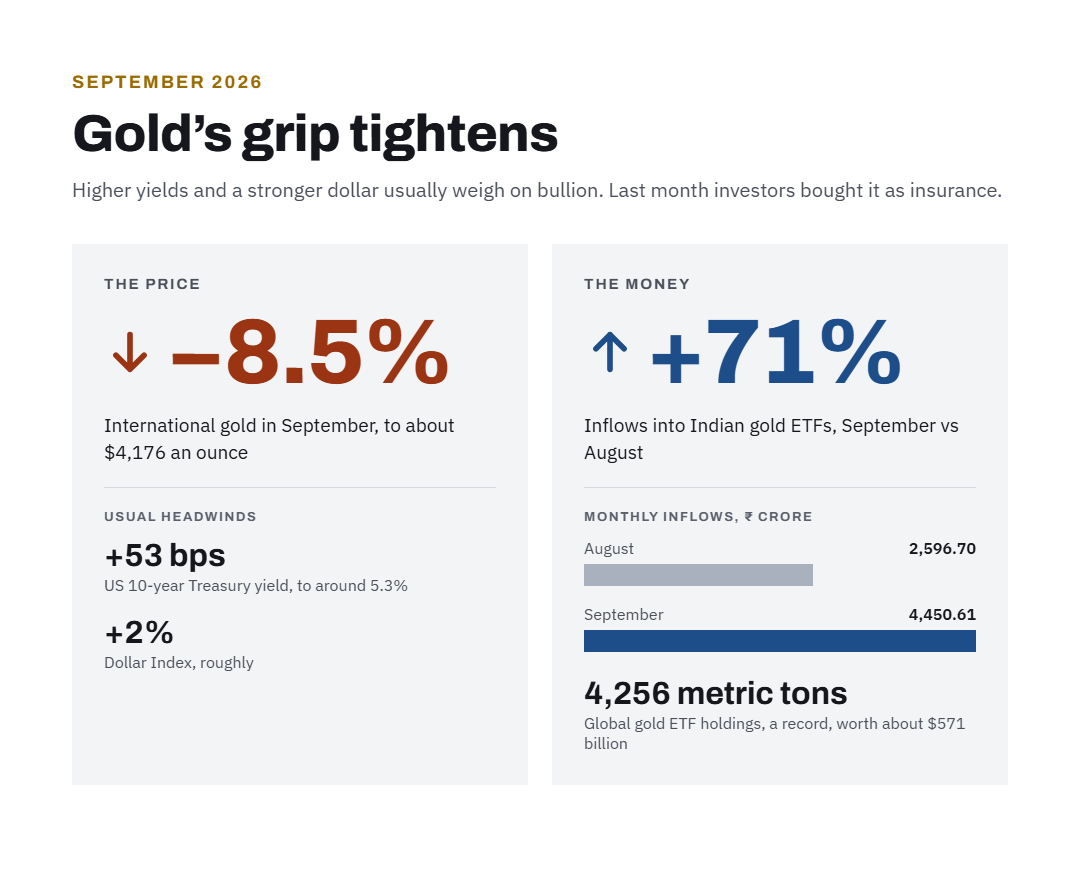
Sources: World Gold Council; Association of Mutual Funds in India (AMFI). One basis point is one-hundredth of a percentage point. Value of ETF holdings calculated at about $4,176 an ounce.
War changes the equation
Geopolitics is one reason. The renewed conflict in the Middle East has pushed energy security back to the center of global markets. For India, the effect is more complicated than for many large economies because it imports most of the crude oil it consumes and much of the gold bought domestically.
When oil prices rise, India needs more dollars to pay for imports. Gold adds to that demand. Heavy gold imports can widen the trade deficit and put further pressure on the rupee, making bullion demand a concern for policymakers as well as investors.
The May duty increase and the latest fund restrictions point in the same direction: limiting fresh gold demand as pressure builds on the rupee and India’s external finances.
The government cannot control the international price of oil or gold. It can try to reduce discretionary imports. Gold is one of the largest such items.
RBI is tightening too
The pressure is visible well beyond bullion. The RBI raised its policy repo rate by 25 bps to 5.50% on 7 October and shifted its stance to calibrated tightening. Governor Sanjay Malhotra said inflation pressures had broadened and highlighted volatile crude prices, the Middle East conflict and financial-market uncertainty.
The central bank raised its inflation forecast for 2026-27 to 5.2% while lifting its growth projection to 7.1%. Higher Indian rates serve an inflation objective, but they also matter for the currency. A wider interest-rate differential can make rupee assets relatively more attractive when global yields are rising.
That has become harder because the US is also operating in a high-yield environment. US Treasury yields rose sharply in September. Higher yields pull global capital toward dollar assets, lift funding costs and put pressure on emerging-market currencies. They also weigh on equity valuations, especially in expensive growth sectors.
India is dealing with several linked pressures at once: a large oil bill, strong US yields, foreign portfolio outflows, a weak rupee and renewed demand for gold. The gold restrictions attack only one part of that equation.
Stocks add another pull
The weakness in equities has also helped gold. Indian investors increased allocations to gold ETFs in September even as they continued putting money into equity mutual funds. Gold ETF inflows climbed 71%, while equity schemes received ₹38,306.55 crore, up about 31% from August.
That suggests gold was being added as a hedge rather than simply replacing equities. Globally, the same portfolio logic has become more visible. Higher bond yields have hurt gold prices at times, but they have also tightened financial conditions and increased pressure on equity valuations. Geopolitical shocks have added another reason to hold bullion.
Gold is therefore being pulled in two directions. High real and nominal yields make it less attractive relative to bonds. War, fiscal concerns, currency uncertainty and volatile equities make it more attractive as insurance. The September data show both forces operating at once.
India’s problem is the import bill
For an Indian investor, gold has another attraction when the rupee weakens. International gold is priced in dollars. A fall in the rupee can lift the domestic price even when the global gold price is flat or declining.
That makes bullion an effective currency hedge for households. It also creates a policy problem. The more investors seek protection from rupee weakness through imported gold, the more dollars the economy may need to pay for bullion. Additional dollar demand can itself add pressure to the currency.
The government has confronted this before. India raised gold duties sharply during earlier periods of external stress, including after the rupee crisis of 2013 and again in 2022. Duties were cut substantially in the 2024 budget before being restored to 15% this May.
The current measures remain far less restrictive than the 80:20 import rule used in 2013, which linked gold imports to re-exports. But the objective is familiar: reduce non-essential demand for foreign exchange before it becomes harder to finance.
Curbs can leak
There is an obvious limit to the strategy. Closing one investment route does not eliminate demand for gold. An investor unable to start a new Gold ETF FoF SIP can still buy a listed ETF. A household can buy coins or jewelry. Investors can also shift money into multi-asset funds that hold precious metals.
The higher import duty presents a different problem. When India sharply raises the gap between domestic and international gold prices, illegal imports become more profitable. That has repeatedly been the trade-off with high bullion duties.
Formal imports may fall while incentives for smuggling increase.
There is also a risk that restrictions on financial gold push some demand back toward physical products, which would be the opposite of what policymakers want if the main concern is conserving foreign exchange.
A pre-emptive move
The latest restrictions are therefore best read as preventive rather than emergency action. Gold ETF inflows accelerated in September. Festival demand is approaching. Global geopolitical risks remain high. US yields are elevated. The RBI has begun tightening monetary policy, and the government has already raised the cost of importing bullion.
Against that background, allowing another rapid build-up of investment demand for gold would work against the effort to contain India’s demand for dollars. The authorities have stopped short of restricting direct ETF trading or physical purchases. That leaves investors plenty of ways to buy gold and means the immediate effect on overall demand may be limited.
But the return of restrictions only weeks after the earlier limits were withdrawn sends a clearer message. India is again treating gold demand as part of its external-sector management.
More Top Stories: