- | 10:50 am
The BRICS summit and the elephants in the room
As India hosts BRICS amid US tariff pressure and the war with Iran, Donald Trump will loom over a summit that will test New Delhi’s balancing act between Washington, Moscow and Beijing.
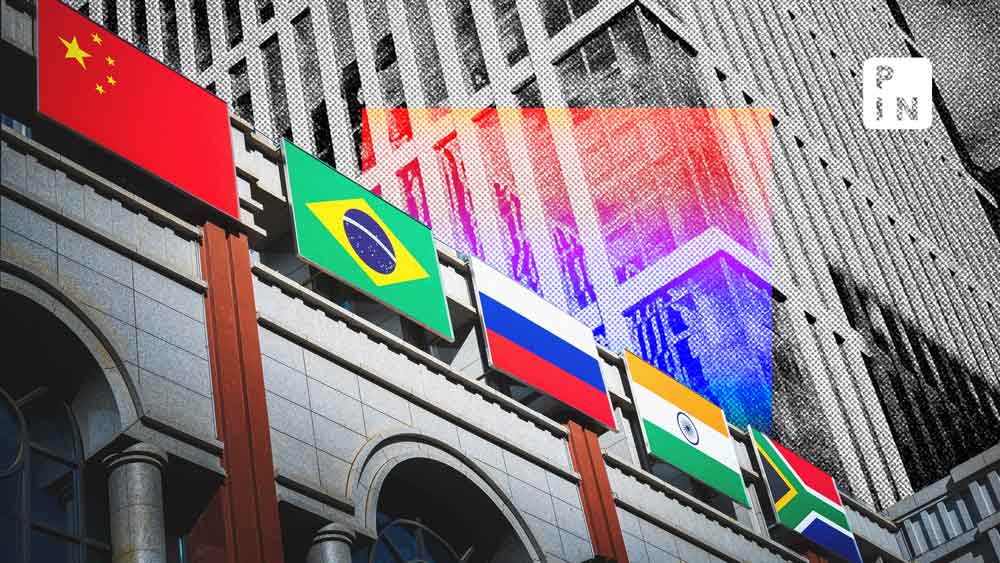


As New Delhi prepares for the BRICS summit on 12 and 13 September, it is worth looking at the geopolitical setting in which the leaders will meet. US President Donald Trump will not be at the table, but he may still be the largest invisible elephant in the room.
Trump has, with considerable success, used tariffs and the threat of tariffs to push the rest of the world into bilateral bargaining with Washington.
The chronology is worth recalling. On 1 February 2025, his administration announced additional tariffs of 25% on imports from Canada and Mexico and 10% on imports from China, with most of them due to take effect from 4 February. On 2 April, Trump followed with his much broader “reciprocal tariff” program covering US trading partners around the world.
What did not emerge was a broad coalition of countries prepared to confront Washington collectively.
This brings to mind Aesop’s fable of the mice debating how to protect themselves from the cat. Attaching a bell to the cat seems an excellent idea until somebody asks the obvious question: who will bell the cat?
China, Canada and the European Union did retaliate against US tariffs at various stages. Canada is doing so again, announcing new tariffs on US goods this month. But retaliation has largely been undertaken country by country rather than through a coordinated international front.
One reason may be the decline of classical diplomacy in favor of diplomacy conducted increasingly in public. Governments announce positions, threats and red lines before diplomats have had enough space to explore compromises discreetly. Trump has accelerated that transformation. His preference for public pressure, leader-to-leader bargaining and threats of economic retaliation has made discreet coalition-building considerably harder.
The war with Iran adds another layer of difficulty.
The US and Israel began their strikes on Iran on 28 February, barely two days after US-Iran nuclear negotiations mediated by Oman had ended with what the mediator described as progress, with the two sides agreeing to plans for further technical talks. Six months later, the conflict continues.
Fresh US sanctions have added to the tension. On 8 September, the US Treasury sanctioned 36 targets connected to Iran’s aviation sector, including foreign intermediaries accused of helping Tehran obtain aircraft and sensitive technology. The wider economic campaign against Iran inevitably complicates matters for BRICS, which includes Iran as well as countries maintaining extensive commercial relations across the Gulf.
India, as BRICS chair, therefore finds itself in an exceptionally challenging situation.
Its relationship with Washington is one consideration. India and the US announced a framework for an interim trade agreement in February. Commerce minister Piyush Goyal said this month that negotiations on the first tranche of the broader bilateral trade agreement had essentially been concluded, but India was waiting for Washington to provide preferential tariff treatment compared with its competitors before the agreement could be finalized.
New Delhi has every reason to want a satisfactory agreement. But it also has limits on the concessions it can make, particularly where domestic economic and political interests are involved.
BRICS itself is another complication.
Trump has repeatedly made clear his hostility to moves that he believes could weaken the international position of the US dollar. In January 2025, he threatened BRICS countries with tariffs of 100% if they sought to create or support a currency to replace the dollar. Later that year, he threatened an additional 10% tariff on countries aligning themselves with what he called the “anti-American policies” of BRICS.
New Delhi will therefore know that the wording of the summit declaration, assuming agreement on one can be reached, will be examined closely in Washington.
Iran is likely to provide one of the most difficult tests.
At the Shanghai Cooperation Organisation (SCO) summit in Bishkek on 1 September, India joined the other member states in a declaration condemning military strikes on Iranian territory that had caused civilian casualties and economic damage. The declaration said such actions violated international law and the UN Charter, and called for a political and diplomatic settlement. It did not, in that passage, name either the US or Israel.
India’s position has evolved.
When the SCO issued a statement in June 2025 explicitly condemning Israeli strikes on Iran, New Delhi distanced itself from the text.
The ministry of external affairs said India had not participated in the discussions that produced the statement and reiterated its preference for de-escalation through dialogue and diplomacy.
At the SCO summit in Tianjin three months later, India agreed to language condemning military strikes on Iran as “a gross violation of the principles and norms of international law and the UN Charter”, without naming Israel.
The Bishkek declaration this month continued that formulation. Having now subscribed to such language, India may find it difficult to retreat significantly from it when BRICS leaders meet in Delhi.
That matters because Iran and the United Arab Emirates have already demonstrated how difficult consensus can be.
At the BRICS foreign ministers’ meeting in New Delhi in May, in preparation for this month’s summit, the two sides clashed openly over the Iran war.
Tehran wanted BRICS to condemn US and Israeli actions, while the UAE rejected Iranian accusations against it. The ministers failed to agree on a joint statement, leaving India to issue a chair’s statement and outcome document instead. The document acknowledged that there were “differing views among some members” over the Middle East.
It may be noted that the ministry of external affairs website does not give the text of the Bishkek declaration. The print media, too, did not carry a detailed report barring a few exceptions.
There is every reason to expect those differences to resurface at the summit.
There is another historical point worth making.
The prevailing impression that “BRICS” was somehow created by Jim O’Neill of Goldman Sachs is misleading.
O’Neill did coin the acronym BRIC in his 2001 paper ‘Building Better Global Economic BRICs,’ grouping Brazil, Russia, India and China as economies whose growing weight would reshape the world economy.
But an investment acronym and a diplomatic grouping are not the same thing.
Official BRICS accounts themselves make the distinction. The acronym originated at Goldman Sachs, but the political forum was created by the governments concerned. The first meeting of BRIC foreign ministers took place on the sidelines of the UN General Assembly in New York in 2006, and the first summit of the four leaders was held in Yekaterinburg in 2009.
Goldman Sachs later turned the investment thesis into a dedicated BRIC fund. It did not flourish particularly well.
The fund’s assets peaked at $842 million in 2010 before falling to $98 million by September 2015. Goldman eventually folded the fund into a broader emerging-markets vehicle after years of weak performance. The financial product disappeared. The diplomatic grouping did not.
There is also a diplomatic prehistory to BRICS that receives less attention.
The Russia-India-China trilateral, or RIC, predates formal BRIC cooperation. Its intellectual architect was Yevgeny Primakov, Russia’s foreign minister and later prime minister, who in 1998 proposed closer cooperation among Moscow, New Delhi and Beijing as Russia became increasingly dissatisfied with a US-dominated post-Cold War order.
The first RIC foreign ministers’ meeting was held in New York in September 2002 on the sidelines of the UN General Assembly. The mechanism subsequently developed into a regular trilateral dialogue. Its 18th foreign ministers’ meeting, held virtually in November 2021, was the last such meeting.
RIC is therefore an important precursor to the political environment from which BRIC emerged. Indeed, India’s own official account says the formal BRIC grouping followed a meeting of the leaders of Russia, India and China on the margins of the G8 outreach summit in St. Petersburg in 2006.
Will RIC now return at summit level in Delhi?
No formal RIC summit has been announced. But Vladimir Putin and Xi Jinping will both be in India, making some form of trilateral interaction possible even if it is not given the RIC label.
Moscow and Beijing will naturally want to prevent New Delhi from moving too close to Washington. Russia and China have meanwhile developed an unusually close relationship of their own.
Putin has been Russia’s dominant political figure since 2000, first as president, then prime minister and again as president. Xi and Putin have met more than 40 times since Xi became China’s president in 2013, making theirs one of the most sustained leader-level relationships in contemporary diplomacy.
And there may be another, smaller elephant in the BRICS room: Israeli Prime Minister Benjamin Netanyahu. This “elephant” has started to shrink, given his diminishing chances to win the election in October.
Israel holds its election on 27 October. Netanyahu is fighting to consolidate the fragmented Israeli right, with polls suggesting his coalition faces a serious risk of losing its majority, although his opponents have yet to demonstrate a certain route to forming an alternative government.
And the diplomatic calendar is hardly becoming quieter.
The BRICS summit follows the SCO meeting in Bishkek. China will host the APEC (Asia-Pacific Economic Summit) leaders’ meeting in Shenzhen on 18 and 19 November. Trump will then host the G20 leaders’ summit at Trump National Doral in Miami on 14 and 15 December.
There is an obvious question.
Are there now too many summits, held too frequently, leaving too little time and space for professional diplomats to do the patient work required between them?
Diplomacy was never meant to consist entirely of leaders arriving in motorcades, posing for photographs, issuing communiqués and moving on to the next capital.
Perhaps the mice need more time for classical diplomacy before somebody asks them, once again, to bell the cat.
More Top Stories: