- | 7:40 pm
BRICS finds rare unity as Trump pressure, global conflicts test bloc
The New Delhi summit brought Iran and the UAE behind the same appeal for restraint, hardened BRICS opposition to unilateral sanctions and trade barriers, and ended with China proposing deeper cooperation on AI, investment and services


BRICS leaders ended their two-day summit in New Delhi on Sunday, 13 September, with an unusually broad show of unity over the wars and economic pressures dividing the international system, adopting common positions on the Middle East, sanctions, trade barriers, terrorism and reform of global institutions despite deep differences among their own governments.
The most difficult agreement came over the Middle East.
Iran and the United Arab Emirates backed the same declaration calling for “maximum restraint,” protection of civilians and respect for sovereignty while stressing the need to keep global trade, supply chains and energy flows moving.
Iranian President Masoud Pezeshkian also met Abu Dhabi Crown Prince Sheikh Khaled bin Mohamed bin Zayed Al Nahyan on the sidelines, their countries’ highest-level encounter since the regional war began.
The summit also produced a sharper common position against unilateral economic pressure. BRICS condemned sanctions imposed outside the UN system, opposed tariff and non-tariff measures that it said distort trade, criticized attacks on safeguarded nuclear facilities and pressed again for changes at the UN, IMF and World Bank.
None of that language named the US.
But it came as Washington has expanded sanctions and tariffs against several BRICS countries and remains directly involved in the war with Iran. The Financial Times described the result as rare unity generated by “Trumpism,” as governments with very different relations with Washington found common ground on economic coercion and the use of American power.
China used the summit’s final day to move the agenda toward economic cooperation. President Xi Jinping proposed new mechanisms covering artificial intelligence, special economic zones and services trade, while urging BRICS countries and partners to keep industrial and supply chains stable and build a more integrated market.
China, which takes over the BRICS chair in 2027, said it would lead the creation of a BRICS AI Open Source Zone to promote work on large language models, AI training and an open AI ecosystem. Xi also proposed a partnership among BRICS special economic zones and said China would host a BRICS Service Trade Forum next year.
Iran and UAE bridge the summit’s deepest divide
The Middle East conflict had threatened to make a consensus declaration difficult. Iran and the UAE entered the summit after months of direct tension. Iran has repeatedly attacked targets in the Emirates during the war, including Al Minhad Air Base in late August, while Abu Dhabi has hardened its political and economic stance toward Tehran.
The New Delhi Declaration nevertheless brought both governments behind the same call for restraint.
“We express deep concern over the continued escalation of tensions in Middle East/West Asia,” the declaration said, calling on all sides to exercise “maximum restraint” and avoid steps that could worsen the situation.
It also called for protection of civilians, respect for sovereignty and territorial integrity, and continued flows of trade, energy and supplies. Pezeshkian’s meeting with Sheikh Khaled added a bilateral channel to that agreement.
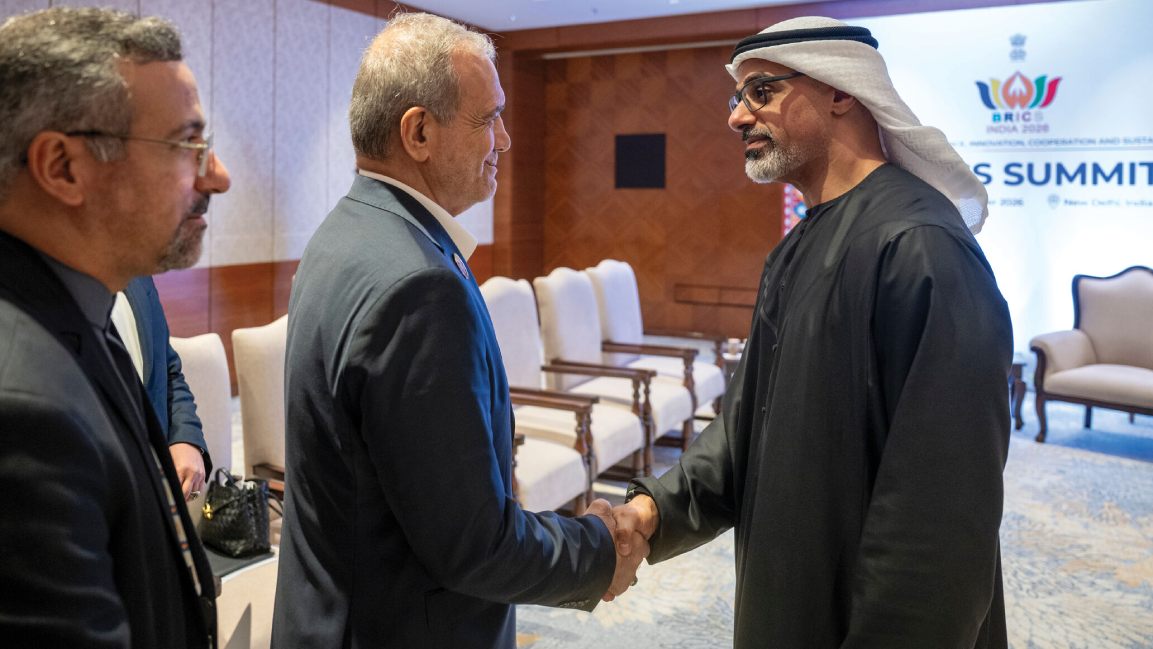
Crown Prince of Abu Dhabi Sheikh Khaled bin Mohamed bin Zayed Al Nahyan meets Iranian President Masoud Pezeshkian on the sidelines of the BRICS Summit in New Delhi.
The Abu Dhabi Media Office said the two discussed regional and international issues and stressed efforts to “ease tensions, promote de-escalation and strengthen regional stability.” It reported no agreement or breakthrough.
For India, the meeting came after Modi had separately held talks with Pezeshkian and Sheikh Khaled. Modi told the Iranian leader that disputes should be resolved through dialogue and diplomacy and raised freedom of navigation, commerce and the safety of seafarers, issues that have become more urgent as fighting disrupts shipping and energy routes around the Gulf.
BRICS hardens its line on sanctions
The declaration devoted unusually direct language to sanctions imposed outside the UN system.
BRICS condemned “unilateral coercive measures” that it said violate international law, specifically citing economic and secondary sanctions. It called for the elimination of such measures and repeated its opposition to sanctions not authorized by the UN Security Council.
That language carries particular importance for Russia and Iran, both targets of extensive Western sanctions. It also gave the wider group a common position without requiring members such as India and the UAE, which have close ties with Washington, to identify the United States by name.
The economic section of the declaration took a similar approach to trade. BRICS expressed “serious concerns” over unilateral tariff and non-tariff measures that it said distort commerce and breach World Trade Organization rules. It warned that rising tariffs and protectionism were disrupting global supply chains and increasing uncertainty for developing economies.
Modi made the trade argument more directly at the BRICS Business Forum.
“At a time when trade barriers are rising across the world, India is building economic bridges,” the Prime Minister’s Office posted on X during his address.
Addressing the BRICS Business Forum. Strong business partnerships can open new avenues for growth, innovation and shared prosperity.@BricsIndia2026 https://t.co/EUIH6agfI2
— Narendra Modi (@narendramodi) September 11, 2026
Modi asked the BRICS Business Council to identify the 10 biggest trade barriers between member countries and proposed targets for helping startups enter each other’s markets and creating new business partnerships.
Carbon tariffs also come under fire
The declaration singled out carbon border adjustment mechanisms as an example of trade policy that can hurt developing economies. BRICS opposed measures it described as “unilateral, punitive, discriminatory and protectionist” when they are not consistent with international law.
The wording has direct implications for the European Union’s Carbon Border Adjustment Mechanism, which puts a carbon price on some imports into the bloc. BRICS countries have repeatedly argued that such measures can penalize exporters in developing countries that have fewer financial and technological resources to cut emissions.
The declaration paired that criticism with support for climate action, carbon markets and financing for adaptation in developing economies.
Xi unveils new Greater BRICS initiatives
China arrived in Delhi with a broader economic agenda.
In the final session, Xi said the success of what Beijing calls the “Greater BRICS Initiative” would depend on practical cooperation rather than political statements alone.
He called for members and partner countries to strengthen supply chains and cultivate an integrated market, then announced three initiatives.
China would lead the proposed BRICS AI Open Source Zone, create a partnership among special economic zones and host a services trade forum in 2027.
The AI proposal would cover large language models, model training and an open AI ecosystem.
The special economic zone initiative would seek closer links among industrial and investment hubs in BRICS countries, while the services forum would focus on expanding cross-border trade and investment.
Xi’s proposals came as China prepared to succeed India as chair of the group next year. The New Delhi Declaration formally gave its full support to China’s 2027 chairship and the next leaders’ summit.
Russian President Vladimir Putin also used the closing discussions to call BRICS a driver of what he described as a fairer multipolar international order.
Modi and Xi push cautious India-China reset
Xi’s visit produced one of the summit’s most closely watched bilateral meetings.
It was his first trip to India since 2019 and followed years of strained relations after the 2020 border clashes in Ladakh. Modi and Xi agreed that relations should be viewed from a “strategic and long term perspective” and that differences should not become disputes, according to the Indian government.
Modi said ties should be guided by “mutual respect, mutual sensitivity and mutual interest” and stressed that peace along the border remained essential to the broader relationship.
The two leaders also agreed to work toward a “fair, reasonable and mutually acceptable” settlement of the boundary dispute.
Economic tensions were discussed as well.
India raised its structural trade imbalance with China, supply-chain concerns and the need for more predictable market access. Both leaders supported stronger business links, cultural exchanges and greater mobility between the two countries.
Xi described China and India as partners rather than rivals and said the two should treat each other as opportunities rather than threats, according to Xinhua.
The meeting continued a gradual improvement in ties since military disengagement agreements eased parts of the border standoff, although the territorial dispute remains unresolved and both sides retain substantial military deployments along the frontier.
BRICS condemns Kashmir attack
India also secured unusually specific counterterrorism language in the declaration. BRICS condemned “in the strongest terms” the 22 April 2025 terrorist attack in Jammu and Kashmir, in which 26 people were killed and others injured.
The declaration also condemned the cross-border movement of terrorists, terrorism financing and safe havens. It called for zero tolerance of terrorism and rejected double standards in counterterrorism policy.
Pakistan was not named. China nevertheless signed the language despite its close relationship with Islamabad, making the paragraph one of the more important outcomes for New Delhi.
The group also called for faster adoption of the long-pending Comprehensive Convention on International Terrorism at the United Nations and for action against UN-designated terrorists and organizations.
BRICS stops short of a common currency
The summit did not revive proposals for a common BRICS currency. Instead, the declaration backed further work on linking payment and messaging systems and expanding settlement of trade and investment in members’ local currencies.
The BRICS Payment Task Force will continue studying cross-border interoperability and payment systems designed to be faster, cheaper and more accessible. The declaration also stressed that different countries have different priorities and that “there is no one-size-fits-all approach.”
The formulation allows members to expand local-currency trade without committing themselves to a single monetary system or a formal challenge to the dollar.
India has been among the members pressing for practical payment links. Its UPI network has already been connected with payment systems in several countries, while New Delhi has also pushed for cheaper remittance channels.
BRICS additionally agreed to continue work on a new investment platform, insurance cooperation and an Indian proposal for a BRICS Risk Lab at Gujarat’s GIFT City.
Palestine and nuclear sites draw strong language
The declaration was expansive on the Israeli-Palestinian conflict. BRICS backed full UN membership for Palestine and repeated support for an independent Palestinian state within the internationally recognized 1967 borders, including Gaza and the West Bank, with East Jerusalem as its capital.
It opposed forced displacement of Palestinians from Gaza and called for implementation of UN resolutions, maintenance of the ceasefire and full humanitarian access. The declaration also expressed serious concern over deliberate attacks on peaceful nuclear facilities under full International Atomic Energy Agency safeguards.
It said nuclear safety and security must be respected even during armed conflict. The statement did not name the United States or Israel in that passage.
Ukraine language remains cautious
On Ukraine, BRICS retained its established formulation rather than adopting a new position. The declaration supported peaceful resolution of disputes through dialogue, consultation and diplomacy and referred to the broader need for mediation and conflict prevention.
India has continued to tell Russia that the war should be resolved through diplomacy while avoiding Western sanctions against Moscow. Modi and Putin met before the formal summit sessions and reviewed cooperation in energy, defense, trade, space and other areas. Modi again raised ongoing conflicts and their impact on maritime commerce and Indian seafarers.
The Kremlin also said Modi and Xi had offered their good offices in efforts to reach a settlement in Ukraine, though no new peace initiative emerged from the summit.
India again presses for UN and IMF reform
Reform of global institutions remained one of the largest sections of the Delhi declaration. BRICS called for changes to the IMF and World Bank that would give emerging and developing economies representation closer to their share of the global economy.
It said governance of the Bretton Woods institutions should reflect changes in economic weight since they were created and called for more transparent leadership selection at both organizations. India also continued its campaign for reform of the UN Security Council.
China and Russia reiterated support for the aspirations of India and Brazil to play a greater role at the United Nations, including on the Security Council. The wording, however, stopped short of an explicit Chinese endorsement of permanent Security Council membership for India.
Modi also discussed UN reform with Secretary-General António Guterres on the summit sidelines. Their meeting covered current conflicts, freedom of navigation, artificial intelligence, renewable energy and global food security.
BRICS expands its practical agenda
Alongside the geopolitical issues, the summit produced agreements or continuing work across finance, energy, climate, health, technology and law enforcement. The declaration supported stronger action against cross-border financial crime, including scam networks, money laundering and misuse of virtual assets.
It also backed closer cooperation among law-enforcement agencies and financial intelligence units and called for stronger protection against fraud in cross-border payment systems. Energy remained another central theme. BRICS called for stable energy markets and uninterrupted supplies while supporting a “just, orderly, equitable and inclusive” energy transition that takes national circumstances into account.
The group also continued discussions on critical minerals and resilient energy infrastructure. Modi used the summit to link trade with maritime security.
“Global trade can move forward only when sea lanes are secure, supply routes remain open and seafarers are safe,” the Prime Minister’s Office quoted him as saying on X. “That is why India is a steadfast advocate of freedom of navigation and the safety of seafarers.”
Modi closed India’s chairship by pressing members to turn summit agreements into practical outcomes.
The New Delhi Declaration contains 140 paragraphs covering global governance, conflicts, trade, finance, climate, energy, technology and development. It was adopted by consensus on the first day of the leaders’ meeting.
India will remain BRICS chair through the end of 2026 before China takes over next year. Xi’s closing proposals gave an early indication of Beijing’s agenda, with AI, trade, investment and supply chains likely to feature heavily during its presidency.
More Top Stories: