- | 9:30 am
CJP leaders face court after forcing entry into Jantar Mantar
Three leaders of the youth movement were placed under preventive arrest after entering the recently closed protest site, deepening a confrontation over voter-roll revisions and restrictions on demonstrations in Delhi
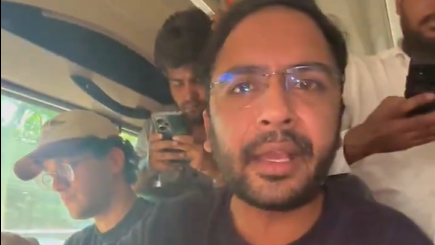


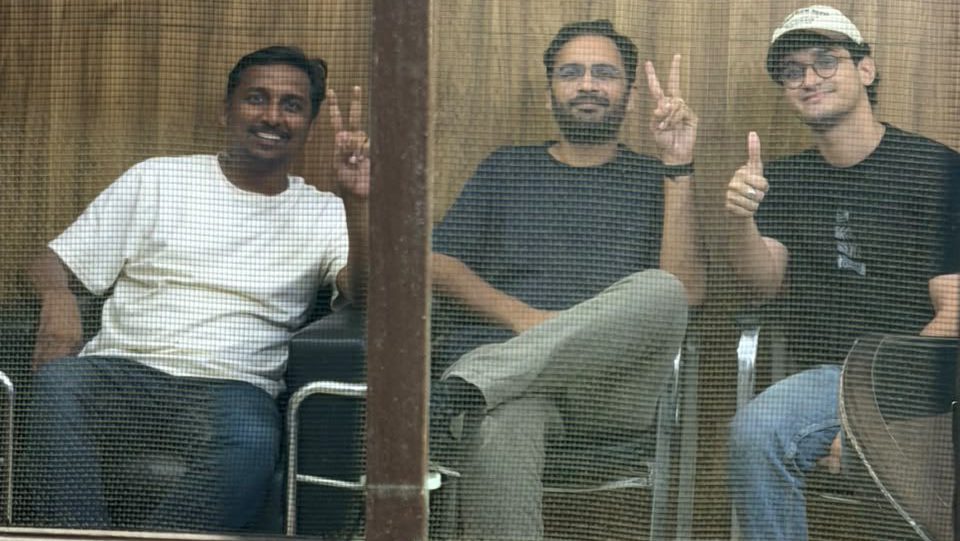
Three senior Cockroach Janta Party (CJP) leaders are due before a magistrate in Delhi on Wednesday, 14 October, after police placed them under preventive arrest for entering Jantar Mantar without permission and staging a brief protest at the site.
Saurav Das, Ashutosh Ranka and Ajinkya Shinde were detained Tuesday morning after a group of CJP members found a lightly guarded approach to the area, entered through adjoining premises and reached Jantar Mantar.
There they unfurled the Indian flag and shouted slogans demanding the resignation of chief election commissioner Gyanesh Kumar before police detained them.
Delhi Police are expected to produce the three before the Special Executive Magistrate Court at Mandir Marg.
Police have described their detention as preventive arrest, while the CJP has called it a formal arrest and accused police of denying the leaders timely access to lawyers.
The case includes allegations of trespass, obstruction of a public servant, breach of prohibitory orders and violation of an earlier peace bond.
Das and Ranka had already been detained on 10 October when they arrived in Delhi with CJP founder Abhijeet Dipke for a planned demonstration.
They were later released after furnishing ₹50,000 bonds carrying a condition that they not engage in activity likely to disturb public peace for a year.
Tuesday’s entry therefore exposes them to the additional allegation that they breached those conditions. The latest detentions are part of a broader dispute over both electoral-roll revisions and the right to protest in central Delhi.
The CJP and opposition parties have been campaigning against the Election Commission’s Special Intensive Revision (SIR) of electoral rolls, which has resulted in about 130 million names being removed during a nationwide verification exercise.
The Election Commission says the deletions largely cover voters who had died, moved, appeared more than once on rolls or could not be traced. Opposition parties and protest groups say the exercise lacks adequate safeguards and may disproportionately disenfranchise minority and poorer voters.
The Election Commission and the BJP reject allegations that the process is politically biased.
The controversy has already reached the Supreme Court.
Opposition parties marched toward the court this week and submitted a petition seeking an audit of deletions, protection against arbitrary removal and suspension of disputed aspects of the revision process.
The CJP confrontation has also become a dispute about where dissent can physically take place.
Delhi Police formally removed Jantar Mantar from the capital’s list of designated protest venues this week. Ramlila Ground, Burari Ground and CBD Ground in east Delhi were named as alternatives.
The change followed a Supreme Court hearing on 9 October in which the court said authorities should identify suitable alternative protest sites. Delhi Police told the Delhi High Court on Tuesday that the denotification followed that order and recommendations from a Home Ministry committee.
Jantar Mantar is about 2 km from Parliament and has long given demonstrations visibility in the center of national political power.
Ramlila Ground is roughly 6 km away, CBD Ground about 14 km and Burari about 23 km from Parliament.
The new sites are also substantially larger. Jantar Mantar can appear crowded with a few thousand protesters. The same number scattered across Burari or Ramlila Ground creates a very different visual and political effect.
CJP founder Abhijeet Dipke said on X after Tuesday’s action that party members had “sneaked into Jantar Mantar” and declared that authorities could not “denotify the resistance.”
Police say restrictions have been necessary because of concerns about public order and repeated attempts to stage demonstrations without permission.
The government had earlier warned states of what the Home Ministry called potentially serious law-and-order consequences around the 10 October CJP protest and asked authorities to monitor mobilization into Delhi. The scale of the response has itself become part of the political argument.
Thousands of demonstrators and opposition figures were detained during earlier protests, while transport restrictions and barricading disrupted parts of the capital. The Supreme Court had told authorities not to pre-emptively shut Metro and rail services simply because protests were expected, while allowing restrictions if conditions on the ground required them.
Wednesday’s court proceedings will determine the immediate fate of Das, Ranka and Shinde.
More Top Stories: