- | 12:40 pm
Houthi capture of Mocha tightens Saudi oil squeeze as Brent hits $110
The Houthi advance towards Bab el-Mandeb puts greater pressure on the Red Sea route Saudi Arabia has relied on to bypass disrupted tanker traffic through Hormuz


Houthi forces have seized Yemen’s Red Sea port of Mocha and advanced towards the Bab el-Mandeb Strait, putting greater pressure on Saudi Arabia’s main alternative oil-export route as Brent crude briefly touched $110 a barrel on Friday, 11 September.
The advance comes as tanker traffic through the Strait of Hormuz remains severely restricted by the war involving Iran, forcing Saudi Arabia to rely more heavily on its East-West pipeline and the Red Sea port of Yanbu to get crude to international markets.
Brent reached a four-month high of $109.97 a barrel in Asian trading on Friday, after jumping more than 6% a day earlier. It later eased to around $107 but remained on course for a weekly gain of about 11%, as traders weighed attacks on shipping around Hormuz and the growing threat to Saudi exports in the Red Sea.
The Houthis captured Mocha after pushing south along Yemen’s western coast and have also reached the Hanish Islands, according to people in the Yemeni government cited by Reuters. Government forces have withdrawn towards Dhubab, which lies close to the Bab el-Mandeb Strait.
Mocha’s capture does not give the Houthis control of Bab el-Mandeb. The group would need a much stronger position around Dhubab and Perim Island to dominate the Yemeni side of the narrow passage. But the advance extends Houthi-held territory toward one of the world’s most important shipping corridors at a time when Saudi Arabia has become unusually dependent on the Red Sea.
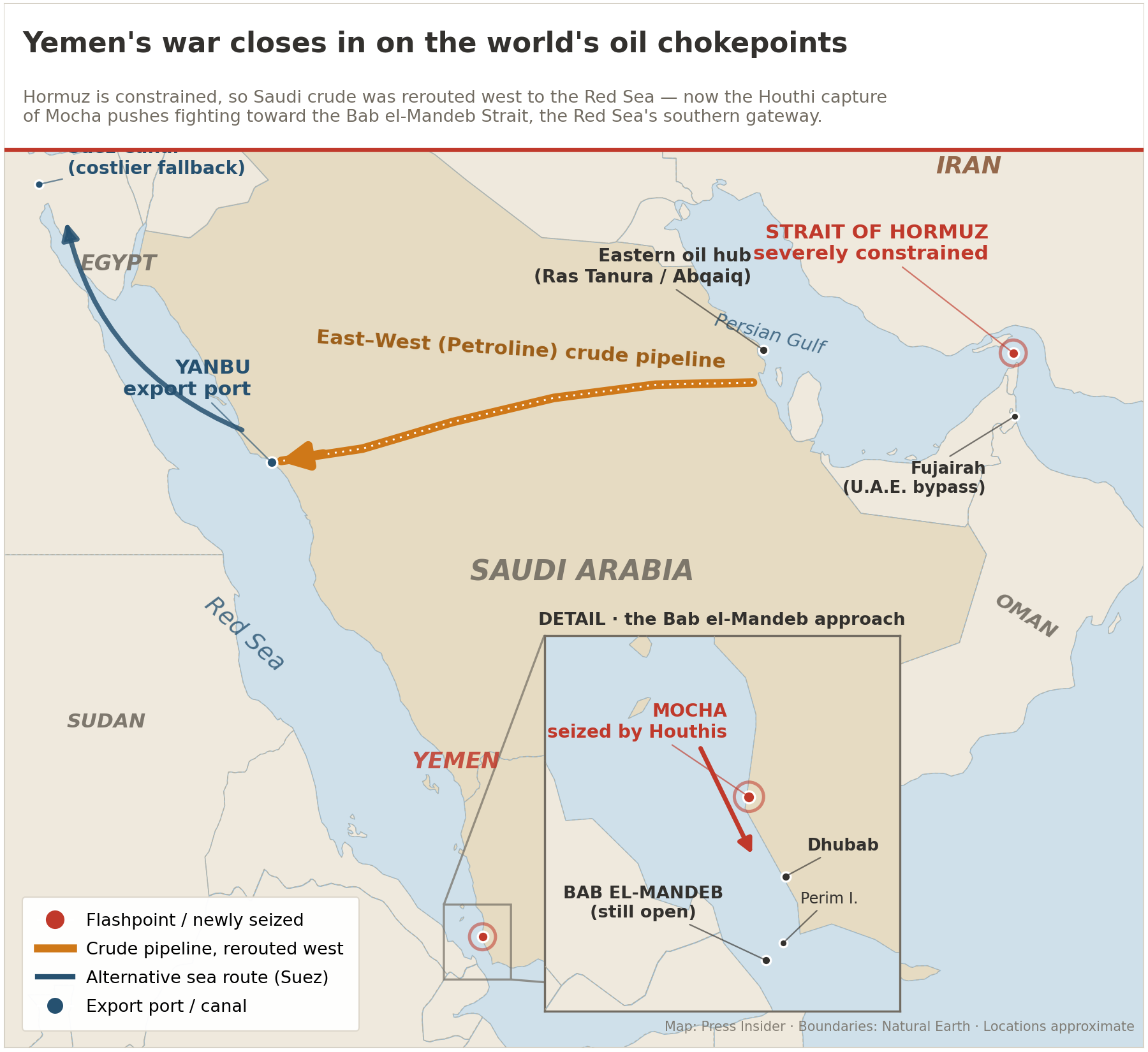
The world’s chokepoints. Credit: AI generated
Saudi Arabia’s Hormuz escape route comes under pressure
Saudi Aramco has sharply increased use of the East-West pipeline since disruption around Hormuz intensified earlier this year. The pipeline runs from Saudi Arabia’s eastern oil-producing region to Yanbu on the Red Sea. Aramco said it reached its maximum capacity of 7 million barrels a day during the first quarter, describing the line as a critical supply artery for customers affected by shipping constraints through Hormuz.
The rerouting has changed global oil flows. The US Energy Information Administration (EIA) estimates that crude oil and petroleum liquids moving through Hormuz fell to 4.9 million barrels a day in the second quarter from 21.6 million in the final quarter of 2025.
Flows through Bab el-Mandeb moved in the opposite direction, rising to 8.1 million barrels a day from 5.4 million as Saudi Arabia redirected crude through the East-West pipeline and Yanbu. That made the Red Sea Saudi Arabia’s main release valve when its traditional Gulf export route became unreliable.
But the workaround was already under strain before Mocha fell.
The EIA said this week that attacks on Saudi oil shipments through Bab el-Mandeb had cut exports from Yanbu, with Vortexa estimates showing August shipments down by about half from July. Saudi Arabia responded by increasing crude shipments north through the Suez Canal.
That option is particularly important for cargoes heading to Europe. For Asian customers, however, sending crude north through Suez rather than south through Bab el-Mandeb adds distance and cost. Saudi Arabia has also reportedly used ship-to-ship transfers outside the Persian Gulf to keep crude moving, but the EIA expects constraints in the Red Sea to limit Saudi supply in the near term while shipping patterns adjust.
The pressure has already reached Saudi production. Saudi crude output fell to about 6.2 million barrels a day in August, down 23% from July and the lowest level this year. Crude exports declined to about 3.1 million barrels a day, their lowest level since at least 2013.
A Reuters survey found that OPEC production fell by 640,000 barrels a day in August to 19.71 million, largely because of Saudi export disruption and the blockade restricting Iranian shipments.
There had been signs of improvement before the latest Houthi advance. Vortexa estimated Saudi crude and condensate loadings from Yanbu at 3.7 million barrels a day so far in September, up from 3.2 million in August. Kpler put the increase at 2.9 million from 1.5 million barrels a day.
Mocha puts that recovery at greater risk.
Bab el-Mandeb remains open
The immediate danger is not that the Houthis have physically closed Bab el-Mandeb. Commercial traffic was still moving through the strait on Thursday. Kpler recorded 26 commodity-vessel crossings, close to the 10-day average of 27. Hormuz was far more severely disrupted, with just seven crossings compared with an average of 15 over the previous 10 days and about 125 large commercial ships a day before the war.
The Houthis have also said international navigation remains safe for ships that are not among their designated targets. Houthi spokesperson Mohammed Abdulsalam said operations were limited to specific targets and would stop when what the group calls the aggression against Yemen ends. The Houthis have separately declared a blockade of Saudi-linked shipping.
That makes the commercial response from shipowners and insurers as important as the military situation onshore. The Houthis do not need to stop every vessel passing Bab el-Mandeb to disrupt Saudi exports. Owners can refuse Saudi-linked cargoes, demand higher charter rates or reroute ships if they believe missile, drone or boarding risks have become unacceptable.
The oil market has seen that dynamic before. Houthi attacks beginning in late 2023 led some of the world’s largest shipping companies to avoid the southern Red Sea and send vessels around the Cape of Good Hope. The longer route increased sailing times, fuel consumption and effective demand for vessels while reducing traffic through the Suez Canal.
A renewed diversion on a large scale would affect more than crude. Bab el-Mandeb and Suez form part of one of the main trade routes connecting Asia with Europe, meaning disruption can feed into container freight, refined fuels and supply chains.
OPEC’s problem is increasingly physical
The disruption also complicates OPEC+ attempts to manage the oil market. The producer alliance left its output policy unchanged for October at a meeting on 6 September after unwinding earlier voluntary cuts. But the gap between production targets and barrels that can physically reach customers is becoming more important than the quotas themselves.
Saudi Arabia still has substantial production capacity and the infrastructure to move oil across the kingdom. Neither is fully useful if export terminals cannot find enough ships willing to load cargoes or the available maritime routes become unreliable.
The same problem applies across the Gulf. Hormuz carried 21.6 million barrels a day of crude and petroleum liquids late last year. Even after producers found alternative routes and adjusted output, flows through the strait averaged just 4.9 million barrels a day in the second quarter.
The United Arab Emirates has a pipeline to Fujairah that bypasses Hormuz, while Saudi Arabia has the East-West system. Other regional producers have far less capacity to avoid the strait. What looked at the start of the Iran conflict like a question of spare production capacity has therefore become increasingly a question of export capacity.
Oil shock spreads into currencies and bonds
The effects are already moving well beyond the crude market. US 10-year Treasury yields approached 5% on Friday as the surge in energy prices revived fears that inflation could force central banks to keep monetary policy tighter for longer. Asian stocks fell and borrowing costs rose across several major economies.
India is particularly exposed because of its heavy dependence on imported crude. The rupee weakened as much as 0.4% to 95.7925 against the dollar on Friday before recovering some ground, with traders saying state-run banks appeared to sell dollars on behalf of the Reserve Bank of India. Brent’s surge towards $110 has increased concerns about India’s import bill, inflation and external balances.
Oil nevertheless faces a counterweight from weakening demand. High prices and months of disruption have already forced consumers to adjust, while production outside the Gulf has provided some additional supply. The result is a market where the loss of Middle Eastern barrels is pushing prices sharply higher even as those higher prices begin to restrain consumption.
That tension may determine whether Brent’s move towards $110 becomes another temporary wartime spike or the beginning of a more persistent energy shock.
Yemen faces a wider war
For Yemen, meanwhile, the advance threatens to reverse years of uneasy de-escalation. Fighting has intensified since 3 September across Taiz and southern Hodeidah. The United Nations said more than 5,600 households had been displaced in the area, while civilian casualties and attacks around displacement sites had been reported.
Reuters reported that Iranian Revolutionary Guard Corps officers provided weapons, funding and military guidance for the latest Houthi offensive, citing people in the Yemeni and Iranian governments, and regional administration. Iran says it does not direct Houthi operations.
Saudi Arabia has so far avoided returning to the scale of direct intervention that marked earlier phases of Yemen’s civil war, providing its allies with intelligence and logistical support while trying to avoid provoking more Houthi strikes on Saudi territory.
That restraint may become harder to maintain if Houthi forces continue towards Dhubab or Perim. The significance of Mocha, therefore, is not the port’s own oil traffic. It is geography. Hormuz, normally the main maritime outlet for Gulf energy exports, remains severely constrained. Saudi Arabia responded by pushing more oil west to Yanbu. Threats around Bab el-Mandeb then forced it to use costlier alternatives and cut output. Now Houthi forces have moved closer to the strait itself.
More Top Stories: