
- | 5:35 pm
India, China seek border progress ahead of Xi’s likely Delhi visit for BRICS summit
Ajit Doval and Wang Yi backed continued work on a political settlement but announced no sector, timetable or new mechanism ahead of the New Delhi summit
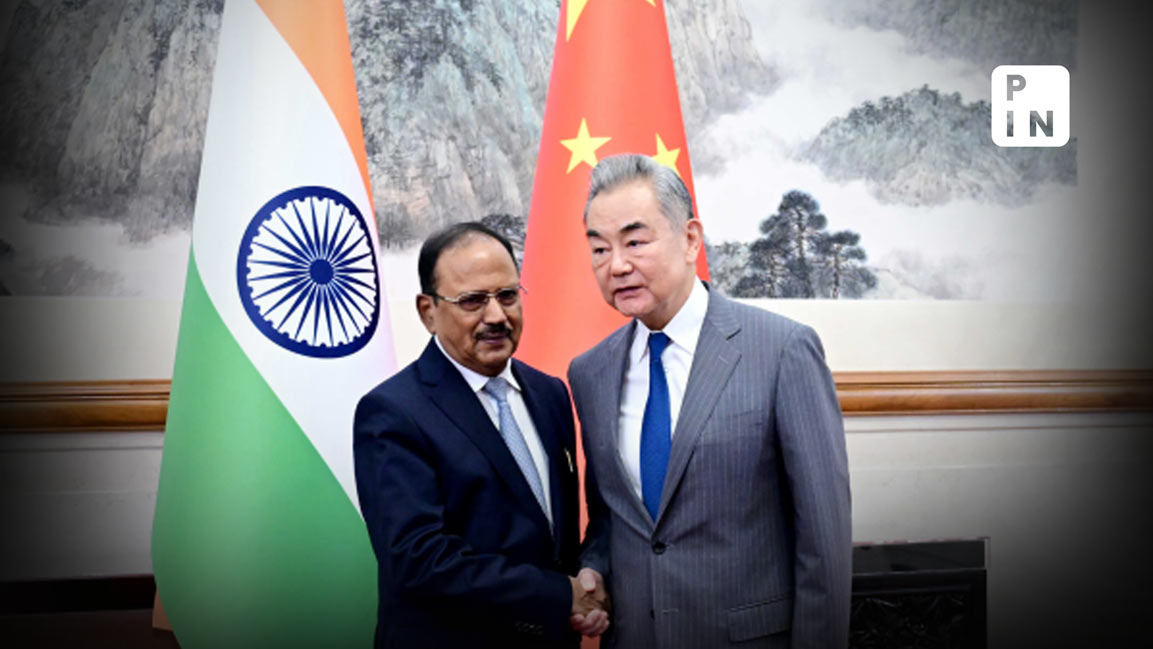


India and China have agreed to continue pursuing a political settlement of their disputed boundary, but announced no sectoral agreement, negotiating timetable or new mechanism after high-level talks in Beijing.
The discussions came weeks before the BRICS leaders’ summit in New Delhi, which Chinese President Xi Jinping is likely to attend. Neither Beijing nor New Delhi has confirmed his participation.
National Security Adviser Ajit Doval and Chinese Foreign Minister Wang Yi held the 25th round of talks between their countries’ special representatives in Beijing on Tuesday, 25 August.
The two sides had a “candid and in-depth” exchange and agreed to continue seeking a political settlement that reflected their broader and long-term interests, India’s ministry of external affairs said.
The Indian Embassy in Beijing said the discussions covered ways to maintain stability and peace in border areas, expand bilateral cooperation and “make progress on boundary delimitation” while continuing work on transboundary issues.
NSA Shri Ajit Doval co-chaired the 25th Meeting of SRs on India-China Boundary Question with his counterpart H. E. Wang Yi, Member of the Politburo of the Central Committee of the CPC and China’s Foreign Minister on 25 August 2026 in Beijing. The two sides positively reviewed the… pic.twitter.com/op50eDrU8i
— India in China (@EOIBeijing) August 25, 2026
To be sure, boundary delimitation involves defining a border through agreements, maps and legal descriptions. It differs from demarcation, which involves marking an agreed boundary on the ground, and from managing the Line of Actual Control, whose alignment is not mutually agreed.
China’s account said the officials discussed advancing delimitation negotiations, managing the border, improving negotiating mechanisms and promoting cross-border cooperation. They reaffirmed their commitment to seeking what Beijing called a fair, reasonable and mutually acceptable package settlement under principles agreed in 2005.
Neither government identified the sectors being considered or said that the two sides had moved closer to agreeing where any part of the boundary should run.
Talks turn toward boundary settlement
Doval and Wang agreed to continue seeking a political settlement that takes account of the countries’ broader and long-term interests, according to the Ministry of External Affairs.
The Indian side again stressed that maintaining peace in the border areas was necessary for further improvement in the relationship.
“I am happy that, over the past year, our relationship has been steadily returning to normalcy,” Doval said in opening remarks reported by The Indian Express.
That improvement, he added, had resulted directly from the two sides maintaining peace and tranquility along the border.
Doval also connected the negotiations to the coming leaders’ meeting.
The latest round was particularly important “in the wake of the BRICS summit to happen shortly,” he said, according to PTI.
Wang said stable relations between the two Asian powers had implications beyond their immediate neighborhood.
“China-India relations have gone beyond the bilateral scope and carry global and strategic significance,” he said, according to the Chinese foreign ministry.
Wang called for the countries to become “good neighbors and friends of amity” and partners that contribute to each other’s success.
China’s account said the discussions covered boundary delimitation, border management, existing negotiating mechanisms and cross-border cooperation. The two countries would continue seeking what Beijing called a fair, reasonable and mutually acceptable package settlement.
The next round of Special Representatives’ talks will be held in India in 2027.
Xi visit remains unconfirmed
Xi is likely to attend the BRICS leaders’ summit in New Delhi on 12 and 13 September, accompanied by a delegation of about 400 officials, Reuters reported, citing three people familiar with the preparations.
Chinese officials have been working on hotel and security arrangements, according to the report. Xi’s final itinerary and any bilateral meeting with Modi had not been settled.
The trip would be Xi’s first to India since he met Prime Minister Narendra Modi at an informal summit in Chennai in October 2019.
China said earlier this week that it attached considerable importance to BRICS cooperation and supported India in successfully hosting the summit.
China on Wednesday separately confirmed that Xi would attend the Shanghai Cooperation Organization summit in Kyrgyzstan and visit Egypt between 30 August and 3 September.
Xi’s expected visit would follow Modi’s trip to Tianjin in August 2025, his first visit to China in seven years. During their meeting there, Modi invited Xi to the 2026 BRICS summit and the Chinese leader offered Beijing’s support for India’s presidency.
The two leaders had earlier met in Kazan, Russia, in October 2024, days after India and China reached an agreement on military patrolling and disengagement at the remaining points of friction in eastern Ladakh.
The Beijing talks this week reviewed the implementation of the understandings reached by Modi and Xi in Kazan and Tianjin.
Thaw still faces limits
Relations deteriorated sharply after the June 2020 clash in the Galwan Valley, in which 20 Indian soldiers and four Chinese troops were killed. The confrontation led to a prolonged military standoff, restrictions on Chinese investment and technology companies, and a broader suspension of political and economic engagement.
The October 2024 disengagement agreement allowed both governments to begin restoring diplomatic contacts. India subsequently resumed tourist visas for Chinese citizens, while the two sides restarted the Kailash Manasarovar Yatra and traditional border trade.
Doval and Wang expressed satisfaction with the resumption of the pilgrimage and trade through three designated passes, the MEA said.
The relationship remains vulnerable to events along the border.
Reports this month alleged that Chinese troops had entered territory near Taksing in Arunachal Pradesh’s Upper Subansiri district and erected temporary tents. Indian defense officials cited by Reuters described the claims as unsubstantiated.
The MEA did not confirm an incursion but reiterated that peace and tranquility in border areas were essential to the wider relationship. China said the border situation was generally stable.
Before meeting Wang, Doval held talks with Chinese vice president Han Zheng covering border stability and cooperation in economic, political and multilateral forums.
China and India should approach their relationship from a “strategic and long-term perspective” and “properly manage differences,” Han said, according to a post by Chinese Ambassador Xu Feihong.
More Top Stories: