

- | 8:45 am
India launches EOS-05 to closely monitor storms, floods, borders
The 2,367-kilogram EOS-05 is headed for geosynchronous orbit, where it will provide India with near-real-time images
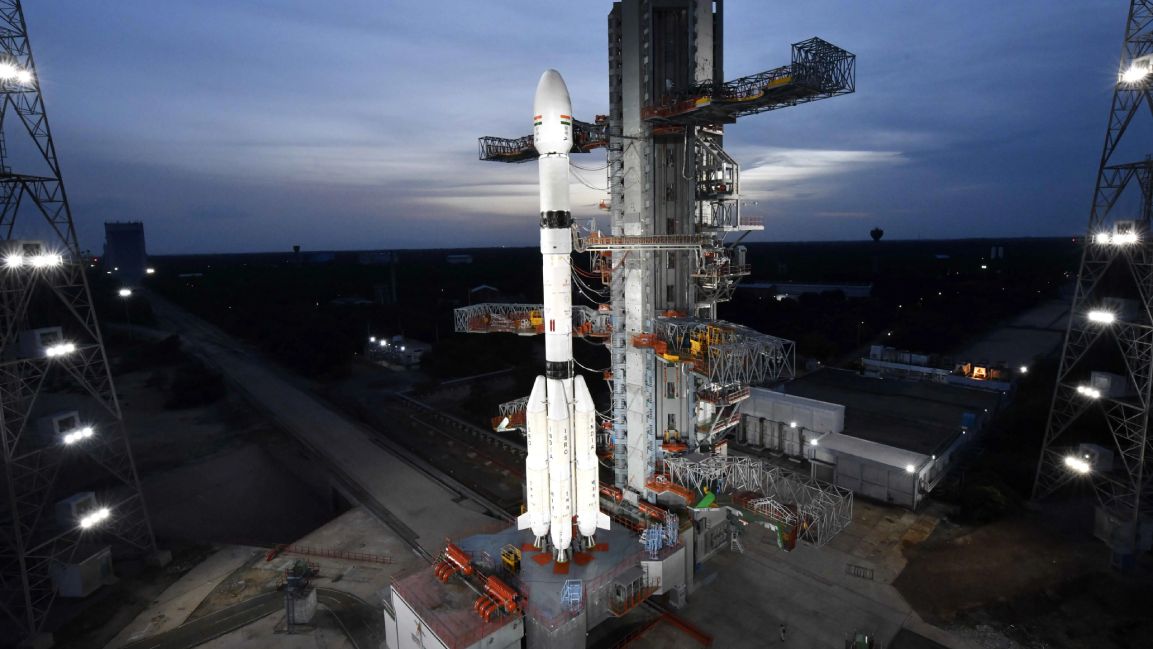


The Indian Space Research Organisation (Isro) successfully launched EOS-05 early Friday, putting India’s first imaging satellite designed for geosynchronous orbit on course to provide frequent views of the country for disaster response, agriculture and strategic monitoring.
The GSLV-F17 rocket lifted off from the Second Launch Pad at the Satish Dhawan Space Centre in Sriharikota at 2.55 a.m. IST on Friday, 4 September. About 18 minutes later, it released the satellite into its planned sub-geosynchronous transfer orbit, Isro said.
EOS-05 is not yet in its operational orbit. The satellite will use its own propulsion system to climb toward geosynchronous orbit, or about 36,000 kilometers above Earth, through a series of maneuvers over the coming days.
Its solar panel has been deployed and its systems are working normally.
“The health of the satellite is perfectly alright,” Isro chairman V. Narayanan said after the launch.
Why the orbit matters
Most Indian remote-sensing satellites circle Earth at much lower altitudes. They can take detailed images, but pass over the same location only at intervals.
EOS-05 is designed to keep the Indian subcontinent and nearby waters within view from geosynchronous orbit. This would allow it to photograph the region more often and follow events that develop too quickly for satellites with longer revisit times.
Such images can be used to track cyclones, floods, cloudbursts and forest fires as they unfold. Other applications include crop assessment, forestry, water-resource management and environmental monitoring.
Narayanan said the satellite would also provide “important strategic data” for the country. Project director Imteyaz Ahamad described EOS-05 as a complex spacecraft capable of operating across multiple imaging bands.
Isro has released little technical information about those instruments. Its four-page mission brochure does not specify the satellite’s spatial resolution, spectral bands, operational life or final orbital location.
EOS-05 weighs about 2,367 kilograms. Narayanan said it was the heaviest satellite carried by a GSLV, while mission director Thomas Kurien described it as the heaviest payload the rocket had placed into a geosynchronous or sub-geosynchronous transfer orbit.
Friday’s launch was the 19th flight of the GSLV family. The three-stage rocket is 51.7 meters tall and weighed 420.5 metric tons at liftoff. It has a solid-fuel core with four liquid-fuel strap-on boosters, followed by a liquid second stage and an Indian-built cryogenic upper stage.
The flight plan called for EOS-05 to enter an elliptical orbit with a nominal low point of 170 kilometers, a high point of 28,934 kilometers and an inclination of 19.28 degrees. Its onboard propulsion system will carry out the remaining climb.
A capability delayed since 2021
EOS-05 was previously known as GISAT-1A. It follows EOS-03, or GISAT-1, which was lost during India’s first attempt to establish a dedicated geosynchronous imaging capability.
That mission lifted off on 12 August 2021, aboard GSLV-F10. The rocket’s onboard computer aborted the flight 307 seconds after launch when the cryogenic upper stage malfunctioned.
An Isro investigation traced the failure to insufficient liquid hydrogen reaching the engine. The agency said the most likely cause was a leak in a vent and relief valve that led to abnormally low pressure inside the hydrogen tank. Isro subsequently recommended changes to the stage’s pressurization system and associated components.
EOS-05 restores the mission Isro lost five years ago.
Its launch also ends a difficult spell for the agency. The PSLV-C61 mission, carrying EOS-09, failed in May 2025 after a problem in the rocket’s third stage. Another third-stage anomaly affected PSLV-C62 in January 2026, preventing EOS-N1 and 15 accompanying payloads from reaching their intended orbits.
The GSLV and PSLV are different launch systems, and the PSLV failures are being investigated separately. Friday’s flight nevertheless gives Isro its first successful launch of 2026 and confirms the performance of the GSLV’s Indian-built cryogenic stage.
The remaining work will take place in orbit. Isro must raise EOS-05 to its assigned position and test its imaging, propulsion and communications systems before putting it into service.
More Top Stories: