
- | 3:05 pm
India courts Japanese capital as foreign funds pull back
Piyush Goyal has asked Japanese financial institutions to increase long-term investment in India as New Delhi tries to reverse a prolonged retreat by foreign portfolio investors
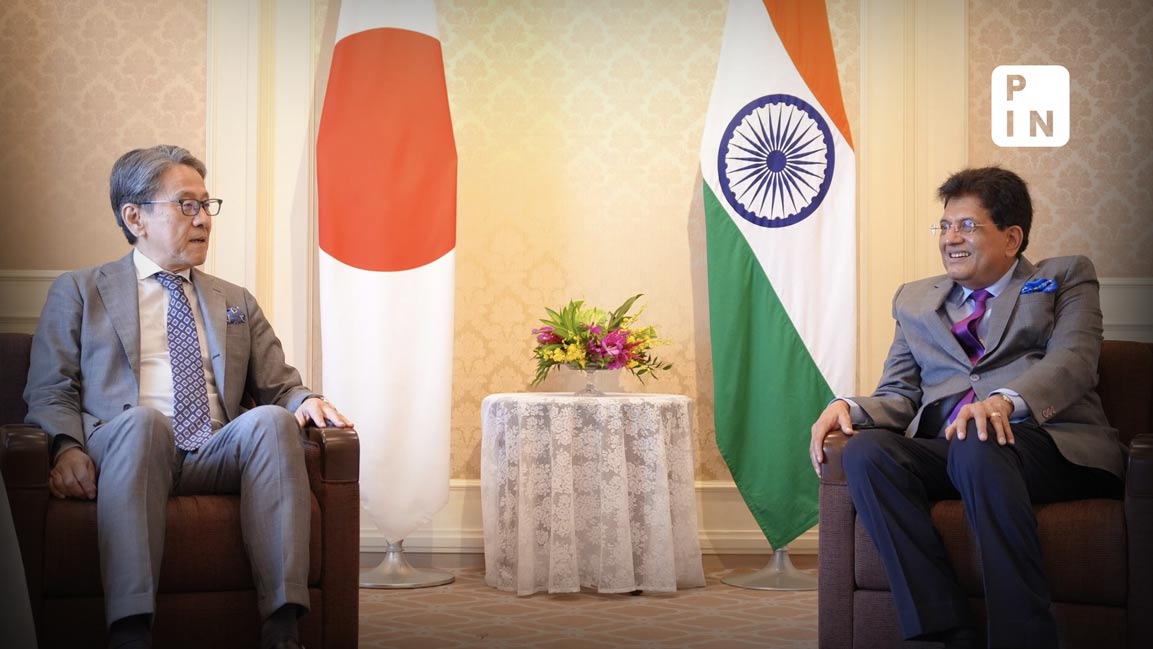


India has taken its investment pitch to Japan as the government tries to draw more long-term overseas capital into an economy that has continued to grow rapidly even as foreign investors cut their exposure to its stock market.
Commerce and industry minister Piyush Goyal met senior executives from MUFG, the Development Bank of Japan, Mizuho, Morgan Stanley, Nomura and Nippon Life in Tokyo on Tuesday, 25 August.
The discussions covered India’s economic outlook, investment rules and opportunities in semiconductors, artificial intelligence, data centers, renewable energy, green hydrogen, advanced manufacturing and digital infrastructure, the commerce ministry said.
Goyal told the institutions that India grew 7.7% in the last fiscal year despite global uncertainty and was working toward becoming a $30 trillion economy by 2047. He cited the health of the banking system, declining bad loans, rising disposable incomes and the expanding middle class as reasons for international investors to commit more capital.
The Japanese institutions expressed long-term confidence in India but also sought easier movement of capital and simpler repatriation of profits, according to the ministry.
That request goes to the heart of India’s challenge. Foreign direct investment has continued to expand, while overseas portfolio investors have sold Indian equities heavily.
Gross foreign direct investment reached a record $94.53 billion in the financial year ended March 2026, up 17% from the previous year, according to Invest India, the government’s investment-promotion agency.
Portfolio flows have been far more volatile. Foreign investors withdrew more than $20 billion from Indian equities in the first four months of 2026 after the Iran war pushed up oil prices and hurt sentiment toward one of the world’s largest crude importers.
Foreign funds sold ₹1.53 trillion, or about $16 billion, of Indian securities during the fiscal year ended March 2026, compared with net purchases of ₹20,020 crore in the preceding year, according to NSDL figures cited by the government in Parliament.
The retreat began earlier. Foreign investors pulled more than $50 billion from Indian equities between October 2024 and June 2026, while their ownership of Indian shares fell to a 17-year low. The rupee has also lost about 6% this year.
The selling has eased in recent months. Foreign portfolio investors returned as net buyers in July and continued buying during much of August, helped by a recovery in corporate earnings, greater currency stability and lower valuations. But their cumulative equity withdrawals for 2026 remain substantial.
India’s market regulator is preparing changes intended to make the market cheaper and easier for large international funds to access. Sebi’s planned measures include lower collateral requirements for trades in liquid shares, changes to stock lending and short selling, longer-duration derivatives and a closing-auction system closer to those used in major international markets.
The government is also presenting GIFT City in Gujarat as a base for cross-border investment and financial services. Goyal’s meeting discussed using the financial center as a gateway for Japanese money entering India.
Japan already has deep financial and industrial ties with the country. India and Japan have set a target of ¥10 trillion in Japanese private investment over a decade. The target was reaffirmed during the India-Japan summit in July, according to a joint statement.
MUFG told Goyal that it had invested about $4 billion in Shriram Finance and was looking at renewable energy and hydrogen. The Development Bank of Japan outlined interest in property, venture capital and other long-term assets, while Mizuho highlighted the expansion of its Indian operations and global capability center in Pune.
Goyal is leading a delegation of about 200 Indian business representatives during a four-day visit to Tokyo, Nagoya and Osaka. His broader pitch is that India can combine a large domestic market with manufacturing incentives, skilled workers and trade agreements that give companies access to other markets.
More Top Stories: