
- | 5:20 pm
India, Singapore hold ministerial talks to widen trade, investment ties
India is courting Singaporean money and expertise for manufacturing and infrastructure, with a 70-member corporate delegation accompanying ministers to this week’s bilateral talks.
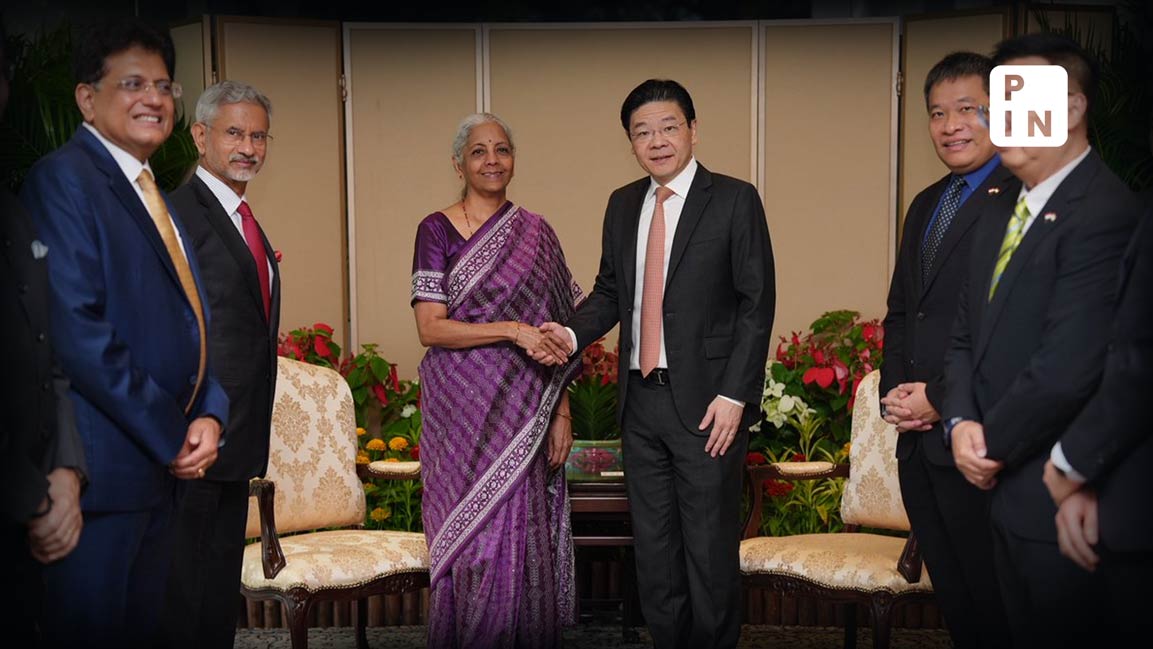


India and Singapore convened their fourth ministerial and business roundtables on Thursday, 20 August, bringing a 70-member Indian corporate delegation into government talks on investment, market access, technology and skills.
Finance minister Nirmala Sitharaman led the Indian side at the India-Singapore Ministerial Roundtable, while commerce and industry minister Piyush Goyal joined the talks during a three-day visit to the city-state. External affairs minister S. Jaishankar was also part of the delegation.
Singapore deputy prime minister and trade and industry minister Gan Kim Yong hosted the meetings, which were held alongside the fourth India-Singapore Business Roundtable. Goyal was also scheduled to meet Prime Minister Lawrence Wong at the Istana.
The program included a memorandum of understanding signing ceremony.
Goyal’s delegation includes executives from technology and artificial intelligence, manufacturing, infrastructure, finance, healthcare, food, logistics and maritime trade.
The talks build on an eight-part roadmap adopted last year. India wants Singaporean capital and technology, as well as better access for its companies and exports. Singaporean businesses are looking more closely at India’s factories, digital economy, infrastructure and consumer market.
Business at the table
Goyal was due to meet executives from Temasek Holdings, Keppel Infrastructure, IHH Healthcare and data-center operator STT GDC. His schedule also includes the Singapore Business Federation and the Global Finance and Technology Network.
A family-office roundtable will put him before another important pool of money. Singapore is one of Asia’s main wealth-management centers, and many of the funds based there invest across the region.
Temasek already has an Indian portfolio worth about $42 billion. Its holdings include financial services, healthcare, consumer and technology companies, and its exposure to India has grown substantially over the past decade.
Goyal will also attend a business forum organized by the Federation of Indian Chambers of Commerce and Industry at INSEAD’s Asia campus. He ends the visit on Friday with an address to the ICAI ASEAN Conference at Marina Bay Sands.
Food exporters have a place in the program as well. Goyal and Singapore minister of state Gan Siow Huang are scheduled to visit a FairPrice initiative with India’s Agricultural and Processed Food Products Export Development Authority.
The project is meant to get more Indian food onto Singapore supermarket shelves and follows the first exports of premium cherries and plums from Jammu and Kashmir to the country, with exporters expecting growers to earn more than they would through conventional domestic sales.
Why Singapore matters
Singapore was India’s largest source of foreign direct investment (FDI) in the financial year ended March 2026, with equity inflows of $19.8 billion.
It invested $194.68 billion between April 2000 and March 2026, equal to 24.72% of all FDI equity received by India over that period, according to the Department for Promotion of Industry and Internal Trade.
Multinational companies, global funds and regional holding companies often route Asian investments through the city. Singapore is also an important source of portfolio capital and overseas borrowing for Indian companies.
Fresh proposals continue to come through. Singapore-based Hillhouse Investment plans to roughly double its commitments in India, with real estate and data centers among the areas it is considering, The Economic Times reported this month.
Coal India, meanwhile, has applied to establish its first overseas trading office in Singapore, Reuters reported on Thursday. The office would trade iron ore and critical minerals and help the company pursue mineral assets abroad.
Trade remains lopsided
Bilateral merchandise trade reached $36.1 billion in 2025-26, up from $6.7 billion two decades earlier.
India sold $11.86 billion of goods to Singapore during the year and bought $24.24 billion, leaving a deficit of about $12.38 billion, commerce ministry data showed.
Exports fell 8.6%, while imports rose 13.9%. Even so, Singapore remained India’s largest trading partner in Southeast Asia.
That imbalance is one reason market access is prominent on Goyal’s agenda. India wants to sell more food, pharmaceuticals, engineering goods and professional services in Singapore, even as it courts investment for manufacturing and infrastructure at home.
The two countries have traded under the Comprehensive Economic Cooperation Agreement since 2005. It was India’s first comprehensive economic pact and Singapore’s first with a South Asian country.
A third review of that agreement is pending. Both sides are also involved in talks to revise the wider ASEAN-India goods pact, where India has sought changes to tariff commitments and rules of origin.
Technology takes a larger role
India and Singapore upgraded their relationship to a Comprehensive Strategic Partnership during Prime Minister Narendra Modi’s visit in September 2024.
Modi and Wong followed that with a roadmap in September 2025 covering the economy, skills, digitalization, sustainability, transport, healthcare, cultural links, and defense and security. The annual ministerial roundtable is supposed to keep those plans moving.
Semiconductors have become one of the main areas of interest. Singapore has an established chipmaking and semiconductor-equipment industry, while India is spending heavily to build one of its own.
The roadmap provides for a semiconductor policy dialogue, research partnerships, workforce training and more resilient supply chains. Singaporean companies have also shown interest in building industrial parks in India, including sites geared toward advanced manufacturing.
Digital finance is another strand. The two countries already connect India’s Unified Payments Interface with Singapore’s PayNow system. They are now discussing capital-market infrastructure, cybersecurity, digital assets and ways to test cross-border financial products without immediately exposing the wider system to risk.
Training plans cover semiconductors, advanced manufacturing and aircraft maintenance. A proposed national center of excellence in Chennai would work with industry on courses, certification and instructor training.
Shipping and clean energy have moved further. India and Singapore signed an agreement in September 2025 to develop a green and digital shipping corridor, covering cleaner marine fuels, digital information exchange and research.
The talks come at a good time for Singapore. Its government last week lifted its 2026 growth forecast to between 4.5% and 5.5%, from an earlier range of 2% to 4%, after the economy grew 6.1% in the first half. The Trade and Industry Ministry said heavy global spending on artificial intelligence infrastructure had helped lift demand.
More Top Stories: