
- | 11:00 am
Student protests over exam paper leaks rock Parliament opening
Thousands marched in central Delhi over examination failures as opposition MPs forced repeated adjournments of parliament and police used tear gas and batons on students
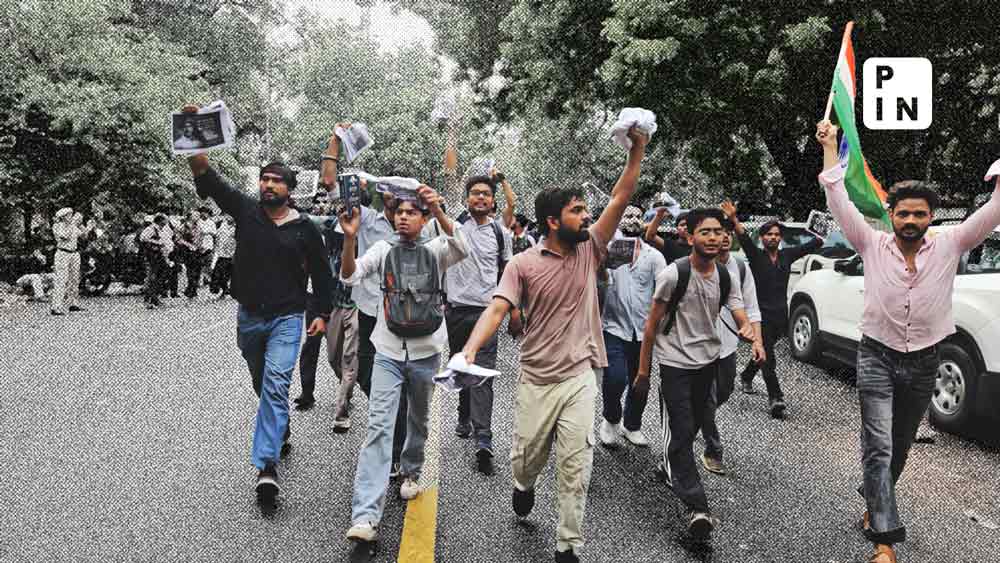


Thousands of students and young protesters converged on central Delhi on Monday, 20 July, as Parliament opened its Monsoon Session, carrying anger over examination failures from the streets into both Houses and forcing the government into its first direct talks with the youth-led movement.
Supporters of the Cockroach Janta Party, or CJP, a movement that started life as online satire and has hardened into arguably the most potent street challenge Prime Minister Narendra Modi has faced since he won a third term in 2024, gathered at Jantar Mantar before attempting to march towards Parliament.
Police blocked the procession, citing prohibitory orders and the absence of permission, and later used tear gas and batons as groups of protesters pushed through barricades and dispersed across central Delhi.
Inside Parliament, opposition members of Parliament raised the same demands, including accountability for the National Eligibility cum Entrance Test (Undergraduate), or NEET-UG, paper leak and the resignation of education minister Dharmendra Pradhan. The Lok Sabha and Rajya Sabha were adjourned repeatedly before both Houses ended proceedings for the day.
The Lok Sabha sat for barely a few minutes before the first of the day’s adjournments. By afternoon both Houses had been sent home for the day without transacting any real business.
Outside, on the barricaded approach to that same building, Delhi Police fired tear gas and swung batons at thousands of young people.
The protests produced two sharply contested accounts. Organizers accused police of attacking largely peaceful students, including women and minors. Police said sections of the crowd threw stones, damaged vehicles and repeatedly defied instructions not to leave the designated protest area.
At least 118 police personnel were injured and 15 to 20 government vehicles were damaged, Delhi Police said. More than 70 people were detained, though some police accounts put the figure above 100. The force said cases were being registered for rioting, assaulting public servants and damaging public property.
RML Hospital said 65 medicolegal cases involving protesters and some police personnel had been recorded by 7 pm. Organizers alleged that several students suffered head injuries, but the full number and severity of injuries could not be independently established.
The CJP’s “Chalo Sansad” march, built on a weeks-long sit-in at Jantar Mantar, roughly 2 km from Parliament, demanded the resignation of Pradhan over the alleged leak of the NEET-UG 2026 medical entrance paper.
March spreads through central Delhi
The turnout was substantially larger than police intelligence estimates, according to The Indian Express. Crowds that had begun arriving on Sunday night filled Jantar Mantar and then moved towards Parliament Street, Raisina Road, Shastri Bhawan and Connaught Place.
By the time the march moved off, the crowd had swelled past 10,000. Several central Delhi metro stations were shut, internet access was throttled in parts of the city, a move condemned by the Internet Freedom Foundation, and prohibitory orders under the new criminal code sealed the routes to Parliament with layer upon layer of barricades.
When demonstrators tried to push through near Sansad Marg, police responded with baton-charges and tear gas at Patel Chowk, near Kerala House and at several other points.
Delhi Police had said before the march that no permission had been sought or granted for a procession towards Parliament. Prohibitory orders under Section 163 of the Bharatiya Nagarik Suraksha Sanhita were in force across the New Delhi district.
“Citizens are advised not to participate in any such unlawful activity,” the force said in a post on X.
Police said protesters first tried to breach welded barricades at about 10.30 am and later threw stones at security personnel. Videos also showed police beating protesters and firing tear gas. One police vehicle was overturned near Janpath Metro station.
Delhi Police said the demonstration was initially “handled professionally” and force was used after the crowd became violent. In a later statement, it accused protesters of “unruly, aggressive and violent behavior.”
CJP disputed that account. Spokesperson Saurav Das posted videos that he said showed officers in plain clothes carrying batons. Founder Abhijeet Dipke alleged that police assaulted minors and tried to drag Sonam Wangchuk’s wife, Gitanjali Angmo, from a vehicle. Police denied the allegations.
“We did not lie to our families and come here to be picked up and detained like criminals,” a 17-year-old protester from Badarpur told Press Trust of India after showing injuries to her hand.
Glory, a Delhi University student, said protesters had regrouped after each police action.
“They tried to stop us multiple times. There was heavy barricading all along the route. We also faced lathicharge and tear gas, but we will not turn back,” she told PTI.
The disruption spread beyond the protest zone. Rajiv Chowk, Janpath, Patel Chowk, Central Secretariat and Seva Teerth Metro stations were temporarily closed. Roads were barricaded, traffic backed up across central Delhi and Parliament’s gates were briefly shut, leaving some lawmakers unable to enter or leave the complex.
Parliament consumed by student protests
Prime Minister Modi began the day by calling for a productive session guided by facts and constructive debate.
“Where there are facts and logic, there is progress,” Modi said before Parliament met. He praised India’s young entrepreneurs, including the team behind Skyroot Aerospace’s Vikram-1 rocket, but did not directly address the student agitation or NEET controversy.
The contrast was quickly seized upon by the opposition.
Congress President Mallikarjun Kharge raised the protests in the Rajya Sabha, saying the issue concerned “the futures of lakhs of children.”
“Thousands of students have gathered at Jantar Mantar for this cause. A lathi-charge has taken place there. The government is trying to use force, suppress voices, and drive them away,” Kharge said.
In the Lok Sabha, Congress, Trinamool Congress and other opposition MPs entered the Well with placards over NEET and the alleged theft of donations at the Ram temple in Ayodhya. Samajwadi Party MPs staged a separate demonstration in the Parliament complex, carrying a banner reading “Paper Leak” and chanting “NEET hai ya cheat hai?”
Dimple Yadav and other Samajwadi Party MPs later walked from Parliament towards Jantar Mantar.
“The youth want to voice their concerns, yet the government refuses to listen or engage in dialogue,” Yadav said. “You are not giving them jobs and you are closing schools. I think the whole process is corrupt.”
The Lok Sabha was adjourned five times. Law minister Arjun Ram Meghwal managed to introduce legislation increasing the sanctioned strength of the Supreme Court, but little other business was conducted. The Rajya Sabha also saw repeated adjournments before being closed for the day.
Pradhan entered the Lok Sabha shortly before noon and was met with calls to resign. He later went to home minister Amit Shah’s office in Parliament but did not publicly address the protesters during the day.
Political battle moves online
Politicians across the spectrum posted videos and statements as images of the confrontations circulated online.
Rahul Gandhi described peaceful protest as an “inviolable and fundamental right” and warned officials against blindly following orders.
“The Constitution is your master. Power does not last forever. Accountability will certainly be enforced,” the Leader of the Opposition said in a post on X.
Gandhi also repeated his claim that 152 paper leaks over the past decade had affected 7.5 crore students without producing a single conviction. Those figures are Congress estimates and have not been independently verified.
Congress MP Priyanka Gandhi Vadra said at Parliament: “There are problems; there are massive issues. Tell us, you are not even ready to discuss them, but you are firing tear gas at children and beating them up? For what? These are our children.”
AAP leader Arvind Kejriwal said students had repeatedly complained about leaks and evaluation errors without receiving a response.
“Where are these students and their parents supposed to go? Whom can they approach for justice and redressal? The government simply does not listen,” he said. Kejriwal’s comments
The BJP rejected the portrayal of the clashes as a straightforward student protest. Its information technology department head, Amit Malviya, blamed Left-affiliated student organizations and other organized groups for what he called “stone-pelting and orchestrated violence.”
“The real conspirators are often those who plan, encourage and coordinate such violence while carefully keeping themselves out of harm’s way,” Malviya said.
BJP MP Kangana Ranaut said protests could not be used to decide who remained in the Cabinet.
“You cannot arm-twist the government into deciding who to sack and who to retain,” she told reporters, arguing that Parliament was the appropriate forum for debate.
First talks bring no settlement
The government opened a channel with the CJP during the protest, sending Union health minister J.P. Nadda to meet spokespersons Saurav Das and Ashutosh Ranka.
The delegation sought Pradhan’s resignation, Wangchuk’s release from hospital and compensation for families of students who died by suicide after examination failures.
Nadda said the protesters had approached the government and that talks had begun at 11.50 am. The CJP maintained that police had first contacted its representatives.
“The meeting took place in a cordial atmosphere,” Nadda said. “I have requested all the protesters to end their sit-in and assist the administration in restoring normalcy.”
Ranka said the delegation received no firm commitment.
“The only assurance we got is that he will talk to the leadership and share the conclusions,” he told Press Trust of India.
Later, Ranka declared on X: “We made the government bow down and listen to us. We will not stop till Dharmendra Pradhan resigns.”
Wangchuk, who was moved to Safdarjung Hospital on Saturday after three weeks on hunger strike, said he would continue fasting until movement leaders were allowed to meet lawmakers or MPs visited him.
“I am touched and moved by how the youth have held on to peace despite provocation,” he said in a social media statement.
The agitation began after the 3 May NEET-UG examination was cancelled and more than two million candidates were required to sit a fresh test on 21 June.
The National Testing Agency has since faced fresh complaints over scores and OMR sheets. On Monday, it warned that some documents circulating online had been altered or generated using artificial intelligence and said candidates submitting fabricated records could face legal action.
The CJP emerged online in May after remarks by Chief Justice of India Surya Kant were widely interpreted as comparing unemployed young people with cockroaches. The chief justice subsequently said he had been misquoted and described young Indians as pillars of a developed India.
More Top Stories: