
- | 4:25 pm
Trump holds up India as model in US voting debate
Trump says India’s use of voter identification and limited postal ballots supports his case for tighter US election rules, though the two systems differ sharply in important areas


US President Donald Trump has turned to India’s vast election system to make the case for tougher voting rules at home, citing its use of photo identification and limited postal voting as he presses Congress to pass the SAVE America Act ahead of the November midterm elections.
India gives Trump a striking comparison. Its elections are overwhelmingly conducted in person, voters must establish their identity at polling stations, and postal ballots account for only a small share of votes cast.
But the comparison only goes so far.
The SAVE America Act would require documentary proof of US citizenship for federal voter registration as well as photo identification when voting. Separately, the White House is also seeking tighter restrictions on mail ballots.
India handles those questions differently. A voter must be an Indian citizen to enter the electoral roll, but the document shown at a polling station is used to establish identity and does not necessarily prove citizenship. Voters can choose from several accepted photo IDs, and linking Aadhaar to the electoral roll is voluntary.
In a Truth Social post on Tuesday, 18 August, Trump said India’s chief election commissioner Gyanesh Kumar had recently asked his administration, “How can you have Elections in the US without a valid Photo ID?”
Trump said 646 million people had voted in India’s last national election, fewer than 1% had voted by mail and all voters were required to show valid photo identification. He called on Congress to pass the SAVE America Act immediately.
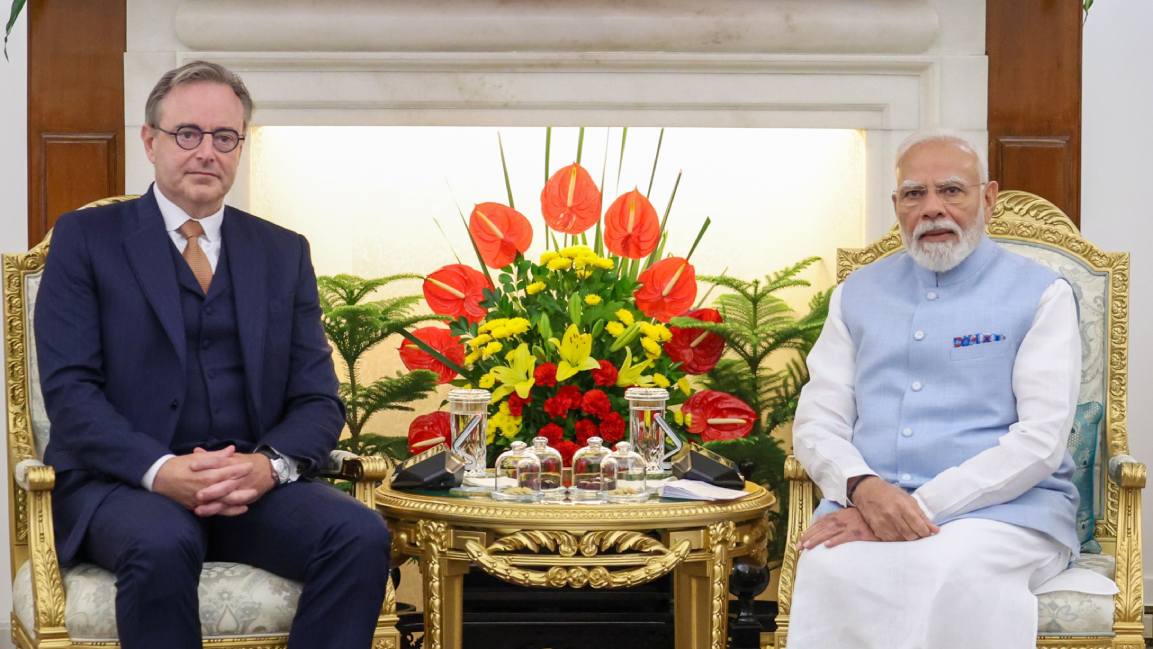
His comments came days after Kumar met US ambassador to India Sergio Gor at the Election Commission headquarters in New Delhi on Wednesday, 12 August.
The commission’s account of the meeting said the two sides agreed to deepen cooperation on election management and staff training. It made no mention of voter ID and did not attribute the question quoted by Trump to Kumar.
Gor subsequently supported Trump’s case, citing the scale of India’s election and its identification requirements while urging Congress to pass the bill.
Trump’s India numbers hold up
Trump’s 646 million figure broadly matches official data, though it represents votes cast rather than the size of the electorate.
India had 979.8 million registered electors in the 2024 Lok Sabha election, according to the Election Commission. About 646.4 million votes were cast, for a turnout of 66.1%.
The postal ballot claim is also accurate. Of 646,420,869 votes recorded by the commission, 4,281,594 were postal ballots, or about 0.66%.
The difference lies in who can use them.
India does not make postal voting generally available to all voters. It is restricted to specified categories, including service voters and certain absentee voters who cannot readily appear at their assigned polling stations.
Mail voting is much more widely available in the US, although eligibility and procedures vary by state. The White House wants its use largely confined to people who cannot vote in person because of illness, disability, military service or travel.
What Indian voters need
Indian voters are normally expected to show an Elector Photo Identity Card, or EPIC, at the polling station. Those without one may use any of 12 alternative photo documents approved by the Election Commission.
The list includes Aadhaar, a driving license, PAN card, Indian passport, MGNREGA job card, pension documents, certain government identity cards and bank or post office passbooks carrying a photograph. In every case, the voter’s name must already be on the electoral roll.
Voting eligibility in India is tied to citizenship. A person must be an Indian citizen, at least 18 years old on the relevant qualifying date and ordinarily resident in the constituency to register.
But the ID shown at the polling station does not itself always establish citizenship.
Aadhaar makes that especially clear. The Unique Identification Authority of India treats Aadhaar as proof of identity, not citizenship or domicile. Qualifying residents who are not Indian citizens may also obtain one.
Aadhaar is not compulsory for the electoral roll either. The Election Commission says voters can choose whether to provide it, and a person cannot be denied registration or removed from the roll merely for failing to do so.
That sits uneasily with the White House’s description of India as a country where voter identification is tied to a biometric database. India does have a nationwide biometric identity system, but its use in voter registration is voluntary and it does not establish citizenship.
What the SAVE America Act does
The SAVE America Act reaches beyond voter identification.
Under the measure passed by the House, people registering to vote in federal elections would have to provide documentary proof of US citizenship. They would then need photo identification when casting a ballot.
An unexpired US passport and certain government identification documents could serve as proof. Other forms of photo ID would need to be accompanied by documents such as a certified birth certificate or naturalization certificate.
The Republican-controlled House passed the bill by 218 votes to 213 on 11 February. Democratic Rep. Henry Cuellar joined Republicans in supporting it.
Backers say a national citizenship check would make it harder for noncitizens to enter voter rolls or cast ballots and would replace a patchwork of state requirements with a common federal standard.
Noncitizens are already prohibited from voting in federal elections. Federal law makes it illegal, with limited exceptions, for an alien to vote for federal office, and the Justice Department has prosecuted violations.
The argument in Congress is therefore over the safeguards required before someone gets on the voter roll and how burdensome those checks should be.
The Bipartisan Policy Center, which supports voter identification but has criticized parts of the legislation, says noncitizen voting is rare and estimates that about 12% of registered US voters lack the forms of documentary proof contemplated by the bill.
It favors greater use of government databases to verify citizenship rather than placing the full burden on individual voters. The group has also warned that introducing a major new registration system during an election year could create problems for states trying to implement it.
Democrats have raised similar concerns. Republicans argue that asking people to document citizenship before entering federal voter rolls is a reasonable safeguard and no more onerous than identification requirements already used in other parts of daily life.
Senate remains the hurdle
The bill’s immediate problem is the Senate.
Senators left Washington for their summer recess without passing the SAVE America Act. Republicans have told Trump they will try to revive parts of it when Congress returns in September, potentially through a wider budget measure.
As written, the legislation lacks the support needed to clear the Senate’s usual 60-vote threshold. Trump has urged Republicans to find a way around that barrier and has also called for changing filibuster rules, something Senate leaders have resisted.
The fight comes less than three months before the 3 November midterm elections, when control of Congress will be at stake.
Trump has separately tried to change election procedures through executive action, with mixed success in the courts.
On 11 August, a federal judge in Boston blocked the US Postal Service from implementing part of Trump’s March executive order on mail voting. The provision would have allowed the agency to refuse delivery of mail ballots if states did not provide the federal government with lists of eligible voters.
US District Judge Indira Talwani ruled that the executive branch could not take over election-regulation powers in that manner. The administration has sought Supreme Court intervention and says the legal challenges are premature.
The setbacks have left Trump pursuing election changes through Congress while continuing to test how far presidential authority can reach.
Trump’s endorsement of India’s election system has landed in the middle of an existing political fight over the Election Commission.
Congress and other opposition parties have accused the commission of bias and challenged its handling of electoral rolls, including the Special Intensive Revision, or SIR. They say the exercise risks removing legitimate voters. The commission rejects the allegations and says the revisions are intended to produce cleaner, more accurate rolls.
Against that backdrop, Congress spokesperson Pawan Khera responded sarcastically to Trump’s praise of Kumar: “Please take Gyanesh Kumar Gupta to America. And keep him there. We will send our EVMs too by the next available flight.”
He signed off: “To SIR With Love, from India.”
More Top Stories: