
- | 6:30 pm
Turkey, Saudi Arabia, Pakistan sign defense pact
The Makkah agreement deepens regional security ties as the widening Middle East war reshapes alliances
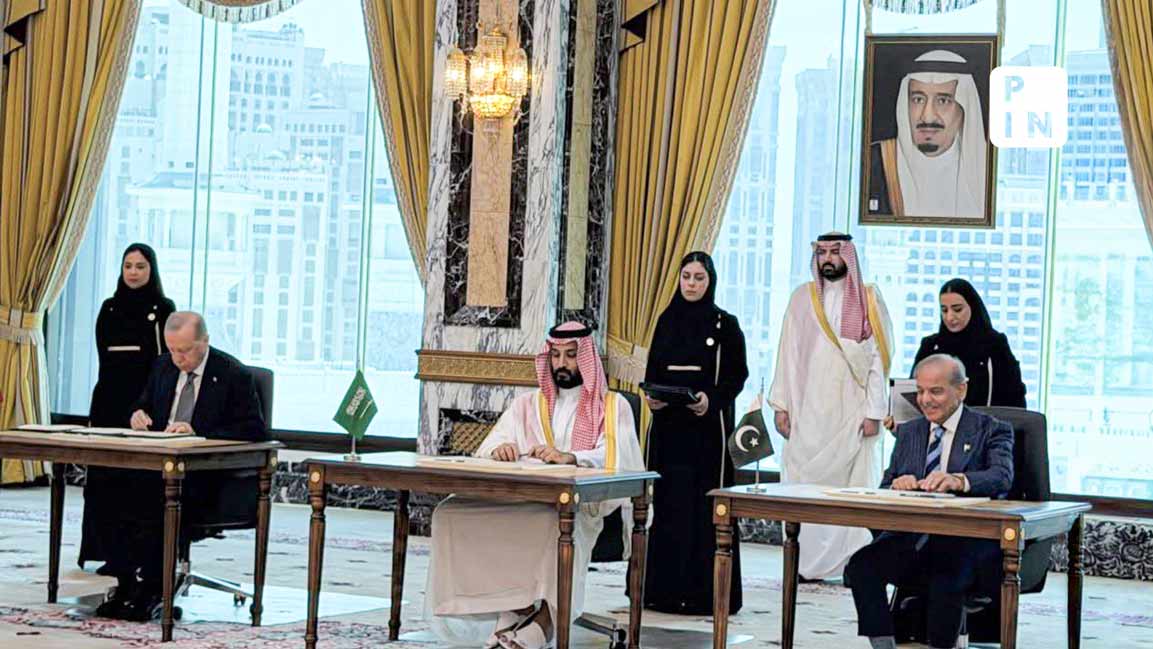


Saudi Arabia, Turkey and Pakistan signed a collective defense agreement in Makkah on Friday, 7 August, bringing Saudi financial power, Turkey’s military and defense industry, and nuclear-armed Pakistan into a new security arrangement.
The Makkah Joint Defense Agreement states that “any armed attack” against one of the three countries will be regarded as an attack against all of them, according to the official statement.
Saudi Crown Prince Mohammed bin Salman, Turkish President Recep Tayyip Erdogan and Pakistani Prime Minister Shehbaz Sharif signed the agreement at Al-Safa Palace in Makkah. Pakistan’s army chief, Field Marshal Asim Munir, also attended the summit.
The three governments said the pact was intended to strengthen collective deterrence, expand defense cooperation and promote security and stability in the region and beyond.
However, they did not explain what the collective defense provision requires each country to do.
There was no detail on whether an attack would trigger an automatic military response, who would determine that aggression had occurred or whether assistance could be limited to intelligence, weapons and logistical support.
The announcement also did not identify troop commitments, joint command arrangements, financing mechanisms or rules governing an intervention.
A Turkish official told Reuters that the pact was “purely defensive,” was not directed against any particular country and was open to other regional states. The official said it did not replace Turkey’s existing bilateral or multilateral commitments.
Joint Statement of the Makkah Al-Mukarramah Summit for Joint Defence between the Kingdom of Saudi Arabia, the Republic of Türkiye, and the Islamic Republic Pakistan. pic.twitter.com/94SOSdPi6X
— Foreign Ministry 🇸🇦 (@KSAmofaEN) August 7, 2026
Meanwhile, India has responded by saying it was “closely following the development.”
Bi-Weekly Media Briefing by the Official Spokesperson (August 07, 2026)
https://t.co/rT0CbgPosI— Randhir Jaiswal (@MEAIndia) August 7, 2026
For India, the immediate significance lies less in the possibility of an automatic three-country military response and more in Pakistan gaining a formal framework for deeper cooperation with Saudi Arabia and Turkey in intelligence, weapons, training, financing and defense technology.
Regional war accelerates agreement
The pact follows almost a year of negotiations, but the widening war involving Iran, Israel and the US increased the urgency surrounding it.
Saudi Arabia and other Gulf states have faced Iranian missile attacks and strikes by Tehran-aligned groups since the US and Israel attacked Iran on 28 February. The conflict has also disrupted shipping through the Strait of Hormuz, which carried about one-fifth of global oil and liquefied natural gas supplies before the war.
Riyadh has been targeted by Iran-aligned Houthi forces in Yemen and militias in Iraq. A senior Saudi official said on Thursday that the kingdom expected further coordinated attacks against energy facilities, ports and other infrastructure.
The crisis has exposed the risks of relying predominantly on the US for Gulf security. The Makkah pact allows Saudi Arabia to diversify its defense relationships and ask regional partners to shoulder more of the military burden.
If Turkey joins a Saudi-Pakistan defense pact, the Mideast alliance map may consolidate@DEsfandiary & I built our geopolitical lego around 4 blocs:
1. Iran + its axis
2. UAE + Israel
3. Saudi + Pakistan
4. Turkey + QatarA new pact could turn 4 camps into 3 https://t.co/NHWBtvxpfn pic.twitter.com/tPYkzEt6N9
— Ziad Daoud (@ZiadMDaoud) August 7, 2026
Each member brings a different capability. Turkey has NATO’s second-largest military by personnel and an expanding drone, missile, aircraft and naval industry. Pakistan has a large military, nuclear weapons and decades of experience training Saudi forces. Saudi Arabia contributes financial resources, energy leverage and substantial defense spending.
Pact formalizes existing military ties
The Makkah agreement brings relationships that have developed over decades under a single trilateral framework.
Pakistan has trained Saudi military personnel and stationed forces in the kingdom for years. It has deployed about 8,000 troops as well as fighter aircraft, drones and an air-defense system to Saudi Arabia, Reuters reported in May.
Saudi Arabia and Pakistan signed a Strategic Mutual Defense Agreement in Riyadh on 17 September 2025. That agreement similarly declared that aggression against either country would be considered aggression against both, according to their official joint statement.
Turkey and Pakistan have expanded cooperation in warships, aircraft, drones, military training and defense production. Turkey has supplied Pakistan with MILGEM-class corvettes, while the two countries have pursued joint production and technology transfers.
Saudi Arabia agreed in 2023 to buy Turkish drones in what Ankara described as its largest defense export contract at the time.
The trilateral arrangement could therefore connect Saudi financing with Turkish technology and Pakistani military capacity. That possibility is potentially more consequential than the collective defense declaration alone.
India assesses broader Pakistan network
For India, the key question is whether the collective defense provision could be invoked during another confrontation with Pakistan. The wording is broad enough to cover an armed attack on Pakistani territory.
Turkey’s role is likely to attract particular scrutiny. Ankara has in the past supported Pakistan diplomatically on Kashmir and has developed extensive defense links with Islamabad.
During the May 2025 India-Pakistan conflict, India said it recovered Turkish-origin unmanned aerial vehicles used in Pakistani attacks against Indian military targets. A Press Information Bureau account identified the recovered systems as Turkish-origin Yiha drones.
A framework that expands Turkish-Pakistani defense production, intelligence exchanges or technology transfers could therefore affect India more directly than the agreement’s mutual defense wording.
Saudi Arabia presents a different calculation. Riyadh has strengthened relations with India in trade, energy, investment, security and defense while preserving its traditional relationship with Pakistan.
During Prime Minister Narendra Modi’s April 2025 visit, India and Saudi Arabia described each other as major economic partners. Their joint statement identified India as Saudi Arabia’s second-largest trading partner and the kingdom as India’s fifth-largest trading partner in 2023-24.
That economic relationship gives Riyadh an incentive to prevent the agreement from developing into an anti-India platform.
When Saudi Arabia and Pakistan signed their bilateral agreement in September 2025, India said it would examine the implications for national security and regional and global stability.
The MEA subsequently said India and Saudi Arabia had a wide-ranging strategic partnership and that it expected Riyadh to respect their “mutual interests and sensitivities.”
The addition of Turkey changes the calculation because Ankara is already Pakistan’s closer diplomatic and defense partner. It raises the possibility of deeper three-way cooperation even if Saudi Arabia remains reluctant to become involved in India-Pakistan disputes.
Nuclear guarantee remains undefined
Pakistan’s nuclear arsenal gives the agreement its most sensitive dimension, though Friday’s statement made no reference to nuclear weapons.
After the 2025 Saudi-Pakistan agreement, Pakistani defense minister Khawaja Asif said his country’s capabilities would be available to Saudi Arabia under the pact. Officials later played down suggestions that Pakistan had formally extended a nuclear guarantee to the kingdom.
The new agreement does not say whether Saudi Arabia or Turkey would be protected by Pakistan’s nuclear deterrent. An analyst quoted by Reuters said the agreement was unlikely to contain a nuclear component because Pakistan’s atomic deterrent remained focused primarily on India.
Pakistan’s membership may still add political deterrence to the grouping. India will therefore be watching what follows the signing.
Joint exercises, Pakistani deployments, Saudi financing of weapons programs, intelligence-sharing arrangements and Turkish technology transfers will provide a clearer measure of the pact’s significance.
More Top Stories: