- | 1:30 pm
US extends China trade truce to January as Xi arrives for Trump summit
Washington pushes back a November deadline as Trump and Xi prepare to discuss tariffs, rare earths, agriculture, technology and the wider economic relationship


The United States and China have agreed to extend their trade truce by two months to 10 January 2027, removing an immediate threat of renewed economic confrontation as Chinese President Xi Jinping arrived in Washington for talks with President Donald Trump.
US Treasury Secretary Scott Bessent announced the extension on Wednesday, 23 September, saying an arrangement that had been due to expire on 10 November would remain in place for another two months.
The decision gives the world’s two largest economies more time to work through disputes over tariffs, rare earths and other critical minerals, agricultural purchases, technology controls and the broader rules governing their economic relationship.
Bessent said the two sides had agreed to extend what he called the “Busan Agreement,” the economic understanding reached after Trump and Xi met in South Korea in October 2025.
Beijing had not separately announced the 10 January date when Bessent made his comments.
China’s foreign ministry had said earlier in the week that the two countries should implement the understandings reached by their presidents and maintain the momentum in economic and trade relations.
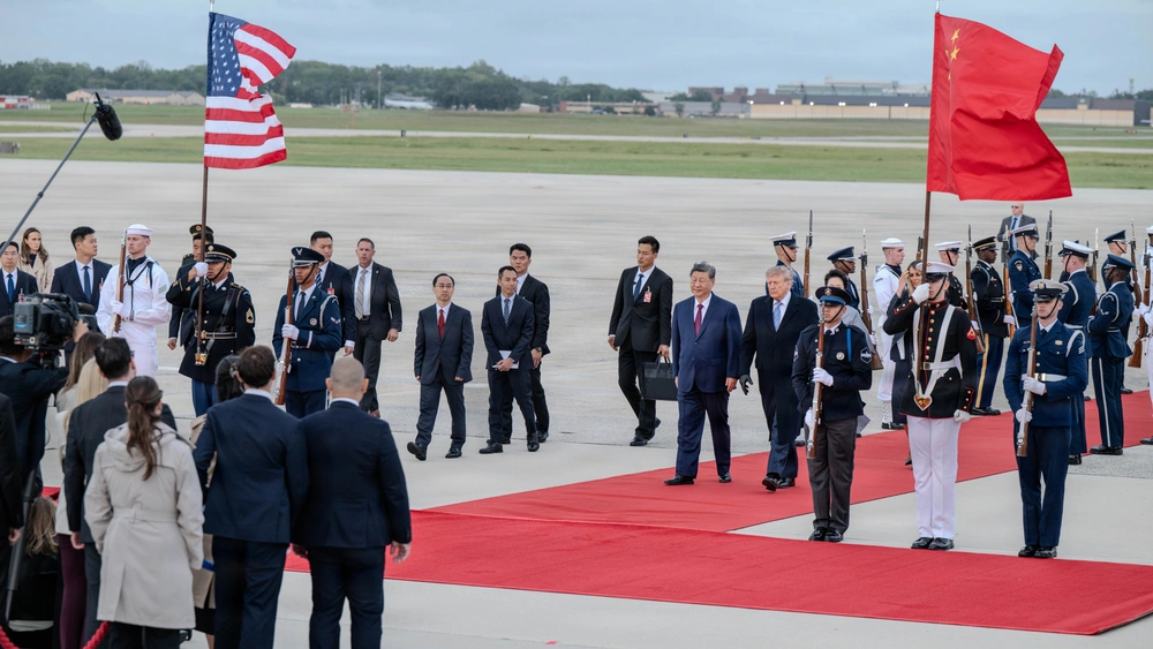
The extension came only hours before Xi arrived at Joint Base Andrews outside Washington for a three-day state visit, his first trip to the US capital in about a decade.
Trump and First Lady Melania Trump personally greeted Xi and his wife, Peng Liyuan, on the tarmac, beginning a visit that will include White House talks and a state banquet.
Xi said in written remarks after his arrival that China and the US should be “partners rather than rivals” and said he expected his discussions with Trump to cover major bilateral and international issues.
The trade extension lowers the risk that the summit will take place under the shadow of an approaching tariff deadline. It does not, however, settle the larger economic disputes between Washington and Beijing.
“I don’t know whether a bigger deal can be done,” Bessent told Fox News after talks with Chinese Vice Premier He Lifeng.
A truce built in stages
The current arrangement can be traced to an intense period of tariff escalation in 2025 after Trump returned to the White House. The two countries exchanged tariffs and other restrictions before negotiations gradually produced a series of pauses. Their most significant breakthrough came after Trump and Xi met in Busan, South Korea, on 30 October 2025.
Under the agreement announced after that meeting, Washington lowered some tariffs and suspended higher reciprocal duties. China agreed to suspend a range of retaliatory tariffs and non-tariff measures, ease restrictions affecting critical minerals and resume substantial purchases of US agricultural goods.
China also committed to buy at least 12 million metric tons of US soybeans in the final months of 2025 and at least 25 million tons annually in 2026, 2027 and 2028. Beijing agreed to resume purchases of products including sorghum and timber.
The US, in turn, agreed to suspend higher reciprocal tariffs on Chinese imports and delay some export-control and shipping measures. The suspension was eventually set to run until 10 November.
Trump and Xi added to that framework during the US president’s visit to Beijing in May this year.
The White House said the two governments agreed to establish US-China boards dealing separately with trade and investment. China also committed to address American concerns over supplies of rare earths and other critical minerals, buy at least $17 billion a year of additional US agricultural products through 2028 and approve an initial purchase of 200 Boeing aircraft.
The January extension keeps alive a collection of arrangements negotiated over nearly a year rather than a single tariff pause.
Rare earths are likely to be among the most difficult issues in the Trump-Xi talks.
China accounts for roughly 70% of global rare-earth mining and more than 85% of refining and production, giving it considerable influence over materials used in electric vehicles, electronics, renewable-energy equipment and advanced weapons systems.
More Top Stories: