
- | 10:15 am
Wangchuk calls off fast, but protests test Modi as CJP takes agitation nationwide
Wangchuk ends his 26-day fast and the government opens talks, but protesters widen their campaign as security restrictions disrupt central Delhi.


The student movement that has shaken New Delhi called for protests across India on Friday, 24 July, as its leaders prepared for negotiations with the government and vowed to continue their campaign despite climate activist Sonam Wangchuk ending a 26-day hunger strike.
The Cockroach Janta Party, or CJP, urged students and civil society groups to hold peaceful demonstrations in districts across the country under the slogan “Every District. One Day. One Demand.”
The call sought to turn the confrontation in Delhi into a broader national mobilization against examination leaks, alleged police violence and the government’s handling of the crisis.
The scale of Friday’s turnout outside the capital was still becoming clear in the morning.
Organizers had circulated protest locations on social media, including a gathering near Chhatrapati Shivaji Maharaj Terminus in Mumbai, while earlier demonstrations had been reported in Mumbai, Bengaluru, Hyderabad, Kolkata and several other cities.
The CJP insisted that the campaign had not been called off after Wangchuk broke his fast.
The nationwide call placed the movement at a critical juncture. The government has begun responding to some of the protesters’ concerns and agreed to formal talks. Yet its offers have so far stopped short of their central political demand, the resignation of education minister Dharmendra Pradhan.
CJP representatives and Union ministers were scheduled to meet at 12.30 pm on Friday at the Constitution Club of India after a disagreement over the venue delayed negotiations. The protest group had rejected holding the meeting inside a government ministry and demanded a neutral site.
Ahead of the meeting, the CJP said it would press for Pradhan’s resignation, withdrawal of police cases against protesters it considers innocent, compensation for affected families and wider reform of the examination system.
Wangchuk ends fast but protest continues
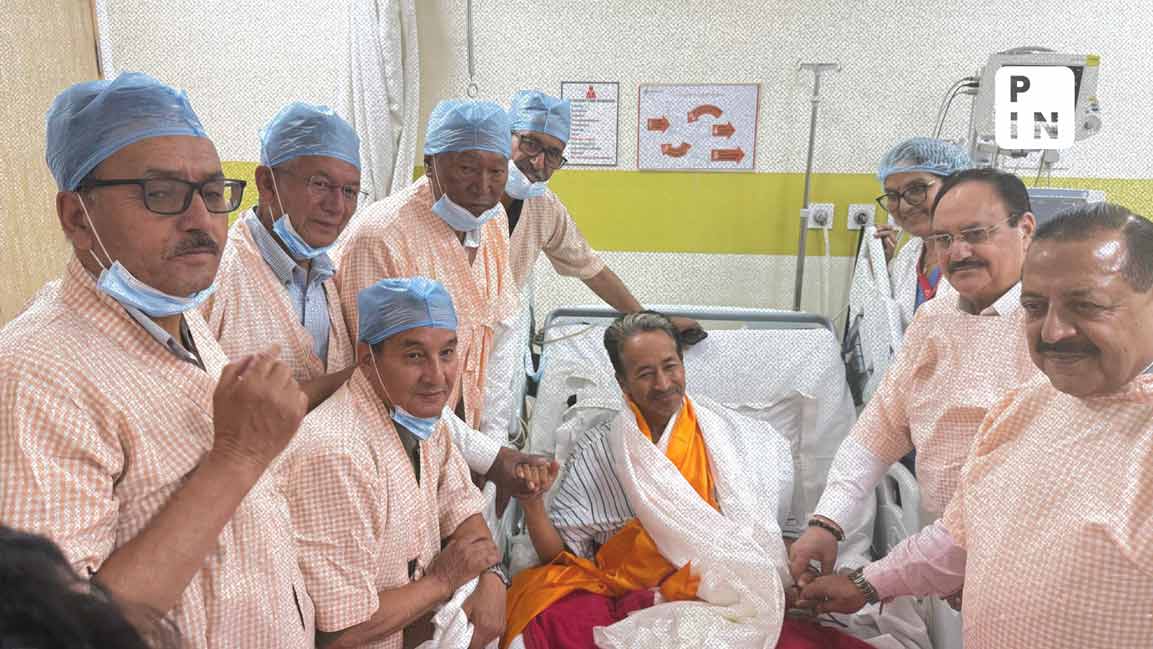
Wangchuk ended his hunger strike shortly after midnight after senior Bharatiya Janata Party (BJP) leaders met him at a hospital in Gurugram.
BJP president J.P. Nadda and Union minister Jitendra Singh were present when Wangchuk broke the fast. His protest had become one of the most visible symbols of the agitation and had helped draw national attention to anger over examination leaks and the treatment of demonstrators.
Wangchuk said he had received assurances that students and young people involved in peaceful protests would not be prosecuted. He also cited concerns that continuing the fast could contribute to further unrest.
The CJP, however, immediately separated his personal decision from the future of the movement. Founder Abhijeet Dipke said the agitation would continue until its demands were addressed, particularly the call for Pradhan to step down.
Wangchuk’s withdrawal may reduce one source of immediate pressure on the government, but it does not resolve the underlying dispute. The protest is no longer organized around the hunger strike alone but has also developed its own leadership, online networks and political momentum.
Government reshuffles officials
The government has responded to the protests on several fronts, combining negotiations, administrative changes and promises of tougher action against examination leaks.
In a late-night bureaucratic reshuffle on Thursday, the Centre transferred higher education secretary Vineet Joshi to the ministry of panchayati raj and appointed Naresh Pal Gangwar in his place.
It also named T.K. Anil Kumar secretary of the Department of School Education and Literacy, amounting to a change of leadership across both principal departments of the education ministry.
The appointments were part of a wider reshuffle involving 13 secretary-level positions, and the government did not formally attribute Joshi’s transfer to the NEET controversy. The timing, however, placed the changes alongside a series of steps intended to ease pressure generated by the protests.
The move gives the government an administrative response to point to without conceding the protesters’ principal demand for education minister Dharmendra Pradhan to resign.
Changes have also taken place at the National Testing Agency, which conducts NEET, CUET and other major entrance examinations.
Abhishek Singh is now its director general, following earlier upheaval in the agencies responsible for administering national tests.
Taken together, the appointments suggest the government is attempting to demonstrate accountability within the examination bureaucracy while drawing a line around Pradhan’s position.
Prime Minister Narendra Modi also sought to regain the initiative through two public interventions on Thursday.
In a post earlier in the day, Modi said the government would establish fast-track courts to deliver swift punishment in examination paper-leak cases.
He said nothing was more important than the welfare and future of young people and warned that those seeking to damage students’ prospects would not be spared.
In a late-night video message, Modi said the Union cabinet would consider further measures against paper leaks on Friday and that the government would seek to pass legislation in Parliament the following week.
The interventions represented Modi’s most direct response since the protests escalated. They also appeared designed to show that the government was moving beyond expressions of concern towards changes in personnel, legislation and enforcement.
The government’s strategy has focused on prosecuting those involved in leaks, changing senior officials, strengthening examination safeguards and promising speedier justice.
It has so far avoided accepting political responsibility or removing Pradhan, who remains the principal target of the protests.
Restrictions continue across central Delhi
The government’s political outreach has been accompanied by a substantial security operation in the capital.
Police and paramilitary forces were deployed around Jantar Mantar, Parliament and other sensitive areas of central Delhi. Barricades and restrictions were used to prevent protesters from approaching Parliament after earlier marches led to clashes with police.
Authorities suspended mobile data services within a 1.5-kilometre radius of Jantar Mantar on Thursday. The restriction disrupted internet-based payments, taxi bookings and the operations of small businesses in Connaught Place and surrounding areas.
Food vendors and drivers said their daily earnings had fallen sharply as customers struggled to make digital payments or use app-based services.
Seventeen Delhi Metro stations were also ordered closed from Friday morning until further notice as authorities sought to limit access to the protest zone and Parliament district.
Combined with road barricades and the security deployment, they effectively placed parts of central Delhi behind a transport cordon.
Delhi Police has defended its response as necessary to maintain order and prevent violence. It said more than 200 people had been taken into preventive custody and warned against misinformation circulating online.
Police also said it had no plan for a late-night crackdown after rumors spread among protesters on Thursday. The force said hundreds of social media accounts originating in Pakistan had been blocked for allegedly spreading false information about the demonstrations. Those claims could not be independently verified from the information made public.
Protesters and opposition parties have accused police of using excessive force, pointing to videos of baton charges, tear gas and the treatment of women demonstrators during marches earlier in the week.
CJP volunteers have repeatedly appealed for peaceful protest. At Jantar Mantar, organizers were seen removing stones from the ground and urging participants not to give police a pretext for further action.
Opposition turns protests into Parliament fight
The agitation has also become a major confrontation inside Parliament.
Opposition lawmakers disrupted proceedings for several consecutive days, demanding Pradhan’s resignation and a debate on examination leaks and alleged police violence.
Congress leaders Rahul Gandhi and Mallikarjun Kharge have backed the protesters’ demands. Opposition members marched outside Parliament, wore black and submitted notices seeking the suspension of regular business to discuss the crisis.
Kharge said the opposition would not accept a debate unless Pradhan first resigned. Rahul Gandhi has argued that the controversy reflects a wider failure of India’s education system rather than an isolated criminal leak.
The Congress had already begun a nationwide education campaign focused on paper leaks, high fees, unemployment and student distress. It is now using the Delhi protests to intensify pressure on the government both inside and outside Parliament.
The opposition’s support gives the movement national political reach, but it also creates a challenge for the CJP. The group emerged as a largely online, youth-driven campaign and has sought to portray itself as independent of established parties.
Government supporters have accused opposition parties of exploiting student anger for political gain. Protest organizers say politicians may support their demands but cannot take ownership of the movement.
The CJP benefits from parliamentary pressure and the visibility provided by senior opposition leaders. At the same time, appearing to become an extension of the Congress or other parties could weaken its claim to represent a broader, non-partisan youth constituency.
A movement born online
Social media has been central to the growth of the campaign.
The “Cockroach” name was adopted as a badge of defiance after a disparaging reference to unemployed young people. What began as satire and anger online developed into a protest organization capable of drawing thousands to the streets and coordinating events in several cities.
Organizers have used X, Instagram and WhatsApp to publish meeting points, appeal for peaceful conduct, circulate videos of police action and rebut claims that the protest had ended.
Public figures have also begun to lend support. Actor Ishaan Khatter said he stood with the movement, describing himself as a student before a professional. Wrestler Bajrang Punia joined protesters at Jantar Mantar and said different public movements stood together.
The same platforms have carried rumors, unverified casualty claims and competing accounts of clashes. Police and organizers have each accused the other side’s supporters of distorting events.
Much of the movement’s legitimacy has been built through videos and first-person accounts rather than formal political structures. Footage of police action has helped broaden sympathy for the protesters, while any violence by demonstrators could allow the government to shift attention from examination failures to law and order.
What happens next
Friday’s talks are the first immediate test.
An agreement on withdrawing cases, compensation or a timetable for examination reform could lower tensions. A meeting that produces only another promise of discussion may strengthen the CJP’s argument that the government is trying to wait out the protests.
Pradhan’s position remains the hardest issue. Removing him would be celebrated by protesters as an acknowledgement of political responsibility. The government may view such a step as surrendering to street pressure and setting a precedent for other movements.
The nationwide protest call is the second test. The CJP has shown that it can draw large crowds in Delhi and inspire solidarity events elsewhere.
For Modi, the calculations extend beyond one minister. The unrest has drawn together examination candidates, students, unemployed graduates, parents, opposition parties and civil society figures around a common complaint that India’s institutions are not protecting the futures of young people.
Fast-track courts and tougher laws may address the criminal machinery behind paper leaks. They do not by themselves answer the political question at the heart of the protests, which is who should be held responsible when systems fail repeatedly.
More Top Stories: