- | 10:40 am
Modi urges Putin to end Ukraine war as Russian oil ties deepen
India’s prime minister called for a cessation of hostilities during SCO talks in Bishkek, while the two leaders reviewed expanding energy, defense and trade ties ahead of Putin’s expected New Delhi visit for the BRICS summit
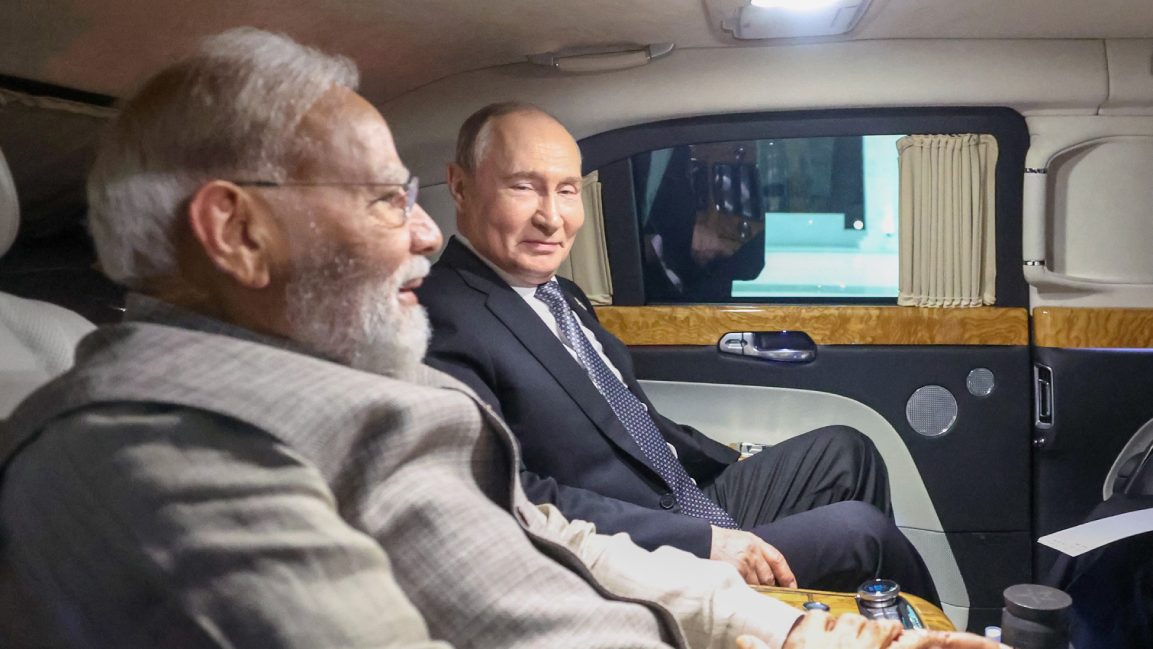


Prime Minister Narendra Modi urged Russian President Vladimir Putin to bring the war in Ukraine to an end, sharpening India’s public message to Moscow even as New Delhi signaled that it was not prepared to weaken its broader strategic relationship with Russia.
“We need to move from endless war to an end to the war, to a cessation of hostilities,” Modi told Putin at the start of their meeting in Bishkek on Monday, 31 August, according to a Kremlin transcript reported by Reuters.
Putin replied that Russia was moving in that direction, although Moscow continues to demand that any settlement recognize its territorial and security claims. Ukraine rejects those conditions as an attempt to formalize the gains of Russia’s invasion.
Modi’s words were among his most direct public appeals to Putin since the war began. They went beyond his formulation at their 2022 meeting in Samarkand, when he said that “today’s era is not of war” and emphasized dialogue, diplomacy and food and energy security.
India’s ministry of external affairs’ official account of the Bishkek meeting was noticeably more restrained.
The readout did not use the word Ukraine, describe Russia as the aggressor or repeat Modi’s appeal for an end to the war. It said instead that the leaders had exchanged views on conflicts in the Middle East and the Black Sea region, particularly their effect on maritime trade and the safety of Indian seafarers.
It also placed Modi’s peace message alongside a lengthy account of cooperation in defense, energy, trade, space, mobility and people-to-people relations. The ministry described the relationship as a “Special and Privileged Strategic Partnership” that had demonstrated resilience despite geopolitical uncertainty.
That contrast captures India’s policy toward Russia. Modi is increasingly willing to state that the war must end, but New Delhi is not joining Western efforts to isolate Moscow or making continued cooperation conditional on a Russian withdrawal from Ukraine.
The costs of balancing those positions are becoming harder to conceal.
At a briefing after the meeting, foreign secretary Vikram Misri said that 227 Indian nationals were known to have been recruited into the Russian armed forces. Of those, 139 had been discharged and 51 had died, according to his account.
Misri said India remained in discussions with Russia to secure the discharge and repatriation of outstanding cases. The Indian Embassy in Moscow was monitoring the issue, he said.
The figures give Modi’s appeal a direct domestic dimension. The war is no longer only a distant dispute affecting commodity prices and diplomatic alignments. Indian families have lost relatives recruited into Russia’s military, sometimes after being promised civilian employment.
Misri said the issue had been taken up with Moscow at different levels and on several occasions, suggesting that India continues to pursue it without allowing it to dominate the relationship.
The reference to Indian seafarers was similarly significant. Four Indian crew members were killed in July when a Russian missile struck the commercial vessel MV Golden Leo as it was leaving the Ukrainian port of Odesa. India subsequently summoned a senior Russian diplomat over the attack.
Seen in that context, the MEA’s mention of maritime trade and seafarer safety was not routine diplomatic language but reflected an emerging concern that the conflict is imposing a direct human and commercial cost on India, even as New Delhi tries to avoid taking sides.
Economic ties present an even more difficult problem.
Trade between India and Russia has expanded dramatically since the invasion, rising from about $13 billion in the year ended March 2022 to nearly $60 billion in the year ended March 2026. But India’s trade deficit with Russia has grown to more than $50 billion, driven principally by its purchases of Russian crude.
External Affairs Minister S. Jaishankar described correcting the imbalance as one of India’s “foremost priorities” at the India-Russia Inter-Governmental Commission meeting in Moscow on 24 August. He called for better market access, stronger payment arrangements and the removal of tariff and logistical barriers.
Misri said Russia had agreed in principle to host an Indian Exporters Forum during the next annual India-Russia summit. The proposal would allow Indian companies to promote goods in Russia and could help diversify trade beyond oil, fertilizers and defense equipment.
The initiative is politically useful but unlikely by itself to correct the imbalance. India would have to increase exports to Russia on a scale that business forums have not previously achieved, while navigating payment difficulties, sanctions risks and weak transport links.
Meanwhile, India’s reliance on Russian energy has deepened. Russia supplied a record 50.83% of India’s crude-oil imports in July, equivalent to 2.47 million barrels a day. The volume was 62.4% higher than a year earlier.
The surge was partly driven by disruptions to Middle Eastern supplies caused by the conflict involving Iran. That has made Russian crude more important to India at the same time that New Delhi faces growing pressure to reduce its purchases.
The US Senate added to that pressure in August by passing legislation that would authorize tariffs of up to 100% on countries making large purchases of Russian energy. The bill has not passed the House of Representatives, and its final form remains uncertain, but it has increased the potential cost of India’s oil strategy.
This leaves New Delhi with limited room for a dramatic change in policy. Cutting Russian purchases quickly could raise domestic fuel and import costs, while continuing them could expose Indian exports to US penalties.
Modi’s language in Bishkek should therefore be understood as a warning to Moscow, but not as evidence of a strategic rupture. India wants the war to end because its diplomatic, human and economic consequences are becoming more severe. It does not want that objective to require abandoning a relationship that New Delhi still considers essential, analysts said.
The timing reinforces that conclusion. Putin is expected in New Delhi for the BRICS summit on 12 and 13 September, less than two weeks after the Bishkek meeting. The MEA said Modi told Putin that he looked forward to welcoming him.
India’s position is becoming more explicit, but its underlying calculation has not changed. New Delhi will press Moscow for peace, seek the return of Indian recruits and complain about an unsustainable trade imbalance. At the same time, it will continue buying Russian oil, maintaining defense cooperation and giving Putin access to major diplomatic forums.
More Top Stories: