

- | 4:30 pm
India leases two MQ-9B SeaGuardians to expand maritime surveillance
The ₹1,943 crore contract will give the Indian Navy two long-endurance surveillance aircraft for 30 months as it awaits deliveries from a larger US purchase
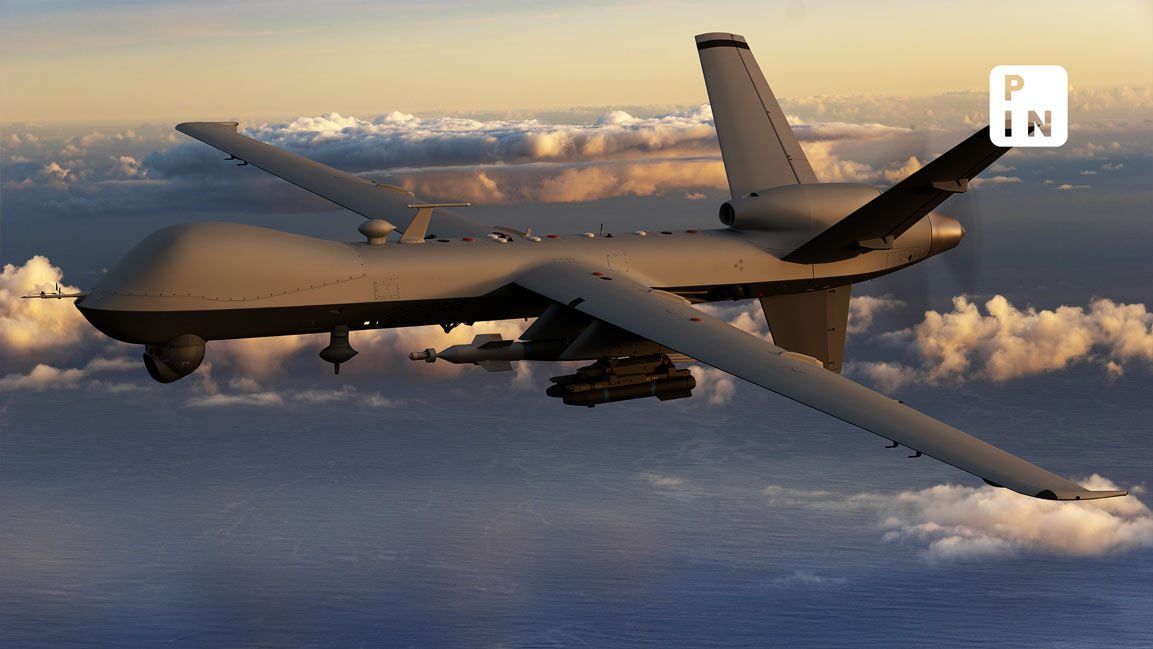


India has signed a ₹1,943 crore, or $203 million, contract with General Atomics Aeronautical Systems Inc. to lease two MQ-9B SeaGuardian remotely piloted aircraft for the Indian Navy, extending its access to long-range surveillance while it waits for aircraft ordered under a separate tri-service purchase.
The 30-month contract was signed in New Delhi on Monday, 17 August.
The aircraft will carry advanced sensors and other surveillance payloads, allowing the Navy to maintain intelligence, surveillance, and reconnaissance coverage over large stretches of the Indian Ocean, the ministry said. It did not disclose the delivery date, operating base, number of flying hours covered by the agreement, or precise sensor configuration.
The government also did not say whether the aircraft would be armed.
The new lease follows an Acceptance of Necessity granted by the Defense Acquisition Council on 29 December 2025. At the time, the ministry said the leased high-altitude, long-endurance aircraft would provide continuous surveillance and “credible Maritime Domain Awareness” across the Indian Ocean. It did not identify the supplier, quantity, or cost in its announcement.
The 30-month term would take the Navy into February 2029. The timing suggests the lease is intended to preserve surveillance capacity until deliveries begin under India’s much larger MQ-9B acquisition program.
A second SeaGuardian lease
The Indian Navy has operated two leased SeaGuardian aircraft since November 2020. They were brought in at short notice as India sought more persistent surveillance over the Indian Ocean and along its northern borders.
The earlier agreement used a company-owned, company-operated model. Under that arrangement, General Atomics supplied and operated the aircraft, provided maintenance and communications support, and delivered surveillance data to India.
A General Atomics account of its international leasing model said such packages could include the aircraft, personnel, satellite bandwidth, and intelligence processing and distribution.
General Atomics said the two aircraft completed 10,000 flight hours within their first two years of Indian operations. They provided surveillance support to Indian warships and surface units across an operating area of more than 14 million square miles, according to the company’s December 2022 statement.
One of the leased aircraft suffered a technical failure during a routine surveillance mission from INS Rajali at Arakkonam in Tamil Nadu on 18 September 2024. The problem could not be corrected in flight, and the aircraft was guided to a safe area before being ditched at sea off Chennai, the Navy said at the time.
General Atomics later replaced it under the lease agreement, the Hindustan Times reported, adding that by February 2025, the leased fleet had logged more than 18,000 flight hours.
Monday’s announcement does not say whether the new aircraft will be added to those already operating, replace them, or form part of a renewed arrangement. It also does not say whether General Atomics personnel will continue to fly and maintain the aircraft under the same company-operated model.
What the SeaGuardian can do
The SeaGuardian is the maritime version of General Atomics’ MQ-9B family. It is built for flights beyond the operator’s line of sight using satellite communications and can remain airborne for more than 30 hours, depending on its configuration.
Its modular design allows different sensors to be fitted for particular missions. These can include wide-area maritime radar, an automatic identification system receiver for tracking commercial shipping, electro-optical and infrared cameras, and electronic-support equipment for detecting and locating signals.
General Atomics says the aircraft can be configured for long-range surveillance, search and rescue, disaster relief, anti-surface operations, mine countermeasures, and over-the-horizon targeting.
An anti-submarine warfare configuration can carry dispensers for as many as 40 full-size or 80 smaller sonobuoys, according to the company’s SeaGuardian specifications.
It is unclear whether India’s leased aircraft will receive the full range of these systems. The ministry referred only to advanced systems, sensors, and payloads without identifying them.
The long endurance matters in the Indian Ocean because a single aircraft can remain over a search area much longer than a crewed patrol aircraft. It can track ships, investigate unidentified contacts, and pass information to naval headquarters or vessels at sea without returning frequently to base.
The SeaGuardian does not replace the Navy’s Boeing P-8I maritime patrol aircraft. The P-8I carries a crew, travels faster, and performs a wider range of anti-submarine, reconnaissance, and combat missions. The remotely piloted aircraft can handle long surveillance sorties, leaving the P-8I fleet available for missions that require its speed, crew, or weapons.
Information gathered by the aircraft can also feed into India’s wider maritime surveillance network. This includes ship- and shore-based sensors and information centers such as the Information Fusion Centre for the Indian Ocean Region in Gurugram.
The Navy commissioned INS Aravali in Gurugram in September 2025 to support its communications, command, and maritime domain awareness systems, according to a Ministry of defense statement.
Separate from the 31 aircraft purchase
The lease should not be confused with India’s October 2024 contract with the US government for 31 MQ-9B aircraft. The purchased fleet comprises 15 SeaGuardians for the Navy and 16 SkyGuardians, divided equally between the Army and Air Force.
That program followed approval from the Defense Acquisition Council in June 2023 and a formal Indian request to the US. A September 2023 India-US joint statement said the aircraft would strengthen surveillance across land, sea, and air domains.
The ministry later confirmed that the government-to-government contract had been signed in October 2024, along with a separate agreement with General Atomics Global India for depot-level maintenance, repair, and overhaul in India.
The US State Department’s original congressional notification placed the maximum value of the proposed package at $3.99 billion. That was an upper estimate. The notified package included 31 aircraft, ground-control stations, satellite and secure communications equipment, maritime surveillance radars, electro-optical and infrared sensors, electronic surveillance systems, and sonobuoys.
It also included 170 AGM-114R Hellfire missiles and 310 GBU-39B/B Laser Small Diameter Bombs, according to the US Defense Security Cooperation Agency notification.
Unlike the leased platforms, those 31 aircraft will be owned by the Indian armed forces. The Navy will receive the largest share because of the area it must monitor, stretching from the Arabian Sea and the approaches to the Persian Gulf to the Bay of Bengal, the Malacca Strait, and waters around the Andaman and Nicobar Islands.
More Top Stories: