- | 6:30 pm
Modi in Tianjin brings SCO back into India’s strategic calculus
The SCO summit offered no breakthroughs, but its timing and optics revealed India’s instinct to keep all options open as tariffs and tensions mount
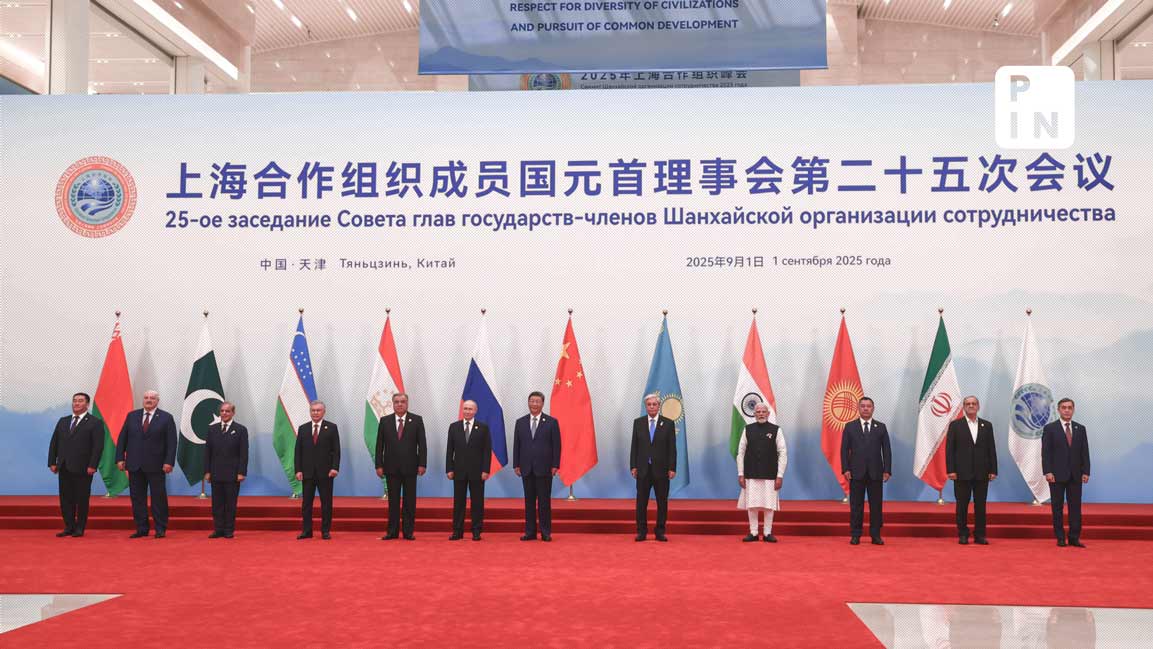


Prime Minister Narendra Modi’s presence at the Shanghai Cooperation Organisation (SCO) Summit in Tianjin on 31 August–1 September was his first visit to China in seven years, and its significance extended far beyond ceremony.
The timing, barely a week after Washington imposed sweeping 50% tariffs on most Indian imports, cast the summit in a new light.
It was not a return to a forum where India has often played a cautious role, but also a moment of strategic hedging as India faces fresh economic and geopolitical headwinds.
The meeting between Modi and Chinese President Xi Jinping, held on the sidelines of the summit, was the first substantive interaction since the Galwan clash in June 2020 that led to the deaths of Indian and Chinese soldiers froze relations.
Both leaders acknowledged “progress” in maintaining calm at the border and agreed to revive stalled border talks, restart direct flights, and resume visa issuance.
Modi’s message was explicit: border issues should not define the bilateral relationship, while Xi, for his part, spoke of placing ties “back on a stable track.”
For Delhi, the optics mattered as much as the substance. With Washington tightening trade screws, a reopened channel with Beijing gives India tactical breathing space, even if fundamental distrust remains.
Modi’s speech at the SCO plenary, meanwhile, was framed around terrorism. Recalling the Pahalgam attack in Kashmir in April that claimed 26 lives, Modi described it as “a stark reminder of the worst face of terrorism,” delivering the point with Pakistan’s Prime Minister Shehbaz Sharif seated nearby.
Modi outlined a triad: “S for Security, C for Connectivity, O for Opportunity” as India’s vision for the grouping in what was a careful attempt to tie security priorities with economic integration, signaling that India intends to use the SCO as more than a symbolic platform.
Putin and the Russia factor
In a bilateral with Russian President Vladimir Putin, Modi reaffirmed long-standing ties in defense, fertilizers, energy, and space cooperation, while also discussing cultural exchanges and the Ukraine war.
Modi welcomed ongoing peace efforts, carefully avoiding specifics but projecting India as a constructive voice. The announcement that Putin will travel to India in December adds weight to the engagement, coming at a time when Russia leans more heavily on Asia to counter Western isolation.
Overshadowing all of this were the new US tariffs, which took effect on 27 August. The levy effectively doubles duties on Indian goods across a swathe of labor-intensive sectors, including textiles, leather, gems and jewelry, furniture, toys, carpets, seafood.
Together, these categories represent millions of jobs and billions in export value. For India, the tariff shock was a reminder of vulnerability to Western politics just as growth had hit a five-quarter high.
Against that backdrop, Tianjin gave Modi a stage to hedge. Engaging with China and Russia, and by extension the SCO, may not be about pivoting away from the US but about insulating India from overdependence.
In economic terms for India, the tariff threat sharpens the need to diversify export markets, build alternative financing routes, and deepen supply-chain resilience.
The Tianjin summit, meanwhile, also showcased Xi’s ambition to make the SCO more than a security forum.
Xi laid out an expansive vision for the SCO, proposing the creation of a development bank, the launch of a shared energy cooperation platform, the integration of the BeiDou satellite navigation system across member states, and the provision of $1.4 billion in loans to support members’ economic needs, while framing these initiatives within a broader call for the world to “resist Cold War thinking” and “bullying behavior.”
For Beijing, a larger, better-resourced SCO provides an institutional platform to contest Western dominance. For Delhi, the question is how much to embrace without being subsumed into China’s orbit.
Modi’s response—thanking Xi and framing India’s role through the SCO acronym—signaled participation without surrender.
Hedging as strategy
India’s external posture has long relied on hedging, but the tariff episode sharpens its contours. On one side, India’s digital economy, capital inflows, and technology partnerships remain deeply tied to the US and Europe. On the other, forums such as the SCO, BRICS, and the Eurasian Economic Union offer avenues to dilute Western leverage.
Modi’s Tianjin presence reinforced that India will not be boxed in as a purely Western partner but will engage all sides, extracting economic and political room to manoeuvre.
This balancing act is not without costs. Western partners may read closer India-Russia or India-China optics with suspicion, but the alternative of overdependence on a West that can turn protectionist overnight appears riskier from Delhi’s vantage point.
Meanwhile, symbolism played no small role. Modi was chauffeured in China’s Hongqi L5 limousine—Beijing’s nationalist flagship—and later in Russia’s Aurus Senat alongside Putin.
The images circulated widely, projecting India’s comfort with alternative power poles even as it courts the US. In diplomacy, vehicles and venues often matter as much as communiqués, and Tianjin offered plenty of both.
For all the choreography, the summit also offered substantive signals. Border talks may resume, India and Russia are preparing new trade initiatives, and SCO itself could become a more active development platform.
Yet the bigger takeaway lies in positioning.
By showing up in Tianjin days after being hit by tariffs, Modi reminded the world that India has options. Whether these options translate into concrete economic gains remains uncertain. But as India seeks to shield growth and jobs from external shocks, hedging through forums such as the SCO may become not just diplomatic theatre but a structural necessity.
More Top Stories: