
- | 1:10 pm
Modi puts seafarer safety on G7 agenda after Indian sailors’ deaths
The prime minister’s remarks came after three Indian seafarers were killed in a US strike on a tanker off Oman, adding a human-security edge to India’s concerns over the Middle East and the Strait of Hormuz
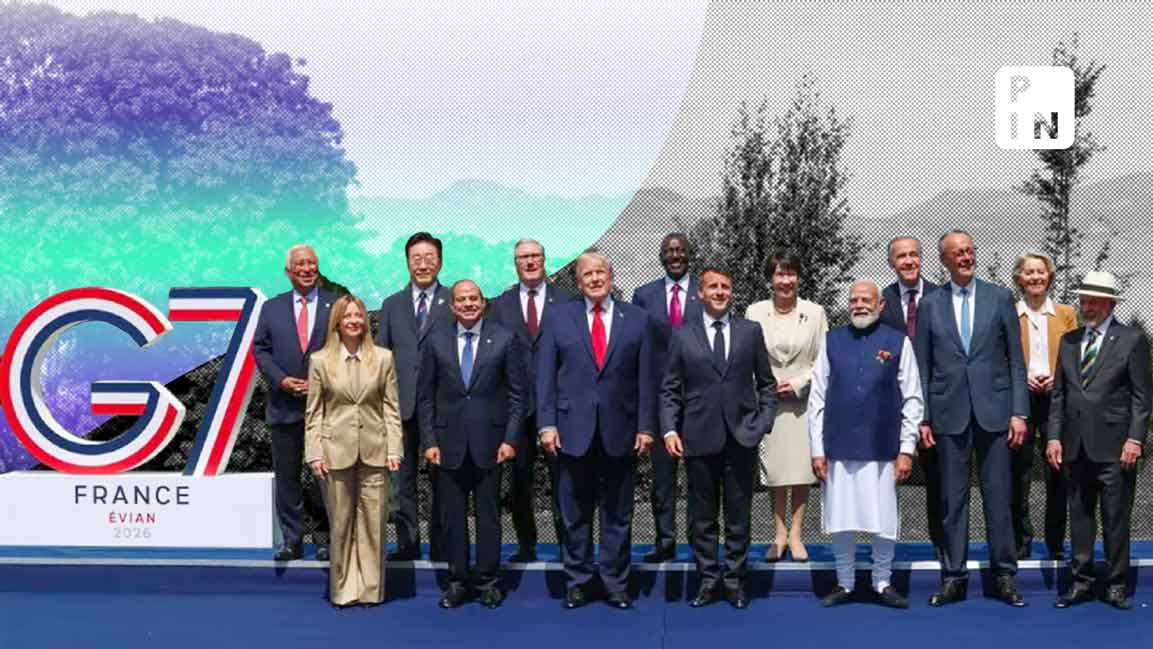


Prime Minister Narendra Modi used India’s G7 outreach appearance in France to press for safer maritime routes and protection for seafarers, days after three Indian sailors were killed in a US strike on a tanker off Oman and as global attention remains fixed on the Strait of Hormuz.
Speaking at the outreach session on “Forging New Partnerships and Rebuilding International Solidarity” in Evian, Modi framed the shipping crisis in the Middle East as both a human-security issue for India and a trade risk for the world economy.
“We welcome the progress made in peace efforts in West Asia,” Modi said. “This conflict has caused loss of life and property in our friendly countries in the region.”
He said disruptions to maritime trade through the Strait of Hormuz had hurt the global economy and that Indian citizens had also paid a price.
“Many Indian civilians have lost their lives,” he said. “It is our responsibility to ensure the safety of the seafarers who connect all nations through global maritime trade. We must ensure that maritime routes remain secure and that seafarers can perform their duties without fear.”
The remarks were delivered in the presence of US President Donald Trump, with whom Modi briefly interacted on the sidelines of the G7 gathering.
Formal bilateral talks between the two leaders were expected to focus on trade, H-1B visas, energy cooperation and security issues, according to reports ahead of the meeting.
India has lodged protests with Washington after US strikes on Indian-crewed vessels in the Gulf of Oman, including the MT Settebello, where three Indian sailors were killed.
The US has said the vessels were linked to attempts to violate its blockade on Iranian ports. India has called for the attacks to stop and for a return to dialogue and diplomacy.
The episode has turned a global shipping crisis into a domestic political and diplomatic issue for New Delhi.
Indian seafarers form a large part of the global maritime workforce, and many serve on foreign-flagged vessels that move oil, gas and other cargo through high-risk waters.
When those vessels are targeted, India is exposed even when the ships are not Indian-owned or Indian-flagged.
Meanwhile, India’s concern is not limited to energy prices or shipping insurance but also about the safety of Indian workers who keep global trade moving but often have little control over the ownership, routing or cargo decisions that put them in danger.
The deaths aboard Settebello came after a series of incidents involving Indian-crewed vessels near Oman.
The Marivex was disabled by US forces on 8 June, with all 24 Indian crew members safe. The Settebello was struck later, with 21 Indian crew members rescued and three confirmed dead. India later said another vessel with Indian crew had also been hit off Oman.
The Indian government has since said the welfare and security of Indian seafarers remain paramount.
The Seafarers Welfare Fund Society is releasing Rs10 lakh to the families of the deceased, while Indian authorities have been monitoring the maritime security situation in the Persian Gulf.
For New Delhi, the issue lands at the intersection of several strategic vulnerabilities.
The Strait of Hormuz remains one of the world’s most important energy chokepoints. Large volumes of crude oil and liquefied natural gas from the Gulf move through the narrow passage, much of it headed to Asian buyers. Any sustained disruption raises costs for import-dependent economies, including India.
The second is labor. India has more than 300,000 seafarers working in global shipping fleets, according to government data. Many are deployed on vessels that are commercially essential but politically exposed, especially during periods of sanctions, blockades and military escalation.
The third is diplomacy. India has close ties with the US, deep energy and trade interests in the Gulf, and longstanding relations with Iran. A maritime crisis near Hormuz tests all three at once. New Delhi has to protect its citizens and register its objections without allowing the dispute to derail broader ties with Washington.
Modi’s decision to raise maritime safety at the G7 is notable though he did not name the US in his remarks.
“Today, the world does not suffer from a shortage of resources,” Modi said. “It suffers from a shortage of trust.”
He added that trust was needed in technology, supply chains, development opportunities and global institutions. The line allowed India to connect the maritime crisis to a broader critique of the way power is exercised in the global economy.
Supply chains, sea lanes and technology networks, New Delhi’s argument goes, cannot be treated as tools of coercion without costs for everyone else.
The G7 summit itself was shaped by the fallout from the US-Iran conflict and uncertainty over the reopening of the Strait of Hormuz.
Trump arrived in France after announcing that a deal with Iran had been reached, though key details remained unclear.
G7 leaders also discussed Ukraine, debt stress in developing countries, economic imbalances, AI and energy security.
Meanwhile, India and the US are trying to keep trade talks moving, with Washington expected to send further negotiators to India after the G7 summit.
But the relationship is also carrying strain from tariffs, visa rules, Trump’s claims about last year’s India-Pakistan conflict and now the killing of Indian sailors in US military action.
That makes the Modi-Trump engagement at Evian politically sensitive. A routine handshake would not be enough for domestic critics in India, while a public confrontation would risk damaging negotiations that New Delhi still wants to preserve, analysts said.
Modi’s G7 address offered a middle path: raise the issue before the world’s leading economies, stress the human cost, and fold it into a wider call for secure sea lanes.
The question is whether that message changes behavior on the water as the US has defended its strikes as part of enforcement against Iran-linked shipping.
Ship managers and unions have questioned parts of that account and called for stronger safeguards for seafarers. India has sought an end to attacks while also working through diplomatic channels with Oman and the US.
Even if the US-Iran peace process advances, the shipping system will take time to normalize. Vessel backlogs, insurance costs, naval warnings, cargo scrutiny and fears of misidentification could continue to affect trade through the Gulf. For India, that means the seafarer safety issue is unlikely to fade with the end of the G7 summit.
More Top Stories: