- | 7:30 pm
UK PM Starmer pushes trade, tech and defense ties in first India visit
Starmer’s first India visit trades protocol for deliverables from reviving JETCO to funding 6G and agreeing a government-to-government missile supply
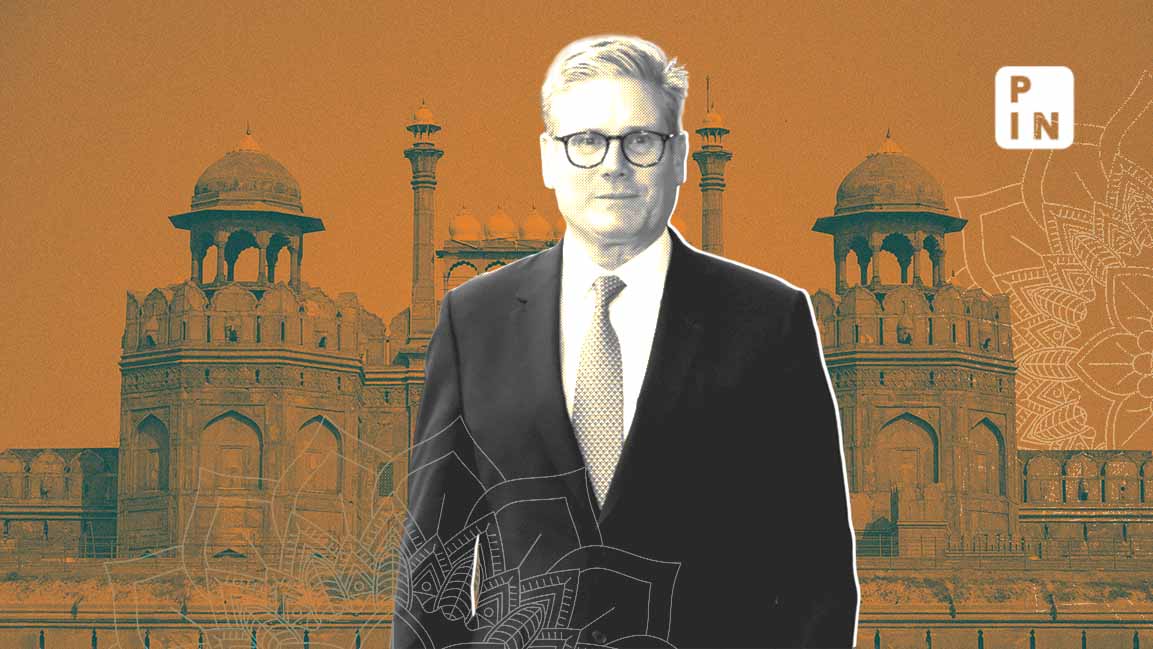


British Prime Minister Keir Starmer used his first official trip to India this week to push a broad reset across trade, technology and defense, unveiling steps with Prime Minister Narendra Modi that include reviving the Joint Economic and Trade Committee (JETCO) to govern a new bilateral trade pact, advancing a government-to-government missile supply, and launching fresh joint work on next-generation telecoms and critical minerals.
The two leaders met in Mumbai on Thursday, addressing the Global Fintech Fest before holding restricted and delegation-level talks at Raj Bhavan and issuing a joint statement that sketches the most far-reaching India-UK agenda in years.
Starmer arrived with a 125-member delegation of business, university and cultural leaders alongside senior ministers Peter Kyle, Douglas Alexander and investment minister Jason Stockwood, underscoring a pitch that closer India ties are central to UK growth, export and security goals.
Modi called the visit a “special occasion,” highlighting the size of the mission and the breadth of sectors in play, from clean energy and manufacturing to finance and consumer goods.
On trade, both sides said they would “look forward to ratification” of the Comprehensive Economic and Trade Agreement (CETA) “as early as possible,” and announced the “resetting” of JETCO to support governance and utilization of the pact and to drive wider investment.
The joint statement roots the Mumbai talks in continuity with Modi’s July trip to London, when the two governments announced the CETA text, a “Vision 2035,” and a defense industrial roadmap.
Thursday’s language signals a push to move from headline agreements to operational frameworks with timelines.
Defense ties were the headline on the day. The UK confirmed an initial government-to-government supply of Lightweight Multirole Missiles for India and progress toward an inter-governmental agreement on maritime electric propulsion systems for Indian naval platforms: two steps that align with India’s “Atmanirbhar Bharat” (self-reliant India) aims while building a longer-term complex-weapons collaboration with British industry.
Reuters reported London valued the LMM package at about £350 million ($468 million), with the deal also securing jobs at Thales’s Northern Ireland plant.
Technology and supply-chain security formed the other pillar. Building on the Technology Security Initiative coordinated by the two national security advisers, the leaders announced an India–UK Connectivity and Innovation Centre focused on an “AI-native” 6G network stack, non-terrestrial networks and telecoms cybersecurity with at least £24 million in first-phase joint funding.
They also launched an India–UK Joint Centre for AI to advance trustworthy AI in health, climate, fintech and engineering biology, plus a UK-India critical minerals “guild” and the second phase of a bilateral minerals supply-chain observatory, including a new satellite campus at IIT-ISM Dhanbad.
Those moves extend a year of ministry-to-ministry work on telecoms, AI standards and mineral diversification into institutional projects meant to attract private capital.
Starmer’s agenda also had a domestic technology angle: the UK leader examined India’s Aadhaar digital ID system in Mumbai, discussing design choices with Infosys non-executive Nandan Nilekani and signaling interest in a British digital ID that would avoid biometrics and emphasize inclusion.
He framed identity infrastructure as a way to cut friction in services from school admissions to mortgages while stressing differences with India’s model given UK civil-liberties debates.
Education featured prominently as both governments look to make transnational higher-education a two-way growth engine.
The joint statement said nine UK universities are opening campuses in India, noting Southampton has already welcomed its first cohort in Gurugram and that letters of intent have been issued for Liverpool, York, Aberdeen and Bristol, with Queen’s University Belfast and Coventry authorized for GIFT City and new approvals for Lancaster (Bengaluru) and an in-principle nod for Surrey at GIFT.
UK and Indian education bodies have separately detailed those moves over recent months as the UGC’s foreign-campus regime matures.
The Mumbai setting mattered. The leaders timed their public remarks to the Global Fintech Fest at Jio World Centre, an annual gathering that has grown into India’s signature fintech and policy forum.
Starmer and Modi used the event to emphasize capital markets and payments linkages, with London pitching itself as a financing partner for Indian scale-ups and infrastructure. The Fest ran 7–9 October this year, putting the visit squarely inside a marquee corridor for investor engagement.
Aviation and connectivity pieces moved forward as well. The two sides said they are discussing renewal of the bilateral air-services agreement and flagged the UK-India Infrastructure Financing Bridge between NITI Aayog and the City of London Corporation as a template for green growth capital.
While the communique doesn’t list tariff lines or aviation quotas, it frames both as levers to expand capacity and lower transaction costs for goods, services and talent.
Migration and mobility, often a sticking point in UK domestic politics, were presented as steady-state. The leaders reaffirmed implementation of the Migration and Mobility Partnership and said cooperation to curb irregular migration is continuing.
They also highlighted people-to-people ties and cultural programs, with a first annual ministerial “Strategic Education Dialogue” flagged to keep the university agenda moving.
Security language tracked wider geopolitics. The statement condemned terrorism “in all its forms,” referenced the April attack in Pahalgam, reiterated counter-radicalization and terror-finance goals, and aligned on maritime security in the Indo-Pacific, including a Regional Maritime Security Centre of Excellence under India’s Indo-Pacific Oceans Initiative and Royal Navy-Indian Navy cooperation.
On wars abroad, the text backed continued diplomatic efforts on Ukraine and supported a US plan for Gaza, calling for a ceasefire, hostage release and humanitarian access as part of a path to a two-state solution.
For business, the signal was breadth plus execution. The CEO Forum met on the summit’s sidelines; the communique listed target sectors: construction, infrastructure, clean energy, advanced manufacturing, defense, education, culture, finance, professional services, science, technology, consumer goods and food, while leaving room for company-specific announcements in the days ahead.
Associated Press characterized the visit as a push to lift trade and jobs, while UK and Indian officials said ratification of CETA would deliver tariff cuts and market access gains.
The defense deliverables give Starmer something immediate to take back to UK industry. Reuters highlighted job support at a Northern Ireland missile plant, while the tech and education planks aim to make the relationship more “sticky” via labs, campuses and standards partnerships.
India, for its part, gets near-term air-defense capability, a pathway on naval electrification, and deeper financing and education linkages, plus a revived governance forum for implementing the new trade agreement, analysts said.
Both leaders used the optics of Mumbai to lean into growth narratives at home. For Modi, a flush of UK university campus activity, a fintech showcase, and defense co-production headlines reinforce New Delhi’s message that India sits at the center of high-tech supply chains and rules-making, analysts said.
For Starmer, the visit tees up defense and export wins and positions the UK as a pragmatic partner in Asia’s largest growth market while he navigates sensitive debates on migration and digital identity in London, analysts added.
More Top Stories: